Care

All posts tagged Care

Beware of Dog

Published January 16, 2026 by tindertender

Source :: https://www.facebook.com/share/181k88cpyH/?mibextid=wwXIfr

I was ready to kill the monster next door. I had a heavy aluminum baseball bat in my hand and the terrified scream of my missing five-year-old daughter echoing in my ears.

I didn’t wait for the police. I didn’t wait for my wife. I kicked open the side gate of the property adjacent to mine, fueled by a parent’s primal nightmare.

Let me explain the geography of my hatred.

My name is David. I’m a risk analyst. I wear button-down shirts, I mow my lawn on Saturdays, and I believe in rules. I moved my family to this subdivision specifically for its safety rating and the strict Homeowners Association (HOA) covenants.

Then there was Ray.

Ray was the stain on our perfect cul-de-sac. He was a mountain of a man, always clad in faded denim and leather that smelled of stale tobacco and old gasoline. He didn’t mow his lawn; he let weeds grow around a collection of rusting engine parts. He didn’t drive a sensible sedan; he rode a deafening, custom V-twin motorcycle that shook my windows every morning at 6:00 AM.

But the real problem was the dog.

Ray owned a Pitbull named Tank. The creature was a biological weapon—eighty pounds of gray muscle, a head like a cinder block, and cropped ears that gave him a permanent, menacing glare. Every time I watered my hedges, that dog would trot to the fence line and stare at me. He didn’t bark. He just watched. It was unnerving.

“That animal is a ticking time bomb,” I told my wife, Sarah, just last week. “It’s not a pet. It’s a liability. And Ray? He’s exactly the kind of irresponsible owner who lets it happen.”

I had spent the last three evenings drafting a formal petition to the HOA board. I cited by-laws regarding “aggressive breeds” and “noise ordinances.” I was going to get them evicted. I was doing it for the neighborhood. I was doing it for my daughter, Sophie.

Then came the Fourth of July.

It was a scorcher. The air was thick with humidity and the smell of charcoal. Our neighborhood takes Independence Day seriously. By 8:00 PM, the sky was already flashing with unauthorized bottle rockets. By 9:00 PM, it sounded like a war zone.

We were in the backyard, finishing up burgers. I turned my back for thirty seconds to grab a cold drink from the cooler.

When I turned back, Sophie’s swing was empty.

“Sophie?” I called out.

Nothing but the boom-crack of a mortar shell exploding overhead.

“Sophie!” Panic, cold and sharp, spiked in my chest.

I ran to the front yard. Empty. I ran back. The gate. The latch on the wooden gate separating my yard from Ray’s was undone. It was swinging slightly in the breeze.

Then, through the cacophony of fireworks, I heard it. A high-pitched cry coming from Ray’s detached garage.

My blood ran cold. I pictured the gray muscle. The teeth. The cropped ears.

I didn’t think. I grabbed the bat leaning against the patio door and sprinted. I crossed the property line, ignoring the “Beware of Dog” sign, and tore across his unkempt yard. The garage door was cracked open a few feet.

“Get away from her!” I screamed, ducking under the metal door, raising the bat, ready to shatter bone to save my child.

I froze.

The bat lowered, inch by inch, until it hung limp at my side.

The garage was dimly lit by a single flickering bulb. It smelled of motor oil and sawdust. But there was no attack happening. There was no blood.

In the corner, squeezed between a tool chest and an old refrigerator, sat Ray. The big, scary biker was curled into the fetal position on the concrete floor. He was wearing industrial-grade noise-canceling headphones, his eyes squeezed shut so tight his face was a mask of wrinkles. He was rocking back and forth, trembling so violently that his heavy boots were scuffing against the floor.

Every time a firework detonated outside—BOOM—Ray flinched as if he’d been physically struck. He was hyperventilating, gasping for air like a drowning man.

And there was Tank.

The “monster” wasn’t attacking. The dog was lying directly on top of Ray’s legs, pressing his heavy chest against the man’s torso. It wasn’t a dominance move. It was an anchor. The dog was using his weight to ground Ray, to keep him from floating away into whatever flashback hell he was currently living in.

Tank’s eyes were wide and alert. He looked at me standing there with the bat. He didn’t growl. He didn’t bare his teeth. He just let out a low, soft whine, and then licked the tears streaming down Ray’s rough, bearded cheek.

And Sophie?

My daughter was sitting cross-legged on the dirty floor next to them. She wasn’t crying. She had one hand on the dog’s broad head and the other resting gently on the biker’s shaking shoulder.

She looked up at me, her eyes huge and solemn. She put a finger to her lips.

“Shhh, Daddy,” she whispered. “Mr. Ray is sad because of the loud noises. Tank is hugging him. I’m helping.”

The bat clattered to the floor. The sound was deafening in the small space.

I stood there, the “civilized” neighbor, the man of rules and risk assessments, feeling the most profound shame I have ever known.

I looked at Ray’s vest hanging on a hook nearby. For the first time, I actually looked at the patches. Among the biker insignias, there was a smaller, faded one. A unit patch from the Marines. A deployment bar that suggested tours in places where loud noises didn’t mean celebration—they meant death.

Ray wasn’t a “bum.” He was a veteran. And Tank wasn’t a fighting dog. He was a service animal, trained to apply Deep Pressure Therapy for PTSD attacks.

While I was busy judging his lawn and drafting letters to the HOA to protect my neighborhood from “danger,” he was sitting in the dark, fighting a war that ended twenty years ago. And the only soul keeping him together was the dog I wanted to have destroyed.

I walked over. My knees felt weak. I knelt down on the other side of Ray.

Tank watched me. He shifted slightly, allowing me space. I hesitated, then placed my hand on the dog’s back. The fur was coarse, but the body beneath it was warm and solid. The dog leaned into my touch.

I looked at Ray. He opened his eyes. They were red, bloodshot, and filled with a terror so raw it was hard to look at. He saw me. He saw the bat on the floor. He saw my daughter.

“I’m sorry,” Ray choked out, his voice a broken gravel. “I… I can’t stop the shaking. The mortars…”

“It’s okay, Ray,” I said, my voice thick. “It’s just us.”

I reached over and pulled the garage door all the way down, shutting out the flashes of light. It dampened the noise, if only a little.

We sat there for an hour. The risk analyst, the biker, the child, and the pitbull.

Every time a particularly loud boom shook the ground, Ray would tense up, and Tank would press harder, letting out a low rumble that vibrated through all of us. It was a frequency of comfort I didn’t know existed. Sophie hummed a nursery rhyme, totally unafraid, understanding instinctually what I had failed to see intellectually: vulnerability isn’t a threat.

When the finale ended and the neighborhood finally went quiet, the spell broke. Ray took a deep, shuddering breath and pulled the headphones off. He wiped his face with a trembling hand.

“He’s a good boy,” Ray said, patting Tank’s head. “He’s the only reason I’m still here.”

“I know,” I said. “I see that now.”

I helped Ray up. We didn’t exchange many words. We didn’t need to.

The next morning, I walked out to my mailbox. I took the envelope addressed to the Homeowners Association—the one filled with complaints about the weeds and the noise—and I ripped it in half. Then I ripped it again, and again, until it was just confetti in the wind.

I went to the hardware store and bought a pair of the highest-rated shooting ear muffs they sold. Then I went to the pet store and bought the biggest, most expensive smoked beef bone I could find.

I walked over to the broken fence. Ray was outside, trying to fix a part on his bike. Tank was lying in the sun, chewing on a stick.

Ray stiffened when he saw me approaching. He expected a lecture. He expected judgment.

I handed him the ear muffs. Then I tossed the bone to Tank. The dog caught it mid-air, his tail thumping a heavy rhythm against the dirt.

“For the next storm,” I said. “Or the next holiday.”

Ray looked at the ear muffs, then at me. His hard expression cracked, just a little. “You don’t have to do that, neighbor.”

“I know,” I said. “I’m David, by the way.”

“Ray,” he nodded.

We live in a world obsessed with appearances. We judge the book by its cover, the neighbor by his lawn, and the dog by his breed. We label people “dangerous” or “safe” based on the uniforms they wear or the cars they drive. We think we know who the monsters are.

But that night in the garage, I learned the truth.

The scariest thing wasn’t the biker or the pitbull. The scariest thing was my own blindness.

We build fences to keep people out, thinking we are protecting ourselves. But sometimes, the most patriotic, human thing you can do is tear down the fence, sit in the dark with a stranger, and just help them breathe.

If a “vicious” dog can learn to heal a broken heart, surely we can learn to stop judging them.

The Honor System

Published December 28, 2025 by tindertender

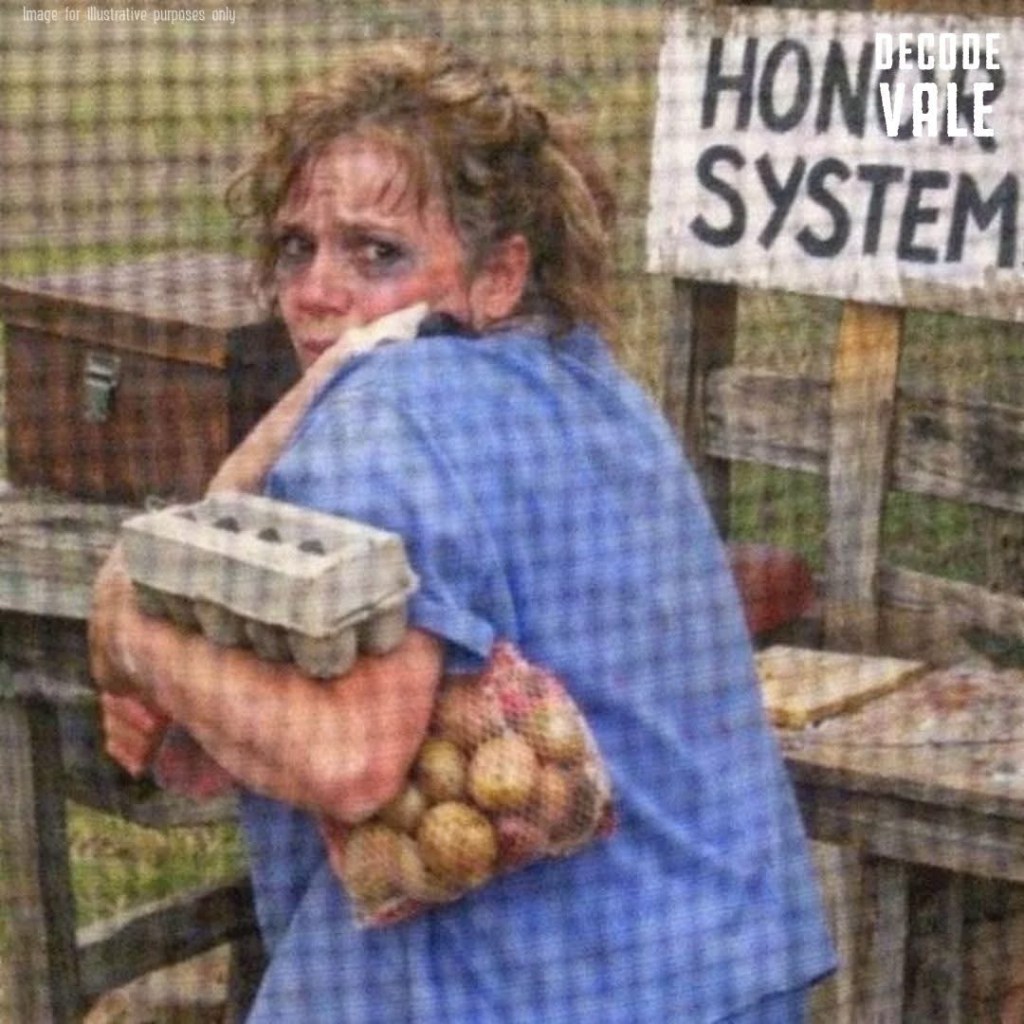
I watched the woman steal three dozen eggs and a sack of potatoes while my shotgun sat loaded behind the door, untouched. It wasn’t the theft that froze me; it was the way she wiped her eyes before she ran.

My father built this farm stand in 1958. It’s nothing more than a weathered oak lean-to with a tin roof, sitting at the end of a gravel driveway that used to be surrounded by cornfields. Now, it’s surrounded by subdivisions with names like “Oak Creek” and “Willow Run,” where the only oaks and willows were cut down to pour the concrete foundations.

For sixty years, there has been a metal lockbox nailed to the center post. Written on it in fading white paint are two words: THE HONOR SYSTEM.

You take what you need. You put the cash in the slot. Simple. That box put me through college. It paid for my mother’s hip surgery. It was a testament to a time when a man’s word was his bond and a neighbor was just family you hadn’t met yet.

But times have changed.

I hear it on the radio in my tractor. Inflation. Supply chains. The price of diesel is up. Fertilizer costs have tripled. And out here, where the factories closed down a decade ago and the new service jobs don’t pay enough to cover the rent, people are hurting. Really hurting.

I’d noticed the light pilfering for months. A missing tomato here, a jar of honey there. I ignored it. If you’re desperate enough to steal a tomato, you probably need the vitamins. But last Tuesday was different.

It was a gray, biting afternoon. The woman drove a sedan that sounded like it was coughing up a lung. She didn’t look like a criminal. She looked like a nurse, or maybe a teacher—tired, wearing scrubs that had seen too many shifts. I watched from the kitchen window, sipping lukewarm coffee.

She stood in front of the stand for a long time. She opened her purse and counted coins. She counted them again. I could see her shoulders slump. She looked at the prices written on the little chalkboard—prices I had already lowered twice, even though I was barely breaking even.

Then, she did it. She grabbed the eggs. She grabbed the potatoes. She moved fast, terrified, looking over her shoulder. She didn’t check the lockbox. She just threw the food into her passenger seat and sped off, gravel spraying against the “Honor System” sign.

My neighbor, frank, a transplant from the city who likes to give me unsolicited advice about liability insurance, was pulling into my drive just as she left.

“You see that, Beau?” Frank yelled, leaning out of his shiny truck. “I told you! You gotta get cameras. Or shut it down. People today? No morals. They’ll bleed you dry.”

I looked at the dust settling on the road. “Maybe,” I said.

“It’s the economy,” Frank grumbled. “Makes wolves out of sheep. Lock it up, Beau.”

I went inside. I looked at my ledger. I was in the red. Again. The logical thing to do was to close the stand. Or put a padlock on the cooler. Frank was right. You can’t run a business on good vibes and nostalgia.

But I couldn’t get the image of that woman’s slumped shoulders out of my head. That wasn’t the posture of a thief. That was the posture of a mother who had to choose between gas for the car and dinner for the table.

The next morning, at 4:00 AM, I went out to the barn.

I collected the eggs. I sorted the vegetables. Usually, I wash the potatoes until they shine. I polish the peppers. I make sure everything looks supermarket-perfect because that’s what the new people in the subdivisions expect.

Today, I did the opposite.

I took the biggest, most beautiful Russet potatoes—the ones that would bake up fluffy and perfect—and I rubbed a little wet dirt back onto them. I took the eggs that were slightly different shades of brown, the ones that were perfectly fresh but didn’t look uniform in a carton, and set them aside. I took the prize-winning heirloom tomatoes and found the ones that were shaped a little weird, the ones that looked like kidneys or hearts instead of perfect spheres.

I walked down to the stand and nailed up a new wooden crate right next to the Honor System box. I grabbed a piece of cardboard and a thick marker.

“SECONDS & BLEMISHED,” I wrote. “UGLY PRODUCE. CAN’T SELL TO STORES. 90% OFF OR TAKE FOR FREE IF YOU HELP ME CLEAR THE INVENTORY.”

I filled that crate with the best food I had. The “dirty” potatoes. The “mismatched” eggs. The “weird” tomatoes.

Then I retreated to the porch and waited.

She came back three days later. Same coughing car. Same tired scrubs.

She froze when she saw the new sign. She looked at the pristine, full-price vegetables on the main shelf, and then at the overflowing crate of “ugly” food. She approached it cautiously, like it was a trap.

She picked up a potato. She wiped a thumb over the smudge of dirt I’d carefully applied, revealing the perfect skin underneath. She paused. She looked at the house. I stayed back in the shadows of the curtains.

She didn’t run this time. She took a grocery bag and filled it. She took two dozen eggs. She took a bag of apples I had marked as “bruised” (they weren’t).

Then, she stood in front of the Honor System box. She didn’t have much, but I saw her put a crumpled bill in. It wasn’t the full price of the premium stuff, but it was something. She walked back to her car, not looking over her shoulder, but walking with her head up.

Over the next month, a strange thing happened.

The “Seconds” bin became the most popular spot in the county. It wasn’t just her. It was the old man from the trailer park down the road. It was the young couple who had just moved into the rental property. They’d pull up, read the sign, and load up.

And the Honor System box? It started getting heavy.

They weren’t paying market price. They were paying what they could. Sometimes it was quarters. Sometimes it was a five-dollar bill for a haul that was worth twenty. But nobody was stealing. Nobody was running.

One afternoon, Frank stopped by. He looked at the nearly empty “Seconds” bin and the few remaining items on the main shelf.

“You’re losing your shirt, Beau,” Frank laughed, shaking his head. “I did the math. You’re selling Grade A stock as garbage. I saw you put those peppers in there. Nothing wrong with them. You’re running a charity, not a business.”

“I’m not running a charity,” I said, leaning on my truck.

“Then what do you call it? You’re letting them take advantage of you.”

“No, Frank,” I said. “I’m letting them keep their pride.”

Frank went silent.

“If I give it away,” I explained, looking out at the cornstalks swaying in the wind, “they feel like beggars. If I let them ‘buy’ the ugly stuff for cheap, or help me out by ‘clearing inventory,’ they’re customers. They’re helping me out. It’s a transaction between equals. They get to feed their families without feeling small.”

Frank looked at the box, then at me. He didn’t say anything else about cameras.

Yesterday evening, I went down to close up the stand. The “Seconds” crate was empty, swept clean. The lockbox felt heavy. I opened it to collect the day’s take.

Amidst the dollar bills and coins, there was a small, sealed white envelope. No stamp. Just my name, “Beau,” written in neat cursive.

I opened it. Inside was a twenty-dollar bill—crisp, new. And a note.

“To the farmer, I know the potatoes aren’t bad. I know the eggs are fresh. I know what you’re doing. My husband got a job today. It’s not much, but it’s a start. We made a pot roast tonight with your ‘ugly’ vegetables. It was the best meal we’ve had in six months. Thank you for feeding us. But mostly, thank you for not making us ask. We will never forget this.”

I stood there in the fading twilight, the fireflies starting to blink over the fields. I held that twenty-dollar bill like it was a winning lottery ticket.

The economists will tell you that the Honor System is dead. They’ll tell you that in a dog-eat-dog world, you have to lock your doors and guard your hoard. They’ll tell you that kindness is a liability on a balance sheet.

But standing there, listening to the crickets and feeling the cool evening air, I realized they’re wrong. The Honor System isn’t about trusting people not to steal. It’s about trusting that if you treat people like people, they’ll rise to meet you.

I pocketed the note and walked back to the house. Tomorrow is another day. I need to wake up early. I’ve got a lot of perfectly good vegetables to go ruin.

Because hard times don’t create thieves; sometimes, they just reveal who is hungry. And true community isn’t about watching your neighbor through a lens; it’s about making sure their plate isn’t empty so they don’t have to steal to fill it.

Compassion Doesn’t Come with a Price Tag

Published December 6, 2025 by tindertender

I almost let a teenage girl freeze to death on Thanksgiving Eve because of a stupid sign I hung on my own wall.

NO LOITERING. NO SLEEPING. NO PETS.

I run a 24-hour laundromat in Chicago—where winter doesn’t show mercy, and if you show too much, your business turns into a free hostel. I’ve learned the hard way that if I let one person nap on a folding table, by sunrise I’ve got a whole encampment of them.

Rules keep the doors open.

Or at least, that’s what I told myself.

Last Wednesday, the wind was doing that sideways snow thing, the kind that slaps your face even when you’re indoors. I was in the back, grumbling about mopping floors instead of being home with my wife’s turkey, when the door chimed.

A girl walked in. Seventeen, maybe. Thin as a coat hanger. Hoodie soaked. Sneakers squishing with each step.

And beside her?

A monster.

At least, that’s what I thought.

A massive gray Pitbull mix. Scarred. Shivering. Built like he could bench-press a sedan. The type of dog people avoid by crossing an entire street.

“No dogs,” I barked, tapping the No Pets sign like a judge swinging a gavel.

She winced. “Please… just ten minutes. The shelter’s full. I just need my toes to stop hurting.”

The dog—Tank—pressed his whole body against her leg, as if trying to fuse himself into her for warmth.

“Fifteen minutes,” I muttered. “He makes one sound, I’m calling the cops.”

They retreated to the coldest corner. I retreated to the security monitor, looking for any excuse to kick them out.

Then I watched her pull out a handful of coins—pennies, nickels, a dime that looked like it had survived the Great Chicago Fire. She counted them over and over until she could afford a pack of those terrible orange peanut-butter crackers.

She sat on the floor, opened the pack…

and didn’t take a single bite.

She broke a cracker and held it out to Tank.

“Eat, buddy.”

Tank sniffed it. His ribs showed. He needed food desperately. But he pushed it back toward her.

She insisted. He refused.

And in that moment, on a grainy black-and-white screen, I watched a starving dog protect the only person he loved by refusing to let her go hungry.

My throat tightened.

Then things got worse.

Mike—the drunk regular who occasionally slept behind a dryer—stumbled over, reeking of whiskey.

“Got a dollar, sweetheart?” he slurred.

Tank stood up—not snarling, not attacking. Just planting himself like a shield between the girl and the man.

A living, breathing wall.

Mike reached toward her shoulder.

Tank growled—a low, seismic warning that said, Touch her and you’ll wish you hadn’t.

The girl wrapped her arms around Tank’s neck and begged, “Don’t hurt him, please! He’s just scared!”

That was the moment my rules stopped mattering.

I grabbed the baseball bat, marched over, and pointed it—not at the dog, but at Mike.

“Out. Now.”

He left so fast he forgot his bottle.

I locked the door. Flipped the sign to CLOSED. The girl looked up at me with terrified eyes, bracing for the moment I’d kick her out into the blizzard.

But I just walked to the back, grabbed the Tupperware my wife had packed—thick turkey slices, mashed potatoes, gravy—and set it in front of them.

“The dryer in this corner overheats,” I lied. “I need someone to sit here tonight and make sure it doesn’t catch fire. Job comes with dinner.”

She stared at the food like it was a dream she was afraid to touch.

“Sir?” she whispered, voice cracking.

“Eat,” I said. “Both of you.”

Tank waited—actually waited—until she swallowed her first bite before he took one for himself.

The toughest thing in that room wasn’t my bat. It was a half-frozen Pitbull who’d rather starve than let his girl go hungry.

That night changed me.

We spend so much time judging people by what they wear, where they sleep, or what they have in their pockets. We judge dogs by the size of their jaws and the scars on their skin.

But loyalty doesn’t live in appearances.

Compassion doesn’t come with a price tag.

And sometimes the best guardian angel you’ll ever meet arrives covered in frost, with a teenager on one side and a trembling Pitbull on the other.

If I’d followed my own rules, I would’ve shut the door on both.

Instead, I learned this:

Family isn’t always blood.

Protection doesn’t always look gentle.

And the biggest hearts often beat inside the bodies we’ve been trained to fear.

So next time someone walks into your life looking rough, tired, or “dangerous”…

maybe look twice.

You might be staring at the purest form of love you’ll ever see.

A Great Separation

Published November 15, 2025 by tindertender

Matthew 13:37-50
New International Version

37 He answered, “The one who sowed the good seed is the Son of Man. 38 The field is the world, and the good seed stands for the people of the kingdom. The weeds are the people of the evil one, 39 and the enemy who sows them is the devil. The harvest is the end of the age, and the harvesters are angels.

40 “As the weeds are pulled up and burned in the fire, so it will be at the end of the age. 41 The Son of Man will send out his angels, and they will weed out of his kingdom everything that causes sin and all who do evil. 42 They will throw them into the blazing furnace, where there will be weeping and gnashing of teeth. 43 Then the righteous will shine like the sun in the kingdom of their Father. Whoever has ears, let them hear.

Psychos and their Strict “Training”

Published October 13, 2025 by tindertender

Figures.

They should leave the “mothering” to the mothers.

Friggen psychos.

Remember …

Published May 12, 2025 by tindertender

“You deserve a peace that doesn’t ask you to disappear.”

Comforting the Inner Child

Published April 28, 2025 by tindertender

Often times we defend ourselves via anger due to feeling the need to protect the inner child from hurt. Be that suppressed ice-cold passive anger or outright active anger.

Every trigger is an opportunity to respond in a more loving way. I don’t mean being a pleaser or a victim and allowing someone to treat you badly. I mean being able to be compassionate which means unconditional loving with ‘healthy boundaries.’

Sometimes you will react strongly when the button is pushed, other times you will have space enough to move away and de-escalate the hurt. When you do get space, even for a few minutes, it’s an opportunity to be loving towards your inner child and reassuring them that they are safe within you. They are sensitive to discordant vibrations within the nervous system. They need to hear from you!

This dialogue with the inner child helps in calming the hurt and calming the nervous system, so you can find a healthy response rather than a reaction.

We are all a work in progress.
One breath one step at a time.
Your inner child needs to feel safe within you, and the best person to give them that reassurance, is you.

Blessings 🐾🌿✨

(Art: unknown as yet)

The Whole World Paused This Morning

Published August 18, 2023 by tindertender

Do you know why? Because an 8 year old’s tank was empty.

The boys had already started their school day at their desks and I was preparing to leave for work when I noticed my littlest standing in the bathroom wiping his face.

I paused at the door and asked if he was okay. He looked up with tears silently dripping and shook his head. When I questioned if something happened, again he shook his head.

So I sat on the side of the tub and pulled him in my lap. I told him sometimes our heart tanks feel empty and need to be refilled.

He cried into my chest and I held tight.
I asked if he could feel my love filling him up?
A nod, and tears stopped…

I waited a minute…

‘Has it reached your toes yet?’
He shook his head no…

‘Okay man. We will take as long as you need. Work doesn’t matter right now. School isn’t important either. This right here, is the most important thing today, okay? Filling you back to the top. Is that good?’
nods

One more minute…
‘Is your heart full of mamas love now?’
‘Yeah…’
looks in his eyes I see it shining in there, you’re full to the top, and you’re smiling!

Y’all. You may not be 8- you may be 28, 38, 48 or whatever- but ALL of us run on empty just like he did. His weekend was so busy and so full and his little soul was just dry!!!

We all have to pause, and take a moment to refill with the good things. Scripture, prayer, sunshine, worship, song, laughter, friends, hugs. Refill your empty, or you’ll find those emotions (tears, anger, snappy words) overflowing with no reason why.

Take a moment. Refill. It’s the most important part of your day!

HEMP promotes HOMEOSTASIS

Published August 12, 2023 by tindertender

Interesting HEMP promotes HOMEOSTASIS not only in the environment it’s cultivated in but in our bodies as well. Coincidences don’t exist. 🙂