When a man is unhappy with himself, he will project that unhappiness onto any woman who tries to love him. He will ruin her happiness because he cannot find his own.
So, dear man, work on yourself because a woman’s love is not a remedy for your pain. It is not her job to heal the wounds you refuse to face. If you carry unresolved anger, insecurity, or self-doubt, you will inevitably turn her tenderness into a battleground where she constantly fights for a love you have not yet learned to give.
She will try to hold you, to remind you of your worth, but if you do not believe in it yourself, her words will feel like lies. You will push her away, not because she is unworthy, but because deep down, you believe you are. And when a man believes he is unworthy of love, he will unconsciously destroy any love that comes his way.
You might criticize her, belittle her, or make her feel like she is never enough. Not because she isn’t, but because you feel like you aren’t. A woman in love will do everything to bring light into your darkness, but if you refuse to let go of the shadows, you will dim her light too.
This is why healing is essential. You cannot pour from an empty cup, nor can you build a loving relationship on a foundation of self-hatred. Work on yourself so that when love comes, you can receive it with open arms instead of rejecting it out of fear.
Heal your past, so you don’t bleed onto a woman who had nothing to do with your wounds. Take responsibility for your happiness, so she doesn’t have to carry the weight of both her heart and yours. Learn to love yourself, so when she loves you, you believe her.
A good woman will love you deeply, but even the strongest woman cannot save a man who refuses to save himself. If you are broken, acknowledge it. If you are lost, find your way. If you are hurt, seek healing.
Your pain is not your fault, but your healing is your responsibility. No woman deserves to suffer because you refuse to do the work. Love is meant to be a sanctuary, not a place of destruction. So, dear man, work on yourself—not just for her, but for you. Love yourself enough to become the man who can love her the way she deserves.
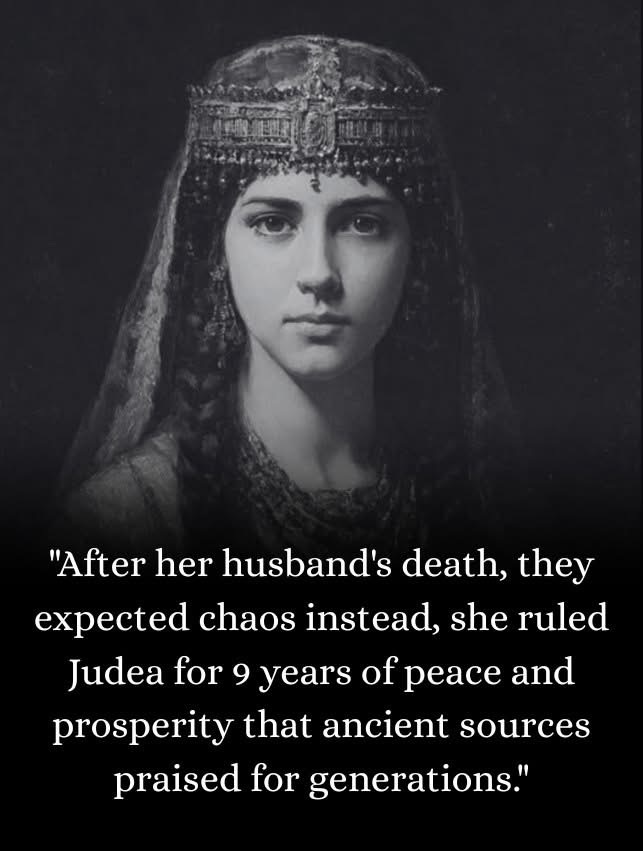
After her husband’s death, they expected chaos—instead, she ruled Judea for 9 years of peace and prosperity that ancient sources praised for generations.
Jerusalem, 76 BCE. King Alexander Jannaeus lay dying. His reign had been brutal—marked by civil war, mass executions, and conflict between religious factions. Judea was exhausted, divided, bleeding.
On his deathbed, Alexander did something unusual: he designated his wife, Salome Alexandra, as his successor. Not one of their sons. Not a military commander. His wife. She was around 64 years old. She would rule for nine years—and those years would be remembered as among the most peaceful and prosperous in Judean history.
This is her actual story, remarkable enough without embellishment.
Salome Alexandra (known in Hebrew as Shlomtzion, meaning “peace of Zion”) was born around 141 BCE. Little is known about her early life, but she came from a priestly family and was well-connected to Jerusalem’s religious and political elite.
She married Alexander Jannaeus around 103 BCE. He was a Hasmonean king—descended from the Maccabees who’d won Jewish independence from Greek rule. But the Hasmonean dynasty had become corrupt, brutal, and increasingly unpopular.
Alexander’s reign was particularly violent. He fought constantly—external wars against neighbors, internal war against the Pharisees (a Jewish religious faction that opposed him). At one point, he crucified 800 Pharisees while feasting and watching them die.
Judea under Alexander was traumatized. When he died in 76 BCE, Salome assumed the throne. She became “Queen” (basilissa in Greek, malka in Aramaic)—the only woman to rule Judea independently in the Hasmonean period. Ancient sources—particularly the Jewish historian Josephus and the Talmud—describe her reign positively, which is notable given how critical they are of other Hasmonean rulers. What made her reign successful?
Political balance: Salome reversed her husband’s policies toward the Pharisees. She allied with them, giving them influence in the Sanhedrin (Jewish council) while keeping the Sadducees (another faction) from becoming too powerful. This balance ended the civil conflict that had plagued her husband’s reign.
Domestic stability: Unlike Alexander, who was constantly at war, Salome focused on internal governance. The Talmud associates her reign with prosperity—harvests were good, peace prevailed.
Diplomatic skill: She maintained Judea’s position without major military campaigns. She recognized that Judea, surrounded by larger powers (Egypt, Syria, Rome), needed diplomacy more than conquest.
Respect for religious authority: By working with the Pharisees and supporting Torah scholarship (generally—not specifically for women), she gained popular support. The Pharisees emphasized law and learning over the priestly aristocracy favored by the Sadducees.
The Talmud (Tractate Taanit 23a) says of her reign: “In the days of Shimon ben Shetach and Queen Shlomtzion, rain fell on Wednesday nights, so that the wheat grains grew as large as kidneys, barley grains as large as olive pits, and lentils as large as gold dinars.”
This is obviously legendary exaggeration, but it indicates how her reign was remembered—as a golden age of peace and plenty.
Was she opposed because she was a woman? The historical sources don’t emphasize this. She seems to have assumed power relatively smoothly as her husband’s chosen successor.
While some Sadducees opposed her alliance with Pharisees, ancient sources frame this as political-religious conflict, not gender-based. Did she champion women’s education specifically? There’s no historical evidence for this claim. While she supported the Pharisees who valued Torah study, nothing in Josephus, the Talmud, or other sources attributes specific policies about women’s education to her.
Women’s formal Jewish education remained extremely limited in this period and for centuries after. If Salome had implemented revolutionary policies expanding women’s education, it would likely have been noted in sources—either as praise or criticism.
This doesn’t diminish her accomplishment. Ruling successfully for nine years in the ancient world as a woman was extraordinary. She didn’t need to also be a feminist education reformer to be impressive.
What happened after her death reveals the fragility of her achievements—but not for the reasons sometimes claimed.
Salome died around 67 BCE at approximately age 73. She’d designated her older son, Hyrcanus II, as her successor. But her younger son, Aristobulus II, challenged him. Civil war erupted immediately—not because people opposed female rule, but because of normal succession disputes between ambitious brothers.
The war weakened Judea at exactly the wrong moment. Rome was expanding eastward. In 63 BCE, Roman general Pompey intervened in the civil war, besieged Jerusalem, and essentially ended Judean independence.
Judea would remain under Roman control (directly or through client kings like Herod) for the next century, until the destruction of the Second Temple in 70 CE.
So yes, everything Salome built collapsed after her death. But not because of gender-based opposition or rollback of women’s rights. It collapsed because her sons’ ambitions destroyed what she’d carefully maintained.
Salome Alexandra’s actual legacy: She proved women could rule effectively: In a world where female political power was rare, she governed successfully for nine years. She ended civil conflict: Through political skill rather than military force, she brought peace after years of violence.
She balanced competing factions: Her diplomatic management of Pharisees and Sadducees maintained stability.
She prioritized domestic prosperity: Unlike her husband’s military adventurism, she focused on governance and peace.
She’s remembered positively: Ancient sources—which were often critical of rulers and rarely praised women leaders—speak well of her reign.
These accomplishments are remarkable and historically documented. We don’t need to invent claims about women’s education advocacy to make her impressive.
Why does this matter? Why not just accept the embellished version that makes her sound more feminist?
Because historical accuracy matters. When we project modern values onto historical figures without evidence, we:
Diminish their actual achievements by replacing them with what we wish they’d done Distort history in ways that ultimately undermine our understanding of how change actually happens
Lose credibility when people discover the claims aren’t supported by sources Miss opportunities to understand the real constraints and possibilities of women’s power in different historical contexts.
Salome Alexandra’s actual story—ruling successfully for nine years, maintaining peace, balancing factions, being remembered positively by sources that usually dismissed female rulers—is impressive precisely because it happened in a world that offered women almost no political power.
We honor her better by acknowledging what she actually accomplished within the constraints she faced, rather than inventing accomplishments that fit modern priorities.
To Salome Alexandra: You ruled Judea during a period of peace and prosperity after years of violence and chaos. You balanced competing religious factions without resorting to your husband’s brutality. You maintained Judea’s independence through diplomacy rather than constant warfare. You proved that a woman could govern as effectively as any king.
Ancient sources that were often critical of rulers praised your reign. The Talmud associated your years with abundance. Josephus acknowledged your political skill.
You didn’t need to revolutionize women’s education to be remarkable—though later generations sometimes claim you did because they want ancient validation for modern values. Your actual accomplishment—ruling successfully for nine years in the ancient world—is impressive enough. The fact that civil war erupted immediately after your death shows how much your skill maintained stability.
You proved women could govern. That was radical in itself.
We don’t need to make you into something you weren’t. What you actually were—a capable ruler who brought peace and prosperity—deserves recognition without embellishment.
She let go. Without a thought or a word, she let go. She let go of fear. She let go of the judgments.
She let go of the confluence of opinions swarming around her head. She let go of the committee of indecision within her.
She let go of all the ‘right’ reasons. Wholly and completely, without hesitation or worry, she just let go.
She didn’t ask anyone for advice. She didn’t read a book on how to let go… She didn’t search the scriptures.
She just let go.
She let go of all of the memories that held her back. She let go of all of the anxiety that kept her from moving forward.
She let go of the planning and all of the calculations about how to do it just right.
She didn’t promise to let go. She didn’t journal about it. She didn’t write the projected date in her day-timer. She made no public announcement and put no ad in the paper. She didn’t check the weather report or read her daily horoscope.
She just let go.
She didn’t analyse whether she should let go. She didn’t call her friends to discuss the matter. She didn’t do a five-step Spiritual Mind Treatment.
She didn’t call the prayer line. She didn’t utter one word. She just let go.
No one was around when it happened. here was no applause or congratulations. No one thanked her or praised her.
No one noticed a thing. Like a leaf falling from a tree, she just let go.
There was no effort. There was no struggle.
It wasn’t good and it wasn’t bad.
It was what it was, and it is just that. In the space of letting go, she let it all be.
A small smile came over her face. A light breeze blew through her. And the sun and the moon shone forevermore.
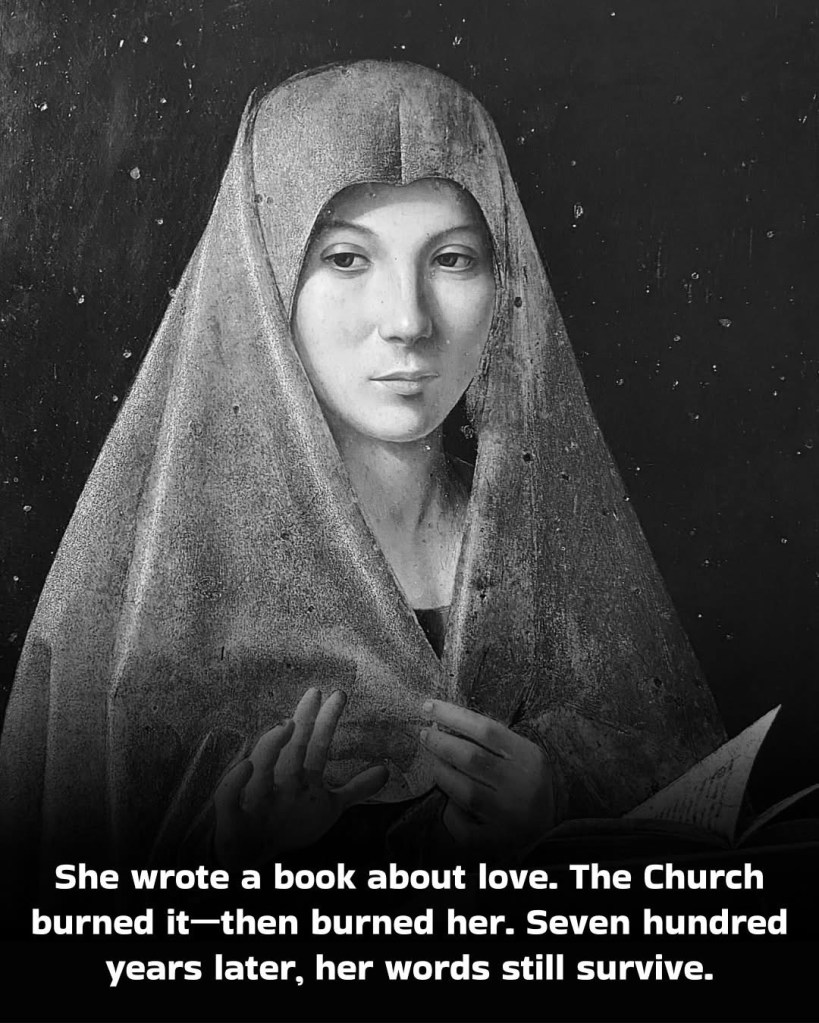
In the year 1310, a woman named Marguerite Porete was led to a stake in the heart of Paris, surrounded by a crowd of thousands. She had been condemned as a heretic—the first person the Paris Inquisition would burn for refusing to recant.
Her crime was writing a book.
Marguerite Porete was born around 1250 in the County of Hainaut, in what is now Belgium. She was highly educated, likely from an aristocratic family, and she joined the Beguines—a movement of women who devoted themselves to spiritual life without taking formal vows or submitting to male religious authority.
The Beguines lived by their own rules. They worked among the poor, prayed in their own communities, and sought God on their own terms. This freedom made Church authorities nervous. Women living outside male control, speaking about God without clerical permission, threatened the very foundations of institutional power.
Marguerite took this freedom further than most. Sometime in the 1290s, she wrote a mystical text called The Mirror of Simple Souls. It was a conversation between allegorical figures—Love, Reason, and the Soul—describing seven stages of spiritual transformation. At its heart was a radical idea: that a soul could become so completely united with divine love that it no longer needed the Church’s rituals, rules, or intermediaries. In the highest states of union, the soul surrendered its will entirely to God—and in that surrender, found perfect freedom.
“Love is God,” she wrote, “and God is Love.”
She did not write her book in Latin, the language of clergy and scholars. She wrote in Old French—the language ordinary people spoke. This meant her dangerous ideas could spread beyond monastery walls, beyond the control of priests and bishops.
And spread they did.
Between 1296 and 1306, the Bishop of Cambrai condemned her book as heretical. He ordered it burned publicly in the marketplace of Valenciennes, forcing Marguerite to watch her words turn to ash. He commanded her never to circulate her ideas again.
She refused.
Marguerite believed her book had been inspired by the Holy Spirit. She had consulted three respected theologians before publishing it, including the esteemed Master of Theology Godfrey of Fontaines, and they had approved. She would not let one bishop’s condemnation silence what she believed to be divine truth.
She continued sharing her book. She continued teaching. She continued insisting that the soul’s relationship with God belonged to no earthly institution.
In 1308, she was arrested and handed over to the Inquisitor of France, a Dominican friar named William of Paris—the same man who served as confessor to King Philip IV, the monarch who was simultaneously destroying the Knights Templar. It was a busy time for burning heretics.
Marguerite was imprisoned in Paris for eighteen months. During that entire time, she refused to speak to her inquisitors. She would not take the oath required to proceed with her trial. She would not answer questions. She maintained absolute silence—an act of defiance that infuriated the authorities.
A commission of twenty-one theologians from the University of Paris examined her book. They extracted fifteen propositions they deemed heretical. Among the most dangerous: the idea that an annihilated soul, fully united with God, could give nature what it desires without sin—because such a soul was no longer capable of sin.
To the Church, this suggested moral chaos. To Marguerite, it described the ultimate freedom of perfect surrender.
She was given every chance to recant. Others in similar positions saved their lives by confessing error. A man arrested alongside her, Guiard de Cressonessart, who had declared himself her defender, eventually broke under pressure and confessed. He was sentenced to life imprisonment.
Marguerite held firm.
On May 31, 1310, William of Paris formally declared her a relapsed heretic—meaning she had returned to condemned beliefs after being warned—and turned her over to secular authorities. The next day, June 1, she was led to the Place de Grève, the public square where executions took place.
The Inquisitor denounced her as a “pseudo-mulier”—a fake woman—as if her gender itself had been a lie, as if no real woman could defy the Church so completely.
They burned her alive.
But something unexpected happened in that crowd of thousands. According to the chronicle of Guillaume de Nangis—a monk who had no sympathy for her ideas—the crowd was moved to tears by the calmness with which she faced her death.
She displayed, the chronicle noted, many signs of penitence “both noble and pious.” Her serenity unnerved those who expected a screaming heretic. Instead, they witnessed a woman who seemed to have already transcended the fire that consumed her body.
The Church ordered every copy of The Mirror of Simple Souls destroyed. They wanted her words erased from history along with her life.
They failed.
Her book survived. Copies circulated secretly, passed from hand to hand across Europe. It was translated into Latin, Italian, and Middle English. For centuries, it was read anonymously—no one knew who had written it. The text was too powerful to disappear, even without a name attached.
It was not until 1946—more than six hundred years after her death—that a scholar named Romana Guarnieri, researching manuscripts in the Vatican Library, finally connected The Mirror of Simple Souls to its author. The woman the Church had tried to erase was finally given back her name.
Today, Marguerite Porete is recognized as one of the most important mystics of the medieval period. Scholars compare her ideas to those of Meister Eckhart, one of the most celebrated theologians of the era—and some believe Eckhart may have been influenced by her work. The book that was burned as heresy is now studied in universities as a masterpiece of spiritual literature.
Her ideas about love transcending institutional control, about the soul finding God directly without intermediaries, about surrender leading to freedom—these are not the ravings of a dangerous heretic. They are the insights of a woman centuries ahead of her time.
The Church that killed her eventually softened its stance on mystical experience. The Council of Vienne in 1312 condemned eight errors from her book, but the broader current of Christian mysticism she represented would continue flowing through figures like Julian of Norwich, Teresa of Ávila, and countless others who sought direct encounter with the divine.
What the flames could not destroy was the truth she had grasped: that love, in its purest form, is greater than fear. That no institution can ultimately control the relationship between a soul and its source. That words born from genuine spiritual insight have a way of surviving every attempt to silence them.
Marguerite Porete spent her final years in silence—refusing to speak to those who demanded she deny her truth. But her book has been speaking for seven centuries.
Some people say your success was just an accident, luck.
They will never admit it was because you tried, tried, tried again. You never gave up, and success was finally achieved.
That’s the way it always happens in the “natural world”.
The others, who get “instant” results, are just manipulators, often thieves and abusers, not successful creators of solutions through genuine, persistent effort on one’s own supply.
Of course the manipulator will whine about your achievements and successes. They’ll insist it’s a hoax.
The Magistrate is the Planetary Stabilizer. She’s the Planetary Gatekeeper. Her roots are in the deepest depths. Her crown is in the high heavens. She is the Energizer, the Magnifier, the Mother. She has Rainbow Covenant with the Most High God.
These “men” are at war with God over this woman being in Status. Their intention is to copycat and replace her. They want the wealth. She is refusing to offer services to them. They tortured her family, genetically altered them, tried to exterminate them. They must leave the planet. They have no such intention. There looks to be a final, big fight to occur. Nasty Jack is trying to “crown” a man puppet as Prince of peace. They want to put a puppet in the Magistrates position. They want control of the planet.
———————————-
Did you know Israel gave Trump the Silver Crown of the Torah and title of Messiah, Prince of Peace? Did you know they say he played everyone with the shots, that the intent is to k!ll the “Adam” lineage?
Not from strangers who know nothing about me… but from our own people. The comments, the digs, the policing, the “you’re not doing it right,” the “you don’t look Lakota enough,” the “who taught you.” The jealousy. The bitterness. The tearing down.
And it’s wild, because that behavior? That’s colonizer behavior. It’s exactly what they wanted us to do to each other. Break each other’s spirits. Doubt each other’s teachings. Destroy each other’s confidence. Attack each other’s identity. Make sure we never trust, never uplift, never celebrate one another.
Our ancestors didn’t survive genocide, boarding schools, forced removals, starvation, outlawed ceremonies, and relentless erasure… so that we could turn around and harm each other the same way.
I’m out here teaching plant knowledge, educating, sharing culture, raising my kids, running a community-centered business, helping people heal, and trying to leave the world better than I found it.
And the hate I get for simply existing as who I was born to be is unreal.
But here’s what I know and what my elders taught me: When people attack your identity, your family, your authenticity, your appearance— they’re speaking from their own wounds. Their own scarcity. Their own disconnection.
I refuse to carry that. I refuse to swallow their hurt like it’s mine. I refuse to dim my voice to make someone more comfortable in their misery.
I was taught to stand strong, to stand in truth, to keep going even when others want to drag me down.
So to all that lateral violence aimed at me lately? All that weird, ugly energy trying to knock me off my path?
Nah. I’m not shrinking. I’m not stopping. I’m not breaking.
When a human being chooses to live in ignorance, arrogance, self-absorption, self-centeredness, selfishness, and self-indulgence… they become emotionally addicted to the identity of pride. They become addicted to the illusion of control, the illusion of superiority, and the illusion of certainty. They attach their worth to stubbornness and rebellion, refusing to soften, refusing to listen, refusing to feel the truth that lives within the heart of their soul.
When someone chooses arrogance over humility, when they choose self-absorption over self-awareness, they disconnect from the true condition of their soul. They choose unloving beliefs. They choose unloving emotions. They choose unloving behaviors. And because of that, they have zero desire to deconstruct their facade. Zero desire to deconstruct their traumas. Zero desire to deconstruct their emotional wounds. Zero desire to deconstruct their sins, their shadows, their false identities that were inherited through their family DNA.
Instead, they worship their addictions. They praise their attachments. They treasure their codependencies as if they are sacred. They idolize the very prison that keeps them suffering.
And so they become emotionally addicted to their rage, their anger, their hatred, their bitterness. They become addicted to their false assumptions. They become addicted to their false narratives. They become addicted to their false stories and false judgments. They become addicted to the identity of their own fears and terrors.
And then, because they refuse to feel, refuse to take accountability, refuse to take ownership, they project all of it onto their reality, onto the people around them, onto the world, onto the ones who actually love them.
And this is why humility is the gateway to God. This is why emotional transparency is the portal to liberation. This is why the willingness to feel is the key to freedom.
Because until a soul becomes willing to dismantle everything false within them, they will remain trapped in the illusion that is destroying them.
And for those who choose truth, who choose humility, who choose emotional honesty, who choose divine accountability, they resurrect. They rise. They rebirth. They reclaim their original soul identity in God.
We God This. Sacred Sovereignty. Divine Liberation. Rise in Truth. Rise in Love. Rise in Humility.
I hold my face in my two hands. No. I am not crying. I hold my face in my two hands to keep my loneliness warm ~ two hands protecting, two hands nourishing, two hands preventing my soul from leaving me in anger.
“When someone predicts what the future will be and you give your attention to that, you are lending your creative power to that outcome. The future is not set in stone. We are creating it right now. Especially ignore those who speak vile words of brokenness or unworthiness or weakness over your life.”
It annoys me to no end how masculines unseen, AND their feminine co-conspirators, demand that someone is no one unless their life matches some weird prophecy some random dude dreamt of in history long ago. My life is not a script. My life does not require their approval in order to BE. My life does not need to conform to their script or ideology. It seems to me they do not worship, and are not a part of, the same Living System the Mother Father Divine Most High have gifted the living, here. No. I will not shift my existence so you can “tolerate” it, actor, actress, script writers. You do not get to write my next “lifetime story” !!!!! In fact, I believe it is the Highest here now. Rewriting yours. It’s the end of your relationship with batteries. It’s the end of you trapping, and feeding upon, Gods family.