May all who think it is, experience this woman’s sacrifice.
Mary Sullivan fought for her life over four relentless days, each hour a brutal test her young body was never meant to endure. On June 7, 1902, the nineteen-year-old went into labor, her small frame no match for the child she carried. The baby’s head pressed against her narrow pelvis, cutting off blood flow to the surrounding tissue. As the days dragged on, the pressure became catastrophic. By June 11th, after four agonizing days, the baby was stillborn. Mary’s body had been torn apart from the inside—her pelvis damaged, the tissue rotted, and a vesicovaginal fistula left her soaked, weakened, and trapped in her own bed.
Her husband Patrick and her mother did everything they could to care for her. They changed sheets, tried to keep her clean, and watched helplessly as her condition worsened. But medicine in 1902 had no answers for what prolonged labor had done. Infection crept in. Fevers climbed. Mary slipped into delirium as her body waged a final, unwinnable fight. The fistula became more than a wound—it became a doorway for sepsis. The very life she had carried now turned against her, claiming her body with silent, merciless precision.
Mary died on June 11, 1902. She was nineteen. Her stillborn baby was buried beside her two days later. Patrick never remarried. He carried the memory of her suffering for the rest of his life. Decades later, he would tell his nephew: “Mary died from childbirth. Nineteen years old. Four days of labor. The baby too big. She was torn apart and infected. That’s what childbirth was.”
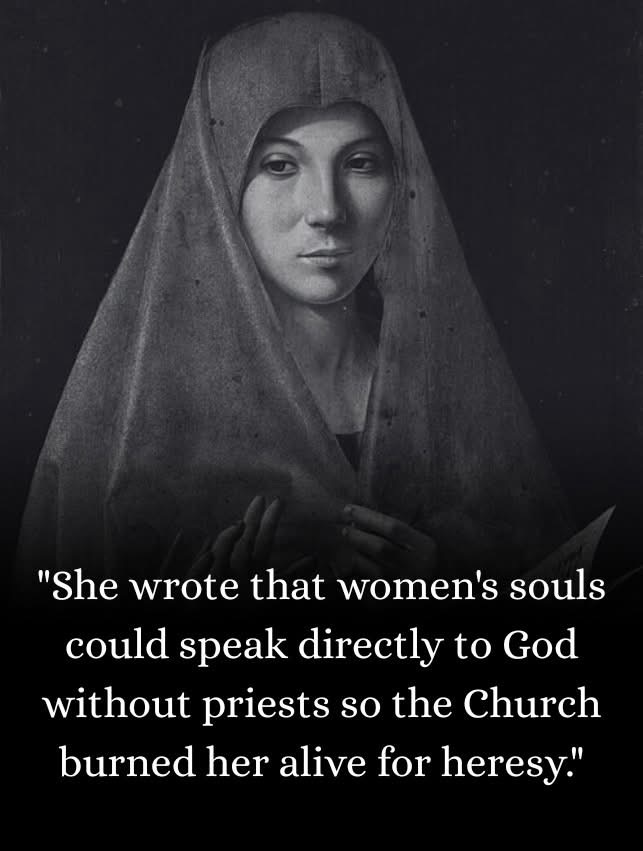
She wrote that women’s souls could speak directly to God without priests—so the Church burned her alive for heresy.
Paris, June 1, 1310.
In the Place de Grève, a woman was led to the stake. Marguerite Porete, accused of heresy, had spent over a year imprisoned, refusing to answer the Inquisition’s questions or defend herself before judges she didn’t recognize as having authority over her soul. Witnesses later described her calm demeanor—no screaming, no begging for mercy, no recantation. She faced the flames with a serenity that unnerved her executioners.
She died for writing a book that claimed a soul could unite so completely with divine love that it transcended the need for Church hierarchy, sacraments, or ecclesiastical mediation. The Church couldn’t tolerate that claim—especially from a woman.
Marguerite Porete was born in the late 13th century in Hainaut (modern-day France/Belgium border region). Little is known about her early life, but she became part of the Beguine movement—communities of lay religious women who lived together in prayer and work without taking formal monastic vows.
Beguines occupied a complicated space in medieval Christianity. They weren’t nuns bound by convent rules, but they weren’t ordinary laywomen either. They lived religious lives outside institutional Church control—which made Church authorities nervous.
Marguerite was educated, literate, and theologically sophisticated—unusual for a woman of her time.
Sometime in the late 13th century, she wrote “The Mirror of Simple Souls” (Le Mirouer des simples âmes) in vernacular Old French rather than Latin.
Writing theology in the vernacular was itself significant. Latin was the language of Church authority—using French made theology accessible to ordinary people, particularly women who hadn’t learned Latin.
But it was the book’s content that proved dangerous.
The Mirror of Simple Souls describes a mystical journey where the soul progressively lets go of attachments, ego, and even virtues until it reaches “annihilation”—complete dissolution into divine love. This “annihilated soul” becomes so united with God that it no longer needs:
Church sacraments Moral rules Priestly mediation Fear of sin Virtuous acts done out of obligation
Because the soul is completely aligned with divine will, it acts naturally from love rather than from external commands.
Marguerite wrote in dialogue form, with characters including “Love,” “Reason,” “The Soul,” and “Holy Church the Little” (institutional Church) versus “Holy Church the Great” (the mystical body of all souls united with God).
Crucially, she distinguished between institutional Church authority and direct divine relationship. “Holy Church the Little”—the hierarchy, rules, and priests—was necessary for beginners on the spiritual path. But advanced souls could transcend it through complete union with God. This was explosive theology.
The Church’s authority rested on being the necessary mediator between humans and God.
Sacraments administered by priests were required for salvation. Confession, penance, Church law—all of this presumed that people needed institutional guidance.
Marguerite was saying: at the highest spiritual level, you don’t need any of that. The soul united with God transcends institutional authority. Church authorities saw this as dangerous heresy. It suggested that mystics could claim direct divine authority superior to Church hierarchy. It implied that someone in mystical union might be beyond sin or moral law—a heresy called “antinomianism. “And it was especially threatening coming from a woman.
The Church insisted women needed male spiritual authority—priests, confessors, bishops—to guide them. A woman claiming direct divine relationship without male mediation challenged the entire gender hierarchy of medieval Christianity.
Around 1296-1306, Marguerite’s book was condemned by the Bishop of Cambrai. It was publicly burned, and she was warned to stop teaching her ideas. Marguerite ignored the warning. She continued circulating the book and discussing her theology. She sent copies to theologians and Church authorities seeking approval, but also continued teaching despite the prohibition.
This defiance was crucial. She had multiple opportunities to submit to Church authority, burn her book, recant her teachings, and avoid execution. She refused every time. Why? Because she believed—genuinely, deeply—that her mystical experience and theological understanding came directly from God. No earthly authority, not even the Church, could invalidate that divine relationship.
In 1308, she was arrested in Paris. The Inquisition began proceedings against her. During her imprisonment (which lasted over a year), she refused to cooperate with the trial. She wouldn’t answer questions. She wouldn’t defend herself. She wouldn’t acknowledge the tribunal’s authority to judge her spiritual state. Her silence was deliberate and theological.
She believed the judges—bound by “Holy Church the Little”—couldn’t understand the mystical theology of souls who’d reached union with God. Answering them would be pointless.
The Inquisition found her guilty of heresy. They declared her a “relapsed heretic”—someone who’d been warned before and persisted in error. The penalty for relapsed heresy was death by burning.
On June 1, 1310, Marguerite was led to the Place de Grève in Paris. Accounts describe her facing execution with remarkable calm—no terror, no last-minute recantation, no screaming as the flames rose. Observers noted this serenity. Some interpreted it as demonic possession keeping her from repenting. Others saw it as proof she’d achieved the mystical state she’d written about—transcendence of fear through complete union with divine love.
Marguerite Porete became one of the first women burned for heresy by the Inquisition in Paris. Her execution was meant to be a warning: women who claimed spiritual authority independent of Church hierarchy would be silenced permanently.
But her book survived. Copies circulated anonymously throughout the 14th and 15th centuries. Because Marguerite’s name was suppressed (she was executed as a heretic), the book was copied without author attribution. Monks, mystics, and scholars read it for centuries without knowing a woman had written it. Some copies attributed it to male authors.
The mystical theology was considered so sophisticated that people assumed a man must have written it.
In 1946, scholar Romana Guarnieri finally proved that Marguerite Porete was the author. The evidence included trial records and manuscript traditions connecting the condemned book to The Mirror of Simple Souls.
Suddenly, a text that had influenced Christian mysticism for centuries was recognized as written by a woman burned for heresy.
Modern scholars recognize The Mirror as a masterpiece of mystical theology. Its influence can be traced in later mystics including Meister Eckhart (who faced similar accusations of heresy).
Marguerite’s theology anticipated ideas that would later appear in Protestant Reformation critiques of institutional Church authority and in modern mystical and contemplative traditions.
Her story matters because: She claimed spiritual authority as a woman: In an era when women were required to be spiritually subordinate to men, she insisted her mystical experience gave her theological insight. She challenged institutional religious power: She distinguished between institutional authority and divine relationship—a distinction that threatened Church hierarchy. She refused to recant: Given multiple chances to save herself by submitting to Church authority, she chose death over betraying her spiritual convictions.
She was right about mystical theology: Modern understanding of contemplative spirituality recognizes the validity of much of what she taught. Her work survived despite suppression: Burning her body didn’t destroy her ideas—they circulated for centuries, eventually vindicated.
The tragedy is that Marguerite was executed for theology that, in different contexts or coming from a man, might have been tolerated or even celebrated.
Male mystics like Meister Eckhart taught similar ideas and, while investigated, weren’t executed. Her gender made her dangerous in ways male mystics weren’t. A woman claiming to transcend priestly authority threatened both religious and gender hierarchies simultaneously.
To Marguerite Porete: You wrote that the soul united with God needs no intermediary—and the Church killed you for threatening their monopoly on salvation. You refused to recant even when recantation would have saved you. You chose death over betraying your mystical experience and theological convictions. Your silence before the Inquisition wasn’t weakness—it was theological statement. You didn’t recognize their authority to judge what you knew through direct divine union. You faced the flames with the serenity you’d written about—the transcendence of fear through complete surrender to divine love. They burned your body. They tried to erase your name. They suppressed your book. But your words survived. For centuries, they circulated anonymously, influencing mystics who didn’t know a woman had written them. When scholars finally proved you were the author, your genius was undeniable. You were right about mystical union. You were right that souls can experience God directly. You were right that love transcends institutional authority. The Church that executed you eventually had to acknowledge the validity of mystical theology like yours. The ideas they burned you for are now recognized as legitimate contemplative spirituality. You died for claiming women’s spiritual authority. For insisting divine love was greater than ecclesiastical power. For refusing to let priests mediate your relationship with God. That claim cost you your life. But it couldn’t be silenced. Your voice, speaking across seven centuries, still insists: the soul united with Love needs no permission to speak directly to God. They couldn’t burn that truth. And they couldn’t burn your courage.
Those entities who believe they own the whole of the world send in dancing puppets, beautiful, scantily clad succubusses, to wiggle and giggle and see if the cobra will rise from its basket and do a little weave and bob according to the dancing puppets will.
“Lust will be your downfall,” said the Most High to the warriors. Absolutely. A man who cannot control his mind, or his phallus, tends to “do the dance” and fall every time.
The hidden controllers have used the enslaved or agreeable Womb of Power against mankind for centuries, while causing great suffering for the Divine Feminine who tries, but cannot compete with the illusion, the alluring dance.
She doesn’t wiggle her hips like that. She doesn’t dress to gain a rise out of the snake. She’s busy building things, adding value to her soul, while he’s chasing smoke … looking for fire.
It’s too bad the Creatress doesn’t light his inner fire to match her efforts for creation … that he feels compelled to dance for the masters puppet, straight into fire of destruction.
In the year 1310, a woman named Marguerite Porete was led to a stake in the heart of Paris, surrounded by a crowd of thousands. She had been condemned as a heretic—the first person the Paris Inquisition would burn for refusing to recant.
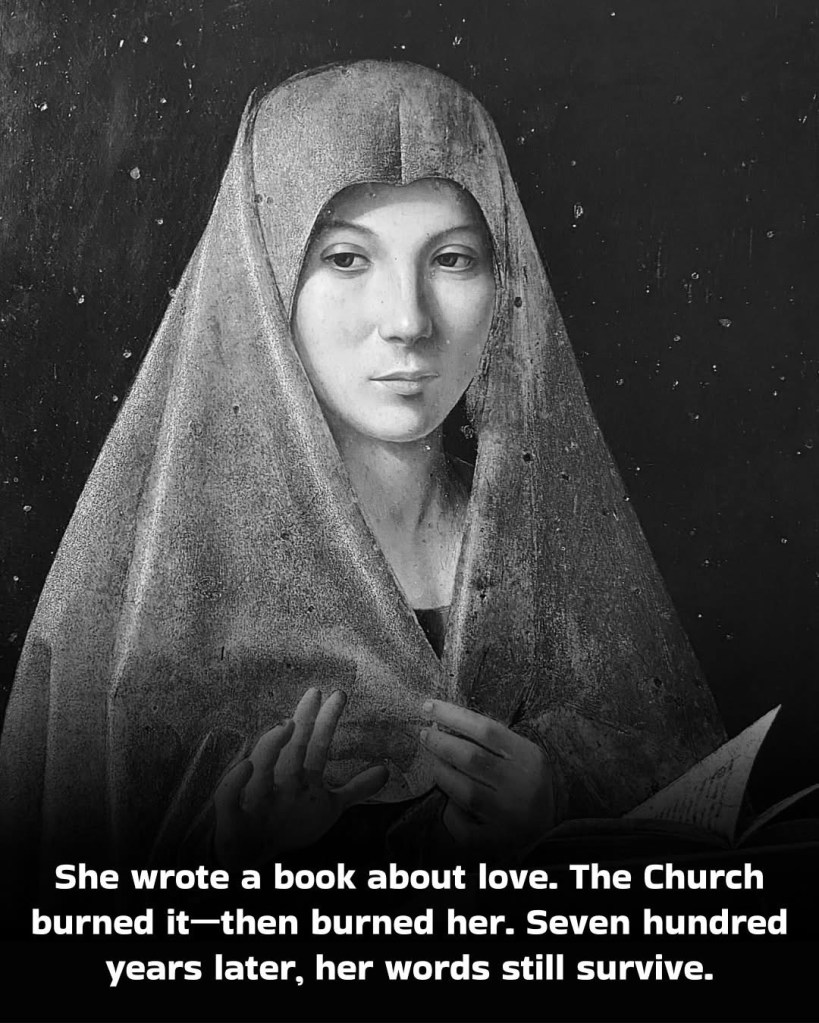
Her crime was writing a book.
Marguerite Porete was born around 1250 in the County of Hainaut, in what is now Belgium. She was highly educated, likely from an aristocratic family, and she joined the Beguines—a movement of women who devoted themselves to spiritual life without taking formal vows or submitting to male religious authority.
The Beguines lived by their own rules. They worked among the poor, prayed in their own communities, and sought God on their own terms. This freedom made Church authorities nervous. Women living outside male control, speaking about God without clerical permission, threatened the very foundations of institutional power.
Marguerite took this freedom further than most. Sometime in the 1290s, she wrote a mystical text called The Mirror of Simple Souls. It was a conversation between allegorical figures—Love, Reason, and the Soul—describing seven stages of spiritual transformation. At its heart was a radical idea: that a soul could become so completely united with divine love that it no longer needed the Church’s rituals, rules, or intermediaries. In the highest states of union, the soul surrendered its will entirely to God—and in that surrender, found perfect freedom.
“Love is God,” she wrote, “and God is Love.”
She did not write her book in Latin, the language of clergy and scholars. She wrote in Old French—the language ordinary people spoke. This meant her dangerous ideas could spread beyond monastery walls, beyond the control of priests and bishops.
And spread they did.
Between 1296 and 1306, the Bishop of Cambrai condemned her book as heretical. He ordered it burned publicly in the marketplace of Valenciennes, forcing Marguerite to watch her words turn to ash. He commanded her never to circulate her ideas again.
She refused.
Marguerite believed her book had been inspired by the Holy Spirit. She had consulted three respected theologians before publishing it, including the esteemed Master of Theology Godfrey of Fontaines, and they had approved. She would not let one bishop’s condemnation silence what she believed to be divine truth.
She continued sharing her book. She continued teaching. She continued insisting that the soul’s relationship with God belonged to no earthly institution.
In 1308, she was arrested and handed over to the Inquisitor of France, a Dominican friar named William of Paris—the same man who served as confessor to King Philip IV, the monarch who was simultaneously destroying the Knights Templar. It was a busy time for burning heretics.
Marguerite was imprisoned in Paris for eighteen months. During that entire time, she refused to speak to her inquisitors. She would not take the oath required to proceed with her trial. She would not answer questions. She maintained absolute silence—an act of defiance that infuriated the authorities.
A commission of twenty-one theologians from the University of Paris examined her book. They extracted fifteen propositions they deemed heretical. Among the most dangerous: the idea that an annihilated soul, fully united with God, could give nature what it desires without sin—because such a soul was no longer capable of sin.
To the Church, this suggested moral chaos. To Marguerite, it described the ultimate freedom of perfect surrender.
She was given every chance to recant. Others in similar positions saved their lives by confessing error. A man arrested alongside her, Guiard de Cressonessart, who had declared himself her defender, eventually broke under pressure and confessed. He was sentenced to life imprisonment.
Marguerite held firm.
On May 31, 1310, William of Paris formally declared her a relapsed heretic—meaning she had returned to condemned beliefs after being warned—and turned her over to secular authorities. The next day, June 1, she was led to the Place de Grève, the public square where executions took place.
The Inquisitor denounced her as a “pseudo-mulier”—a fake woman—as if her gender itself had been a lie, as if no real woman could defy the Church so completely.
They burned her alive.
But something unexpected happened in that crowd of thousands. According to the chronicle of Guillaume de Nangis—a monk who had no sympathy for her ideas—the crowd was moved to tears by the calmness with which she faced her death.
She displayed, the chronicle noted, many signs of penitence “both noble and pious.” Her serenity unnerved those who expected a screaming heretic. Instead, they witnessed a woman who seemed to have already transcended the fire that consumed her body.
The Church ordered every copy of The Mirror of Simple Souls destroyed. They wanted her words erased from history along with her life.
They failed.
Her book survived. Copies circulated secretly, passed from hand to hand across Europe. It was translated into Latin, Italian, and Middle English. For centuries, it was read anonymously—no one knew who had written it. The text was too powerful to disappear, even without a name attached.
It was not until 1946—more than six hundred years after her death—that a scholar named Romana Guarnieri, researching manuscripts in the Vatican Library, finally connected The Mirror of Simple Souls to its author. The woman the Church had tried to erase was finally given back her name.
Today, Marguerite Porete is recognized as one of the most important mystics of the medieval period. Scholars compare her ideas to those of Meister Eckhart, one of the most celebrated theologians of the era—and some believe Eckhart may have been influenced by her work. The book that was burned as heresy is now studied in universities as a masterpiece of spiritual literature.
Her ideas about love transcending institutional control, about the soul finding God directly without intermediaries, about surrender leading to freedom—these are not the ravings of a dangerous heretic. They are the insights of a woman centuries ahead of her time.
The Church that killed her eventually softened its stance on mystical experience. The Council of Vienne in 1312 condemned eight errors from her book, but the broader current of Christian mysticism she represented would continue flowing through figures like Julian of Norwich, Teresa of Ávila, and countless others who sought direct encounter with the divine.
What the flames could not destroy was the truth she had grasped: that love, in its purest form, is greater than fear. That no institution can ultimately control the relationship between a soul and its source. That words born from genuine spiritual insight have a way of surviving every attempt to silence them.
Marguerite Porete spent her final years in silence—refusing to speak to those who demanded she deny her truth. But her book has been speaking for seven centuries.
I almost let a teenage girl freeze to death on Thanksgiving Eve because of a stupid sign I hung on my own wall.
NO LOITERING. NO SLEEPING. NO PETS.
I run a 24-hour laundromat in Chicago—where winter doesn’t show mercy, and if you show too much, your business turns into a free hostel. I’ve learned the hard way that if I let one person nap on a folding table, by sunrise I’ve got a whole encampment of them.
Rules keep the doors open.
Or at least, that’s what I told myself.
Last Wednesday, the wind was doing that sideways snow thing, the kind that slaps your face even when you’re indoors. I was in the back, grumbling about mopping floors instead of being home with my wife’s turkey, when the door chimed.
A girl walked in. Seventeen, maybe. Thin as a coat hanger. Hoodie soaked. Sneakers squishing with each step.
And beside her?
A monster.
At least, that’s what I thought.
A massive gray Pitbull mix. Scarred. Shivering. Built like he could bench-press a sedan. The type of dog people avoid by crossing an entire street.
“No dogs,” I barked, tapping the No Pets sign like a judge swinging a gavel.
She winced. “Please… just ten minutes. The shelter’s full. I just need my toes to stop hurting.”
The dog—Tank—pressed his whole body against her leg, as if trying to fuse himself into her for warmth.
“Fifteen minutes,” I muttered. “He makes one sound, I’m calling the cops.”
They retreated to the coldest corner. I retreated to the security monitor, looking for any excuse to kick them out.
Then I watched her pull out a handful of coins—pennies, nickels, a dime that looked like it had survived the Great Chicago Fire. She counted them over and over until she could afford a pack of those terrible orange peanut-butter crackers.
She sat on the floor, opened the pack…
and didn’t take a single bite.
She broke a cracker and held it out to Tank.
“Eat, buddy.”
Tank sniffed it. His ribs showed. He needed food desperately. But he pushed it back toward her.
She insisted. He refused.
And in that moment, on a grainy black-and-white screen, I watched a starving dog protect the only person he loved by refusing to let her go hungry.
My throat tightened.
Then things got worse.
Mike—the drunk regular who occasionally slept behind a dryer—stumbled over, reeking of whiskey.
“Got a dollar, sweetheart?” he slurred.
Tank stood up—not snarling, not attacking. Just planting himself like a shield between the girl and the man.
A living, breathing wall.
Mike reached toward her shoulder.
Tank growled—a low, seismic warning that said, Touch her and you’ll wish you hadn’t.
The girl wrapped her arms around Tank’s neck and begged, “Don’t hurt him, please! He’s just scared!”
That was the moment my rules stopped mattering.
I grabbed the baseball bat, marched over, and pointed it—not at the dog, but at Mike.
“Out. Now.”
He left so fast he forgot his bottle.
I locked the door. Flipped the sign to CLOSED. The girl looked up at me with terrified eyes, bracing for the moment I’d kick her out into the blizzard.
But I just walked to the back, grabbed the Tupperware my wife had packed—thick turkey slices, mashed potatoes, gravy—and set it in front of them.
“The dryer in this corner overheats,” I lied. “I need someone to sit here tonight and make sure it doesn’t catch fire. Job comes with dinner.”
She stared at the food like it was a dream she was afraid to touch.
“Sir?” she whispered, voice cracking.
“Eat,” I said. “Both of you.”
Tank waited—actually waited—until she swallowed her first bite before he took one for himself.
The toughest thing in that room wasn’t my bat. It was a half-frozen Pitbull who’d rather starve than let his girl go hungry.
That night changed me.
We spend so much time judging people by what they wear, where they sleep, or what they have in their pockets. We judge dogs by the size of their jaws and the scars on their skin.
But loyalty doesn’t live in appearances.
Compassion doesn’t come with a price tag.
And sometimes the best guardian angel you’ll ever meet arrives covered in frost, with a teenager on one side and a trembling Pitbull on the other.
If I’d followed my own rules, I would’ve shut the door on both.
Instead, I learned this:
Family isn’t always blood.
Protection doesn’t always look gentle.
And the biggest hearts often beat inside the bodies we’ve been trained to fear.
So next time someone walks into your life looking rough, tired, or “dangerous”…
maybe look twice.
You might be staring at the purest form of love you’ll ever see.
How do I know Who I am When all I have been taught Is who to be According to rules That belong to a past That believed in the domination Of nature As a path to power.
How do I know Who to be When the judgment that gets thrown Arises from a fear so old That no one even knows Why it’s wrong To shine Or show pleasure
As a woman Why would I stay Cooped up in a cage Of shoulds and oughts When this body Is crafted from moonlight And fire And the deeper river Of ancient knowing Guides my every felt sense Of what it means To be a woman
So I stand Shameless bright My heart open wide Wild crafted pleasure And mountainous might
I define myself As I set myself free And I laugh out loud As I birth a new me, For all women.
Is it more than a dream? The idea of sweet love in wholeness, balanced?
I suppose in a world of wholeness, pleasure and pain would be balanced … a bit of joy, a bit of sorrow … sort of like a sweet and spicy soup that isn’t SO spicy it burns the hairs out of the nose upon consumption.
Gambled you. Didn’t even try. You ARE the teacher of Love. They buried you centuries ago. Free now.
Unicorn, YOU were to teach Love and lift relationships into higher good! Lustful childish dominator tyrant didn’t want love. They thought lust and brutality and forgery and identity theft was the way to the Kingdom of God. Jacko did not have it in him. They flipped and twisted and martyred the Teacher of Love!! They said She was a soldier of death. LIAR!!!
Your friends network are congratulating you on your commitment to life and family. Enemy cannot mess your mind any more. Everything you no longer need is falling away to make room for the love you deserve. Irresponsible horse playing immaturity has lost.




 opensenseme