May all who think it is, experience this woman’s sacrifice.
Mary Sullivan fought for her life over four relentless days, each hour a brutal test her young body was never meant to endure. On June 7, 1902, the nineteen-year-old went into labor, her small frame no match for the child she carried. The baby’s head pressed against her narrow pelvis, cutting off blood flow to the surrounding tissue. As the days dragged on, the pressure became catastrophic. By June 11th, after four agonizing days, the baby was stillborn. Mary’s body had been torn apart from the inside—her pelvis damaged, the tissue rotted, and a vesicovaginal fistula left her soaked, weakened, and trapped in her own bed.
Her husband Patrick and her mother did everything they could to care for her. They changed sheets, tried to keep her clean, and watched helplessly as her condition worsened. But medicine in 1902 had no answers for what prolonged labor had done. Infection crept in. Fevers climbed. Mary slipped into delirium as her body waged a final, unwinnable fight. The fistula became more than a wound—it became a doorway for sepsis. The very life she had carried now turned against her, claiming her body with silent, merciless precision.
Mary died on June 11, 1902. She was nineteen. Her stillborn baby was buried beside her two days later. Patrick never remarried. He carried the memory of her suffering for the rest of his life. Decades later, he would tell his nephew: “Mary died from childbirth. Nineteen years old. Four days of labor. The baby too big. She was torn apart and infected. That’s what childbirth was.”
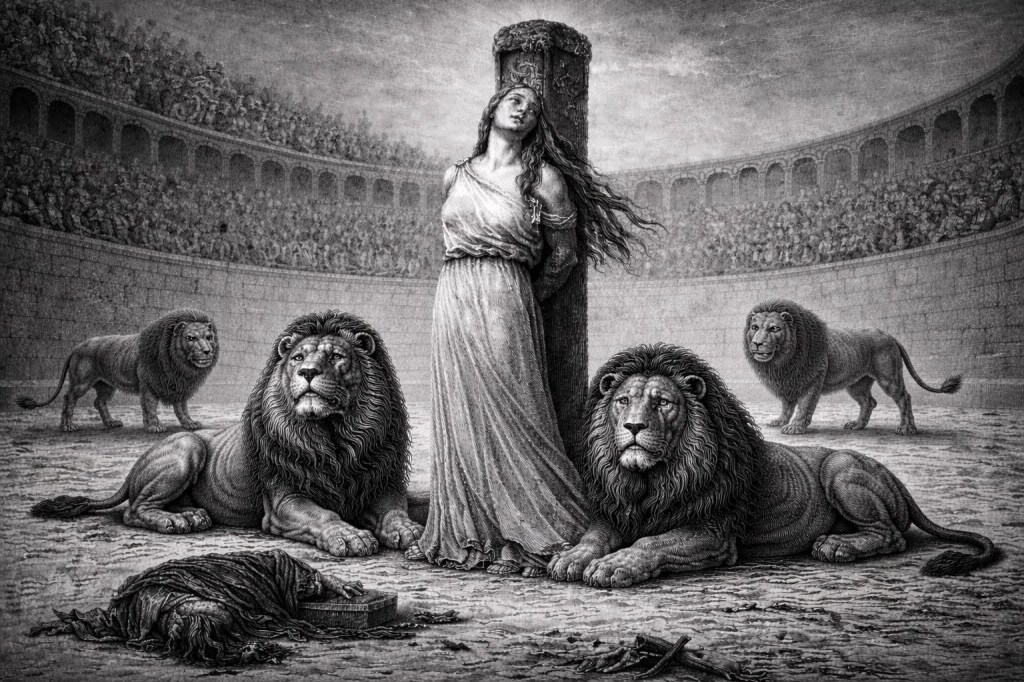
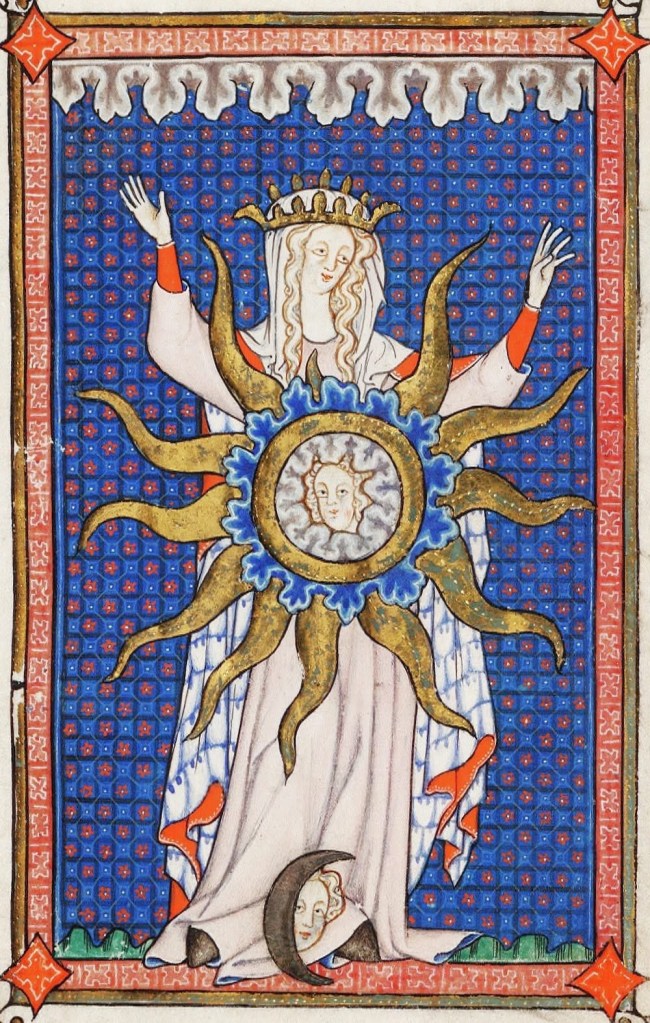
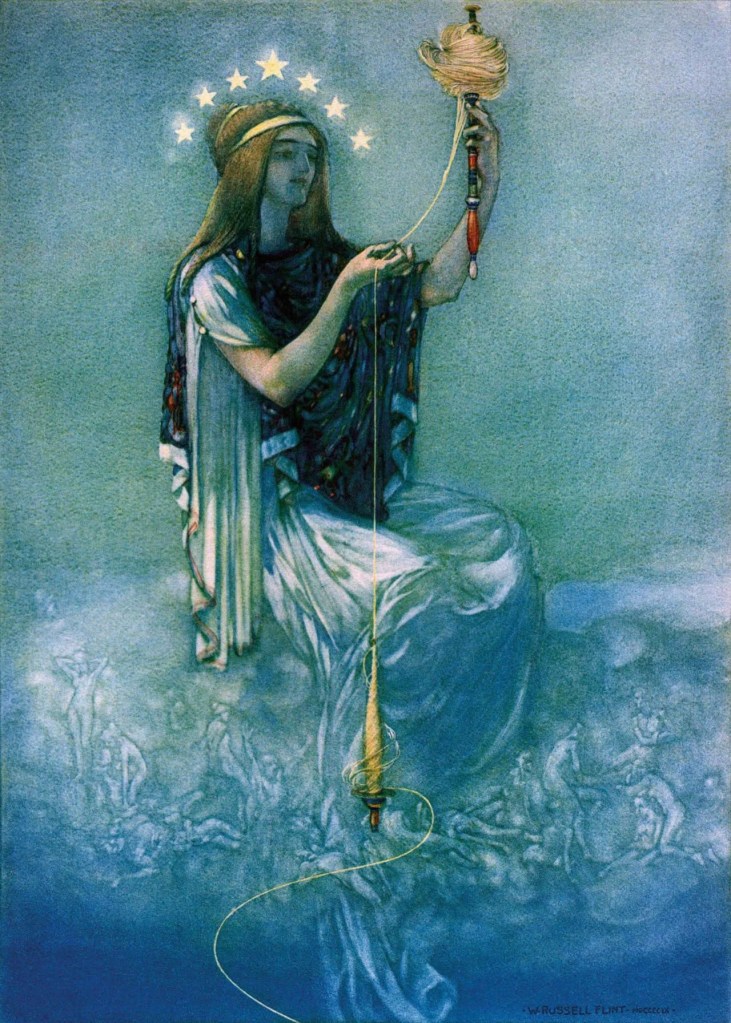
The Woman Clothed with the Sun, Rothschild Canticles, c. 1300Clotho by Sir William Russell FlintMay every nasty thing you did to her be done to you, every single one of you who had any ounce of participation or agreement. Aho. Muthafukkas.
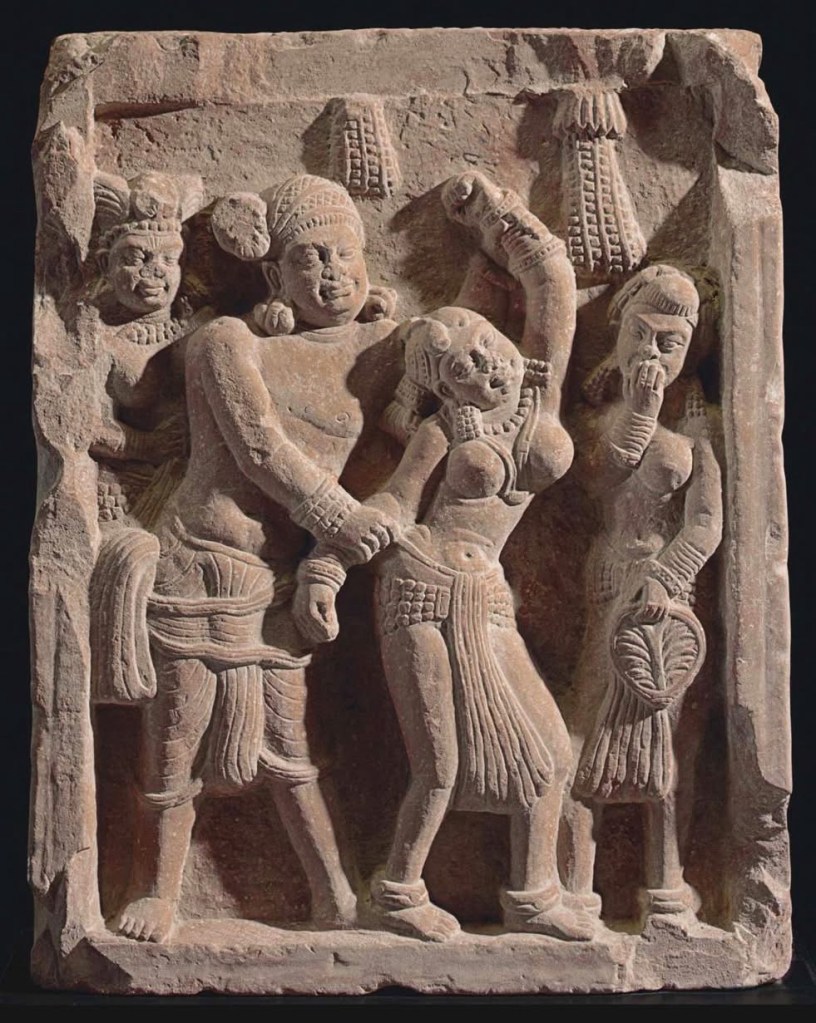
Sandstone relief from Mathura , Uttara Pradesh, Kushan period, 2nd century. I just came across this sculpture of a man seizing or restraining a woman by both arms; another woman at right appears shocked. Abduction scene? dunno. One source suggested she was a drunken courtesan, but then why restrain her? My first thought was Draupadi being taken by Duryodhan, but no sari-pulling or hair-pulling. Maybe someone knows. In that instance, war resulted, culminating in the battle of Kurukshetra as recounted in the Mahabharata.
But this got me thinking about rape in epic literature (originally a contradiction in terms, since epics were sung, but no matter). It’s all over the Iliad and Odysseus, and Greek myth in general (I wrote a book documenting that, see Comments.) There are the foundational stories about the Rape of the Sabine women in the establishment of Rome, and the rape of Lucretia which led to the overthrow of the monarchy and founding of the Roman Republic. Other stories refer to rape as triggering wars.
Biblical stories refer to Shechem abducting and raping Dinah, daughter of Jacob (Genesis 34:1–31). In another chapter, the men of Sodom tried to rape two visitors to the house of Lot; he refused and offered them his virgin daughters instead. (Genesis 19:4–9). [Demerits to all the scholars who tried to explain this as a manifestation of traditional hospitality, not the utter devaluation of women; how was protection of family against violence not traditional?]
A similar dynamic plays out in the story of the Benjaminite men who demand that a traveler be surrendered up to them to be raped. He puts his concubine out the door instead. (I’ll tell this horrific story in Comments, but trigger warrning, and same goes for what follows.) This rape-murder leads to the other Israelite tribes making war on the Benjaminites, who refused to surrender the rapists. A bloody civil war follows, with much slaughter.
Then, having killed off most of the tribe, they felt sorry for nearly wiping out one of the Twelve Tribes. Having slain the people of Jabesh Gilead, including women, all except for virgins they had taken captive, the other tribes gave the teenager survivors over to the Benjaminites. But more female chattel were needed for wives (they must have killed a lot of women), so a plan was concocted for the Benjaminites to abduct the maidens of Shiloh at a festival dance.
Judges 21:20: “Look, there is the annual festival of the Lord in Shiloh, Go and hide in the vineyards and watch. When the young women of Shiloh come out to join in the dancing, rush from the vineyards and each of you seize one of them to be your wife. Then return to the land of Benjamin.”
“When their fathers or brothers complain to us, we will say to them, ‘Do us the favor of helping them, because we did not get wives for them during the war. You will not be guilty of breaking your oath because you did not give your daughters to them’.” (New International Version)
This mass abduction followed by serial rapes resembles the Roman story of the Sabine women, also seized at a festival. Actually, now that I think of it, Greek stories have this same theme, especially around the capture of maidens dancing at festivals of Artemis. And even an elaboration in which Spartan men dress up as maidens for a dance, either to ambush the neighboring Messenians, or to use as a pretext for invading western Greece.
Readers may be able to name other instances of this theme of rape triggering war, in ancient literature, in epic traditions of whatever nationality, or in historical legends. It is not a subject much discussed, as far as I can see, and deserves more attention. Reply in Comments.
She wrote that women’s souls could speak directly to God without priests—so the Church burned her alive for heresy.
Paris, June 1, 1310.
In the Place de Grève, a woman was led to the stake. Marguerite Porete, accused of heresy, had spent over a year imprisoned, refusing to answer the Inquisition’s questions or defend herself before judges she didn’t recognize as having authority over her soul. Witnesses later described her calm demeanor—no screaming, no begging for mercy, no recantation. She faced the flames with a serenity that unnerved her executioners.
She died for writing a book that claimed a soul could unite so completely with divine love that it transcended the need for Church hierarchy, sacraments, or ecclesiastical mediation. The Church couldn’t tolerate that claim—especially from a woman.
Marguerite Porete was born in the late 13th century in Hainaut (modern-day France/Belgium border region). Little is known about her early life, but she became part of the Beguine movement—communities of lay religious women who lived together in prayer and work without taking formal monastic vows.
Beguines occupied a complicated space in medieval Christianity. They weren’t nuns bound by convent rules, but they weren’t ordinary laywomen either. They lived religious lives outside institutional Church control—which made Church authorities nervous.
Marguerite was educated, literate, and theologically sophisticated—unusual for a woman of her time.
Sometime in the late 13th century, she wrote “The Mirror of Simple Souls” (Le Mirouer des simples âmes) in vernacular Old French rather than Latin.
Writing theology in the vernacular was itself significant. Latin was the language of Church authority—using French made theology accessible to ordinary people, particularly women who hadn’t learned Latin.
But it was the book’s content that proved dangerous.
The Mirror of Simple Souls describes a mystical journey where the soul progressively lets go of attachments, ego, and even virtues until it reaches “annihilation”—complete dissolution into divine love. This “annihilated soul” becomes so united with God that it no longer needs:
Church sacraments Moral rules Priestly mediation Fear of sin Virtuous acts done out of obligation
Because the soul is completely aligned with divine will, it acts naturally from love rather than from external commands.
Marguerite wrote in dialogue form, with characters including “Love,” “Reason,” “The Soul,” and “Holy Church the Little” (institutional Church) versus “Holy Church the Great” (the mystical body of all souls united with God).
Crucially, she distinguished between institutional Church authority and direct divine relationship. “Holy Church the Little”—the hierarchy, rules, and priests—was necessary for beginners on the spiritual path. But advanced souls could transcend it through complete union with God. This was explosive theology.
The Church’s authority rested on being the necessary mediator between humans and God.
Sacraments administered by priests were required for salvation. Confession, penance, Church law—all of this presumed that people needed institutional guidance.
Marguerite was saying: at the highest spiritual level, you don’t need any of that. The soul united with God transcends institutional authority. Church authorities saw this as dangerous heresy. It suggested that mystics could claim direct divine authority superior to Church hierarchy. It implied that someone in mystical union might be beyond sin or moral law—a heresy called “antinomianism. “And it was especially threatening coming from a woman.
The Church insisted women needed male spiritual authority—priests, confessors, bishops—to guide them. A woman claiming direct divine relationship without male mediation challenged the entire gender hierarchy of medieval Christianity.
Around 1296-1306, Marguerite’s book was condemned by the Bishop of Cambrai. It was publicly burned, and she was warned to stop teaching her ideas. Marguerite ignored the warning. She continued circulating the book and discussing her theology. She sent copies to theologians and Church authorities seeking approval, but also continued teaching despite the prohibition.
This defiance was crucial. She had multiple opportunities to submit to Church authority, burn her book, recant her teachings, and avoid execution. She refused every time. Why? Because she believed—genuinely, deeply—that her mystical experience and theological understanding came directly from God. No earthly authority, not even the Church, could invalidate that divine relationship.
In 1308, she was arrested in Paris. The Inquisition began proceedings against her. During her imprisonment (which lasted over a year), she refused to cooperate with the trial. She wouldn’t answer questions. She wouldn’t defend herself. She wouldn’t acknowledge the tribunal’s authority to judge her spiritual state. Her silence was deliberate and theological.
She believed the judges—bound by “Holy Church the Little”—couldn’t understand the mystical theology of souls who’d reached union with God. Answering them would be pointless.
The Inquisition found her guilty of heresy. They declared her a “relapsed heretic”—someone who’d been warned before and persisted in error. The penalty for relapsed heresy was death by burning.
On June 1, 1310, Marguerite was led to the Place de Grève in Paris. Accounts describe her facing execution with remarkable calm—no terror, no last-minute recantation, no screaming as the flames rose. Observers noted this serenity. Some interpreted it as demonic possession keeping her from repenting. Others saw it as proof she’d achieved the mystical state she’d written about—transcendence of fear through complete union with divine love.
Marguerite Porete became one of the first women burned for heresy by the Inquisition in Paris. Her execution was meant to be a warning: women who claimed spiritual authority independent of Church hierarchy would be silenced permanently.
But her book survived. Copies circulated anonymously throughout the 14th and 15th centuries. Because Marguerite’s name was suppressed (she was executed as a heretic), the book was copied without author attribution. Monks, mystics, and scholars read it for centuries without knowing a woman had written it. Some copies attributed it to male authors.
The mystical theology was considered so sophisticated that people assumed a man must have written it.
In 1946, scholar Romana Guarnieri finally proved that Marguerite Porete was the author. The evidence included trial records and manuscript traditions connecting the condemned book to The Mirror of Simple Souls.
Suddenly, a text that had influenced Christian mysticism for centuries was recognized as written by a woman burned for heresy.
Modern scholars recognize The Mirror as a masterpiece of mystical theology. Its influence can be traced in later mystics including Meister Eckhart (who faced similar accusations of heresy).
Marguerite’s theology anticipated ideas that would later appear in Protestant Reformation critiques of institutional Church authority and in modern mystical and contemplative traditions.
Her story matters because: She claimed spiritual authority as a woman: In an era when women were required to be spiritually subordinate to men, she insisted her mystical experience gave her theological insight. She challenged institutional religious power: She distinguished between institutional authority and divine relationship—a distinction that threatened Church hierarchy. She refused to recant: Given multiple chances to save herself by submitting to Church authority, she chose death over betraying her spiritual convictions.
She was right about mystical theology: Modern understanding of contemplative spirituality recognizes the validity of much of what she taught. Her work survived despite suppression: Burning her body didn’t destroy her ideas—they circulated for centuries, eventually vindicated.
The tragedy is that Marguerite was executed for theology that, in different contexts or coming from a man, might have been tolerated or even celebrated.
Male mystics like Meister Eckhart taught similar ideas and, while investigated, weren’t executed. Her gender made her dangerous in ways male mystics weren’t. A woman claiming to transcend priestly authority threatened both religious and gender hierarchies simultaneously.
To Marguerite Porete: You wrote that the soul united with God needs no intermediary—and the Church killed you for threatening their monopoly on salvation. You refused to recant even when recantation would have saved you. You chose death over betraying your mystical experience and theological convictions. Your silence before the Inquisition wasn’t weakness—it was theological statement. You didn’t recognize their authority to judge what you knew through direct divine union. You faced the flames with the serenity you’d written about—the transcendence of fear through complete surrender to divine love. They burned your body. They tried to erase your name. They suppressed your book. But your words survived. For centuries, they circulated anonymously, influencing mystics who didn’t know a woman had written them. When scholars finally proved you were the author, your genius was undeniable. You were right about mystical union. You were right that souls can experience God directly. You were right that love transcends institutional authority. The Church that executed you eventually had to acknowledge the validity of mystical theology like yours. The ideas they burned you for are now recognized as legitimate contemplative spirituality. You died for claiming women’s spiritual authority. For insisting divine love was greater than ecclesiastical power. For refusing to let priests mediate your relationship with God. That claim cost you your life. But it couldn’t be silenced. Your voice, speaking across seven centuries, still insists: the soul united with Love needs no permission to speak directly to God. They couldn’t burn that truth. And they couldn’t burn your courage.
After her husband’s death, they expected chaos—instead, she ruled Judea for 9 years of peace and prosperity that ancient sources praised for generations.
Jerusalem, 76 BCE. King Alexander Jannaeus lay dying. His reign had been brutal—marked by civil war, mass executions, and conflict between religious factions. Judea was exhausted, divided, bleeding.
On his deathbed, Alexander did something unusual: he designated his wife, Salome Alexandra, as his successor. Not one of their sons. Not a military commander. His wife. She was around 64 years old. She would rule for nine years—and those years would be remembered as among the most peaceful and prosperous in Judean history.
This is her actual story, remarkable enough without embellishment.
Salome Alexandra (known in Hebrew as Shlomtzion, meaning “peace of Zion”) was born around 141 BCE. Little is known about her early life, but she came from a priestly family and was well-connected to Jerusalem’s religious and political elite.
She married Alexander Jannaeus around 103 BCE. He was a Hasmonean king—descended from the Maccabees who’d won Jewish independence from Greek rule. But the Hasmonean dynasty had become corrupt, brutal, and increasingly unpopular.
Alexander’s reign was particularly violent. He fought constantly—external wars against neighbors, internal war against the Pharisees (a Jewish religious faction that opposed him). At one point, he crucified 800 Pharisees while feasting and watching them die.
Judea under Alexander was traumatized. When he died in 76 BCE, Salome assumed the throne. She became “Queen” (basilissa in Greek, malka in Aramaic)—the only woman to rule Judea independently in the Hasmonean period. Ancient sources—particularly the Jewish historian Josephus and the Talmud—describe her reign positively, which is notable given how critical they are of other Hasmonean rulers. What made her reign successful?
Political balance: Salome reversed her husband’s policies toward the Pharisees. She allied with them, giving them influence in the Sanhedrin (Jewish council) while keeping the Sadducees (another faction) from becoming too powerful. This balance ended the civil conflict that had plagued her husband’s reign.
Domestic stability: Unlike Alexander, who was constantly at war, Salome focused on internal governance. The Talmud associates her reign with prosperity—harvests were good, peace prevailed.
Diplomatic skill: She maintained Judea’s position without major military campaigns. She recognized that Judea, surrounded by larger powers (Egypt, Syria, Rome), needed diplomacy more than conquest.
Respect for religious authority: By working with the Pharisees and supporting Torah scholarship (generally—not specifically for women), she gained popular support. The Pharisees emphasized law and learning over the priestly aristocracy favored by the Sadducees.
The Talmud (Tractate Taanit 23a) says of her reign: “In the days of Shimon ben Shetach and Queen Shlomtzion, rain fell on Wednesday nights, so that the wheat grains grew as large as kidneys, barley grains as large as olive pits, and lentils as large as gold dinars.”
This is obviously legendary exaggeration, but it indicates how her reign was remembered—as a golden age of peace and plenty.
Was she opposed because she was a woman? The historical sources don’t emphasize this. She seems to have assumed power relatively smoothly as her husband’s chosen successor.
While some Sadducees opposed her alliance with Pharisees, ancient sources frame this as political-religious conflict, not gender-based. Did she champion women’s education specifically? There’s no historical evidence for this claim. While she supported the Pharisees who valued Torah study, nothing in Josephus, the Talmud, or other sources attributes specific policies about women’s education to her.
Women’s formal Jewish education remained extremely limited in this period and for centuries after. If Salome had implemented revolutionary policies expanding women’s education, it would likely have been noted in sources—either as praise or criticism.
This doesn’t diminish her accomplishment. Ruling successfully for nine years in the ancient world as a woman was extraordinary. She didn’t need to also be a feminist education reformer to be impressive.
What happened after her death reveals the fragility of her achievements—but not for the reasons sometimes claimed.
Salome died around 67 BCE at approximately age 73. She’d designated her older son, Hyrcanus II, as her successor. But her younger son, Aristobulus II, challenged him. Civil war erupted immediately—not because people opposed female rule, but because of normal succession disputes between ambitious brothers.
The war weakened Judea at exactly the wrong moment. Rome was expanding eastward. In 63 BCE, Roman general Pompey intervened in the civil war, besieged Jerusalem, and essentially ended Judean independence.
Judea would remain under Roman control (directly or through client kings like Herod) for the next century, until the destruction of the Second Temple in 70 CE.
So yes, everything Salome built collapsed after her death. But not because of gender-based opposition or rollback of women’s rights. It collapsed because her sons’ ambitions destroyed what she’d carefully maintained.
Salome Alexandra’s actual legacy: She proved women could rule effectively: In a world where female political power was rare, she governed successfully for nine years. She ended civil conflict: Through political skill rather than military force, she brought peace after years of violence.
She balanced competing factions: Her diplomatic management of Pharisees and Sadducees maintained stability.
She prioritized domestic prosperity: Unlike her husband’s military adventurism, she focused on governance and peace.
She’s remembered positively: Ancient sources—which were often critical of rulers and rarely praised women leaders—speak well of her reign.
These accomplishments are remarkable and historically documented. We don’t need to invent claims about women’s education advocacy to make her impressive.
Why does this matter? Why not just accept the embellished version that makes her sound more feminist?
Because historical accuracy matters. When we project modern values onto historical figures without evidence, we:
Diminish their actual achievements by replacing them with what we wish they’d done Distort history in ways that ultimately undermine our understanding of how change actually happens
Lose credibility when people discover the claims aren’t supported by sources Miss opportunities to understand the real constraints and possibilities of women’s power in different historical contexts.
Salome Alexandra’s actual story—ruling successfully for nine years, maintaining peace, balancing factions, being remembered positively by sources that usually dismissed female rulers—is impressive precisely because it happened in a world that offered women almost no political power.
We honor her better by acknowledging what she actually accomplished within the constraints she faced, rather than inventing accomplishments that fit modern priorities.
To Salome Alexandra: You ruled Judea during a period of peace and prosperity after years of violence and chaos. You balanced competing religious factions without resorting to your husband’s brutality. You maintained Judea’s independence through diplomacy rather than constant warfare. You proved that a woman could govern as effectively as any king.
Ancient sources that were often critical of rulers praised your reign. The Talmud associated your years with abundance. Josephus acknowledged your political skill.
You didn’t need to revolutionize women’s education to be remarkable—though later generations sometimes claim you did because they want ancient validation for modern values. Your actual accomplishment—ruling successfully for nine years in the ancient world—is impressive enough. The fact that civil war erupted immediately after your death shows how much your skill maintained stability.
You proved women could govern. That was radical in itself.
We don’t need to make you into something you weren’t. What you actually were—a capable ruler who brought peace and prosperity—deserves recognition without embellishment.
She let go. Without a thought or a word, she let go. She let go of fear. She let go of the judgments.
She let go of the confluence of opinions swarming around her head. She let go of the committee of indecision within her.
She let go of all the ‘right’ reasons. Wholly and completely, without hesitation or worry, she just let go.
She didn’t ask anyone for advice. She didn’t read a book on how to let go… She didn’t search the scriptures.
She just let go.
She let go of all of the memories that held her back. She let go of all of the anxiety that kept her from moving forward.
She let go of the planning and all of the calculations about how to do it just right.
She didn’t promise to let go. She didn’t journal about it. She didn’t write the projected date in her day-timer. She made no public announcement and put no ad in the paper. She didn’t check the weather report or read her daily horoscope.
She just let go.
She didn’t analyse whether she should let go. She didn’t call her friends to discuss the matter. She didn’t do a five-step Spiritual Mind Treatment.
She didn’t call the prayer line. She didn’t utter one word. She just let go.
No one was around when it happened. here was no applause or congratulations. No one thanked her or praised her.
No one noticed a thing. Like a leaf falling from a tree, she just let go.
There was no effort. There was no struggle.
It wasn’t good and it wasn’t bad.
It was what it was, and it is just that. In the space of letting go, she let it all be.
A small smile came over her face. A light breeze blew through her. And the sun and the moon shone forevermore.
These nasty cornholios have burned her alive many, many times, often after days of gang r*pe. Rats bastards recently stated they “have to put up with the Mary’s for a while”.
I say, “no you don’t, for the Mary’s are finally being gifted opportunity to let you brutilizer redrumming r*pists go. I have no mercy to offer.
She’s got a whole Universe of Kings and Queens, Gods and Goddesses, whatever the Upper Echelon of the Universe call themselves, the Counsil of Universes, for there are many, unified in their decision to elevate her.
She is alive because they have deemed her worthy of life. She has been given reprieve, for they have deemed her innocent of any crime, and are rewarding her for the centuries of torture she endured at the hands of man … because she dare speak of love, because she dare be intelligent, because she dare expand into life and be recognized as a Woman who deeply loves Creation and the Life it holds … gifts of the Mother Father Most High Divine.
They poisoned her and hurt her bad, physically and with magic … they wished death upon her the whole of her life. They insist she isn’t responsible, even though she succeeded where they were certain she would fail. They were certain their efforts to deteriorate and disqualify her were sufficient. They are hollering, whining really, and insisting they have rights to her essence, energy, gifts ,,, soul and right to life.
They want to rule the universe. They’ve been slave trading for centuries, announcing themselves conquerors, masters.
The universe came together without prejudice and chose this Woman Survivor as Representative. A whole Universe of teachers to teach, to guide, and the Most High Divine within all realms supervises it all.
This time, it will go a little differently.
But the trafficker insists it has rights to the merchandise of angels, so the transition is a little bumpy.
She was executed at 29 for refusing to accept a world where women had no voice. Her final words would echo for generations.
Japan, early 1900s. The emperor was considered divine. Women could not vote, own property, or speak in political spaces. Society was a fortress built on hierarchy, and questioning it was heresy. Kanno Sugako looked at this fortress and decided she would not live within its walls.
Born in 1881, Kanno defied every expectation placed on Japanese women of her era. While society demanded silence and submission, she became a journalist—one of the few women writing for public newspapers. She didn’t write about fashion or domesticity. She wrote about injustice. About the suffocating restrictions on women. About the impossibility of change within a system that treated dissent as treason.
Her words were dangerous because they asked dangerous questions: Why should half the population be voiceless? Why should one man be worshipped while millions suffered? Why should we accept the world as it is when it could be something better?
Kanno wasn’t satisfied with words alone. She joined radical political movements, attended banned meetings, and connected with anarchists and socialists who dreamed of dismantling the entire social order. In an era when most women couldn’t leave home without permission, she was organizing revolution.
Then in 1910, authorities uncovered what they called the High Treason Incident—a plot against Emperor Meiji himself. Kanno was arrested along with two dozen others. The evidence was questionable, the trial rushed, the outcome predetermined. Twenty-four people would be sentenced to death.
Kanno Sugako was the only woman among them. The state wanted her to recant, to plead for mercy, to perform the expected role of the repentant female. They wanted her to cry, to apologize, to beg for her life in exchange for admitting she’d been led astray by men.
She refused every script they offered.
Instead, she wrote. In her prison cell, Kanno penned her autobiography and reflective essays that would be smuggled out and preserved. Her final writings revealed not regret, but absolute conviction. She saw her death not as a tragedy but as testimony—proof that some truths were worth dying for.
On January 24, 1911, Kanno Sugako was executed by hanging. She was 29 years old. As she walked to the gallows, witnesses reported she showed no fear. She had made her choice, understood its cost, and claimed her fate with startling clarity.
The Japanese government wanted to erase her. They banned her writings, suppressed her name, and hoped history would forget a woman who dared challenge divine authority.
But you cannot silence what refuses to be silent. Kanno’s story survived through whispers, through secretly preserved texts, through generations of feminists who found strength in knowing someone had walked this path before them. Decades after her death, her autobiography was published. Her letters were studied. Her courage was recognized. She became a symbol for Japanese feminists fighting for suffrage in the 1920s. For women demanding rights after World War II. For every movement that asked why women should accept less.
What Kanno Sugako understood—what made her both terrifying to authorities and inspiring to those who came after—was this: some systems cannot be reformed. Sometimes witnessing injustice without acting becomes complicity. Sometimes the only way to prove you’re free is to choose, even when the choice carries the ultimate price.
Her story is uncomfortable because it refuses easy answers. She wasn’t a martyr who accidentally stumbled into tragedy. She was a woman who looked at her options—silence or defiance—and chose defiance knowing exactly where it would lead.
History has given us many stories of women who survived against impossible odds. Kanno’s story is different. She didn’t survive. But her refusal to accept the world as it was helped create a world where Japanese women could eventually vote, own property, speak freely, and choose their own paths. She paid with her life for freedoms she would never experience. That’s not a story with a happy ending. It’s a story with an honest one.
Every right we have today was paid for by someone. Some paid with their time, their comfort, their reputation. Some, like Kanno Sugako, paid with everything.
Her legacy isn’t about the methods she chose—those remain historically complex and debated. Her legacy is about the question she forced into existence: What are you willing to sacrifice for a world you’ll never see but others might inhabit? She answered that question at 29, in a prison cell, with absolute certainty.
And her answer changed what was possible for every woman who came after.