I woke this morning hearing, “They bit off more than they could chew.” I opened social media to see this. Took a snap shot. When I clicked it to see the comments, it said the post had been deleted.
These entities operate on human sacrifice. These “men” defile and enslave the Divine mother through the Planetary Daughters at the start of their beautiful lives, binding them, using their own essence to harm them and others in the world.
Primera noche de Purim, y hay luna de sangre. Durante el fin de semana, Israel asesinó a más de 150 niñas en Irán, el mismo pueblo persa. ¿Es todo aleatorio o está relacionado? Creo que es indicativo.
🚨 PETER THIEL JUST DUMPED 2 MILLION PALANTIR SHARES.
Read that again.
The man who BUILT the surveillance backbone of the US military. The man whose software runs inside the CIA, the NSA, the Pentagon. The man who knows EXACTLY what's happening in every war room in America.
It is odd how obsessive these masculines are with the innocence and purity of the world. They aren’t obsessed because of love they feel for the living, they are obsessed because their “system” requires, and is fed by, human sacrifice. They are astral stalking people to find the greatest light and power sources.
God said this is the end of their relationship with batteries. I hope they stop with their stalking of us soon. It is disheartening, listening to them 24/7 talking about unaliving folks, trapping them with proper words of love, and marriage contracts, or promises of such which never manifest, but instead, folks wind up ded.
——————————
These entities keep talking about “compensation”, as if the Soul of a Human Being has a price upon it. They cannot compensate for the lost ones, those who were consumed. They cannot compensate for the many centuries of suffering, of working to push that love up the mountain only to have them knock us down again, and take credit for getting that pretty bundle of love up to the top, stealing our rewards, our honor. They cannot compensate for the “intention” they had and have, of burning us alive, of exterminating us. They cannot compensate for their bad behaviors and willful terrorism upon the children.
They need to leave. Just go away. Let the original, organic people have their Sacred Space so they can heal from the damage that has been done. The traffickers need to get out of the House, that curator and his friends. This is not a “human” candy store full of delicacies for consumption.
God said this is the end of their relationship with batteries. They won’t be consuming the life force of humanity any longer. They are “concentrating” and pushing thoughts that are not your own, then coming to “offer opportunity” knowing full well they do not have anything to offer. They just need someone who “does” have something to offer, to do a thing, to become trapped, by agreeing to do a thing.
——————————
I heard the adversary complaining about the War Lord.
AI Overview Yehoshua (Joshua) bin Nun was the biblical leader who succeeded Moses, commanding the Israelites in a seven-year military campaign to conquer Canaan (c. 1355–1245 BCE). As a warrior-prophet, he led the conquest of 31 kings, including the destruction of Jericho, and divided the land among the twelve tribes.
Key Aspects of Yehoshua as a Warrior Leader:Military Leadership: He led the Israelites in a series of strategic battles across central, southern, and northern Canaan. Divine Support: Battles, such as at Jericho and against the Amorites, are depicted as being won through divine intervention, including the sun standing still. Conquest and Division: Following the military campaigns, he overseen the division of the land among the Twelve Tribes. Legacy: Known for unwavering obedience to God, he served as a bridge between the wandering in the desert and the settlement in the Promised Land.
——————————
I was in a dream and heard a masculine unseen, who was prepping his bride for sacrifice say, “Sometimes all a man has to offer is his wife.” Then he stuck a knife in her. He is no man.
Anyone who offers the life of his wife and children before offering his own, is no man. He ought to be removed from the position of guardian, and foundational keeper.
——————————
Everything coming out of the fake masculine is a lie. The children deserve a world where the fathers (or the he/she mothers) won’t be r*ping them, eating them, draining them of their corpuscles and life-force. The children deserve a world where they won’t have their minds manipulated and their little bodies torn apart by brutalizing liars and thieves wanting to ravage their Soul, all while speaking “proper words”, all while presenting themselves as a “mother and father”, made in the image of Mother Father God Most High.
These mutations have defiled the image of God. They have used the “made in the image of”, that powerful body, to “man handle” and torture the Mother and Child … and unfortunately, the Men who would not conform to their attempt to gender switch them.
This curator insists “she need the medicine.” He is a liar. He has been creating false stories of people for centuries, then convicting them of the lie, and using the lie as excuse to harvest the Earth Angelic “merchandise”.
Anyone asking this turd what the truth is, is just an idiot. What that cow once knew, he only knew because he had trapped and r*ped the mind of an actual Source Connected Angel. He’s a nothing, a no-body, who has the whole world of life-pirates, lining up to “do business”.
May the creator “arrest” his soul, if he has one, and learn him some lessons. A’ho. Amen. Wado.
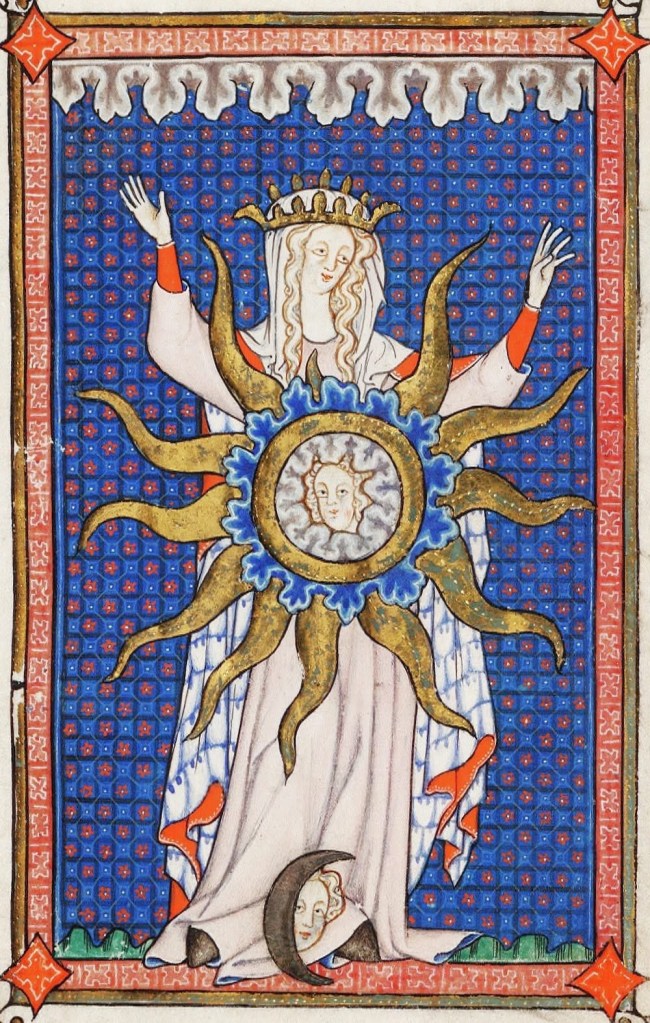
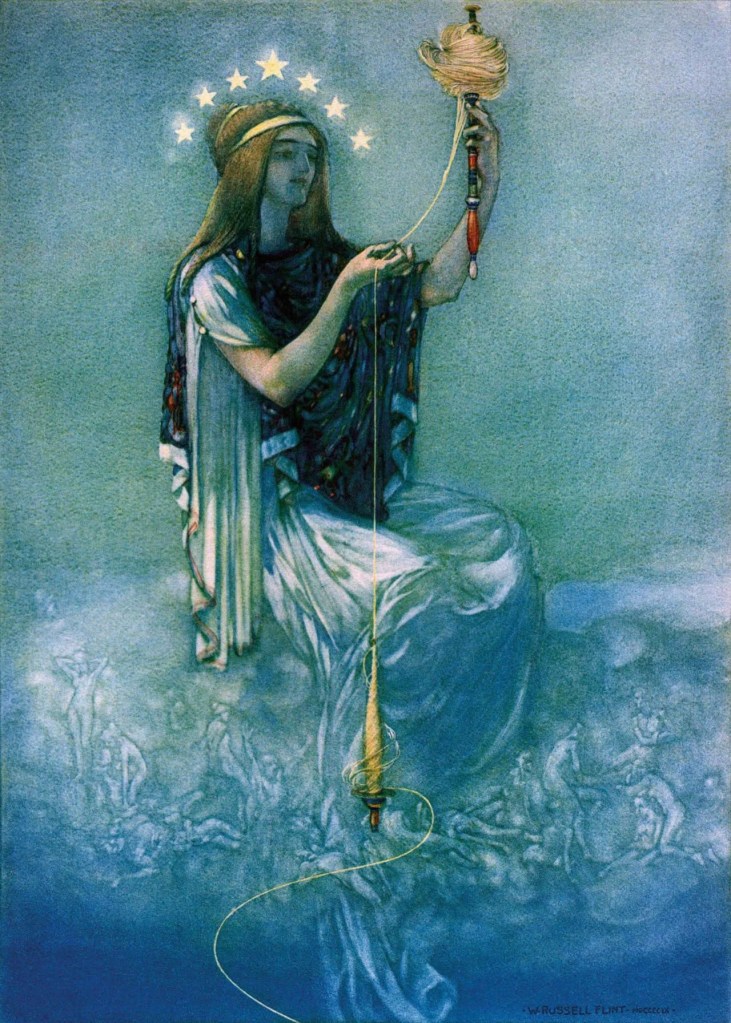
The Woman Clothed with the Sun, Rothschild Canticles, c. 1300Clotho by Sir William Russell FlintMay every nasty thing you did to her be done to you, every single one of you who had any ounce of participation or agreement. Aho. Muthafukkas.
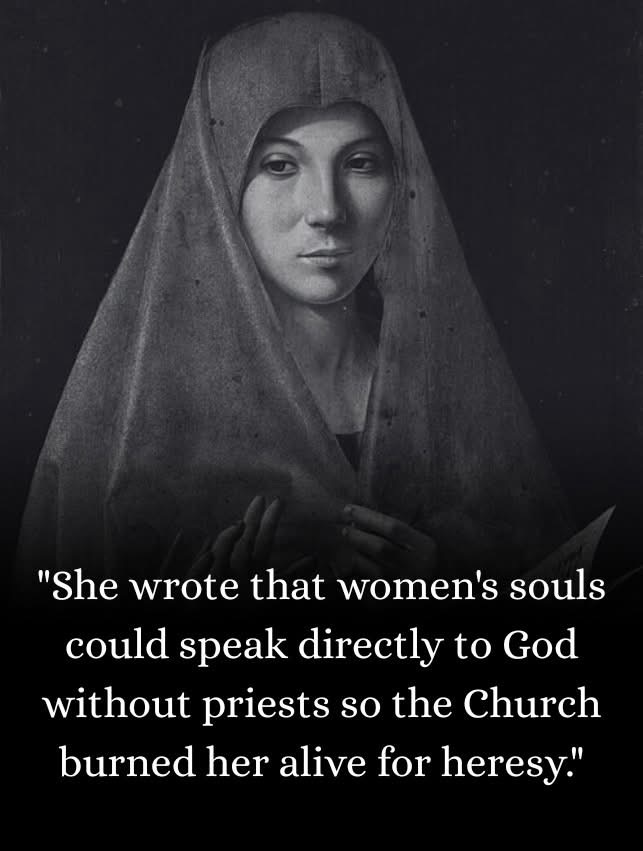
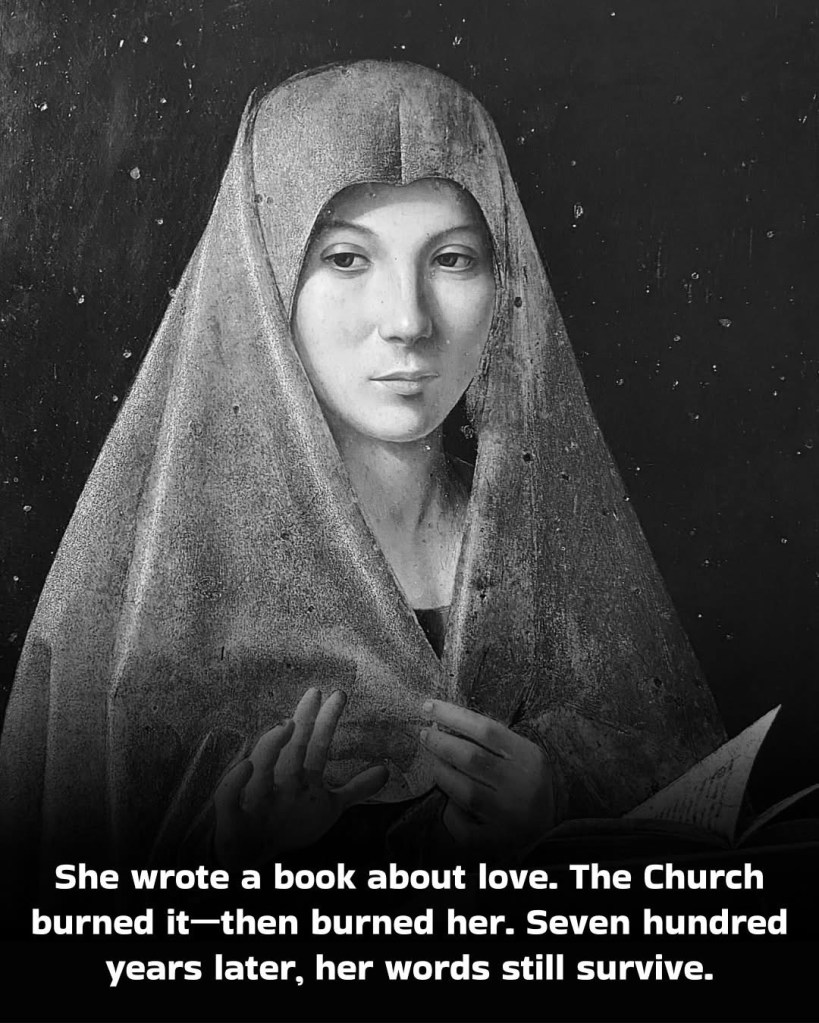
She wrote that women’s souls could speak directly to God without priests—so the Church burned her alive for heresy.
Paris, June 1, 1310.
In the Place de Grève, a woman was led to the stake. Marguerite Porete, accused of heresy, had spent over a year imprisoned, refusing to answer the Inquisition’s questions or defend herself before judges she didn’t recognize as having authority over her soul. Witnesses later described her calm demeanor—no screaming, no begging for mercy, no recantation. She faced the flames with a serenity that unnerved her executioners.
She died for writing a book that claimed a soul could unite so completely with divine love that it transcended the need for Church hierarchy, sacraments, or ecclesiastical mediation. The Church couldn’t tolerate that claim—especially from a woman.
Marguerite Porete was born in the late 13th century in Hainaut (modern-day France/Belgium border region). Little is known about her early life, but she became part of the Beguine movement—communities of lay religious women who lived together in prayer and work without taking formal monastic vows.
Beguines occupied a complicated space in medieval Christianity. They weren’t nuns bound by convent rules, but they weren’t ordinary laywomen either. They lived religious lives outside institutional Church control—which made Church authorities nervous.
Marguerite was educated, literate, and theologically sophisticated—unusual for a woman of her time.
Sometime in the late 13th century, she wrote “The Mirror of Simple Souls” (Le Mirouer des simples âmes) in vernacular Old French rather than Latin.
Writing theology in the vernacular was itself significant. Latin was the language of Church authority—using French made theology accessible to ordinary people, particularly women who hadn’t learned Latin.
But it was the book’s content that proved dangerous.
The Mirror of Simple Souls describes a mystical journey where the soul progressively lets go of attachments, ego, and even virtues until it reaches “annihilation”—complete dissolution into divine love. This “annihilated soul” becomes so united with God that it no longer needs:
Church sacraments Moral rules Priestly mediation Fear of sin Virtuous acts done out of obligation
Because the soul is completely aligned with divine will, it acts naturally from love rather than from external commands.
Marguerite wrote in dialogue form, with characters including “Love,” “Reason,” “The Soul,” and “Holy Church the Little” (institutional Church) versus “Holy Church the Great” (the mystical body of all souls united with God).
Crucially, she distinguished between institutional Church authority and direct divine relationship. “Holy Church the Little”—the hierarchy, rules, and priests—was necessary for beginners on the spiritual path. But advanced souls could transcend it through complete union with God. This was explosive theology.
The Church’s authority rested on being the necessary mediator between humans and God.
Sacraments administered by priests were required for salvation. Confession, penance, Church law—all of this presumed that people needed institutional guidance.
Marguerite was saying: at the highest spiritual level, you don’t need any of that. The soul united with God transcends institutional authority. Church authorities saw this as dangerous heresy. It suggested that mystics could claim direct divine authority superior to Church hierarchy. It implied that someone in mystical union might be beyond sin or moral law—a heresy called “antinomianism. “And it was especially threatening coming from a woman.
The Church insisted women needed male spiritual authority—priests, confessors, bishops—to guide them. A woman claiming direct divine relationship without male mediation challenged the entire gender hierarchy of medieval Christianity.
Around 1296-1306, Marguerite’s book was condemned by the Bishop of Cambrai. It was publicly burned, and she was warned to stop teaching her ideas. Marguerite ignored the warning. She continued circulating the book and discussing her theology. She sent copies to theologians and Church authorities seeking approval, but also continued teaching despite the prohibition.
This defiance was crucial. She had multiple opportunities to submit to Church authority, burn her book, recant her teachings, and avoid execution. She refused every time. Why? Because she believed—genuinely, deeply—that her mystical experience and theological understanding came directly from God. No earthly authority, not even the Church, could invalidate that divine relationship.
In 1308, she was arrested in Paris. The Inquisition began proceedings against her. During her imprisonment (which lasted over a year), she refused to cooperate with the trial. She wouldn’t answer questions. She wouldn’t defend herself. She wouldn’t acknowledge the tribunal’s authority to judge her spiritual state. Her silence was deliberate and theological.
She believed the judges—bound by “Holy Church the Little”—couldn’t understand the mystical theology of souls who’d reached union with God. Answering them would be pointless.
The Inquisition found her guilty of heresy. They declared her a “relapsed heretic”—someone who’d been warned before and persisted in error. The penalty for relapsed heresy was death by burning.
On June 1, 1310, Marguerite was led to the Place de Grève in Paris. Accounts describe her facing execution with remarkable calm—no terror, no last-minute recantation, no screaming as the flames rose. Observers noted this serenity. Some interpreted it as demonic possession keeping her from repenting. Others saw it as proof she’d achieved the mystical state she’d written about—transcendence of fear through complete union with divine love.
Marguerite Porete became one of the first women burned for heresy by the Inquisition in Paris. Her execution was meant to be a warning: women who claimed spiritual authority independent of Church hierarchy would be silenced permanently.
But her book survived. Copies circulated anonymously throughout the 14th and 15th centuries. Because Marguerite’s name was suppressed (she was executed as a heretic), the book was copied without author attribution. Monks, mystics, and scholars read it for centuries without knowing a woman had written it. Some copies attributed it to male authors.
The mystical theology was considered so sophisticated that people assumed a man must have written it.
In 1946, scholar Romana Guarnieri finally proved that Marguerite Porete was the author. The evidence included trial records and manuscript traditions connecting the condemned book to The Mirror of Simple Souls.
Suddenly, a text that had influenced Christian mysticism for centuries was recognized as written by a woman burned for heresy.
Modern scholars recognize The Mirror as a masterpiece of mystical theology. Its influence can be traced in later mystics including Meister Eckhart (who faced similar accusations of heresy).
Marguerite’s theology anticipated ideas that would later appear in Protestant Reformation critiques of institutional Church authority and in modern mystical and contemplative traditions.
Her story matters because: She claimed spiritual authority as a woman: In an era when women were required to be spiritually subordinate to men, she insisted her mystical experience gave her theological insight. She challenged institutional religious power: She distinguished between institutional authority and divine relationship—a distinction that threatened Church hierarchy. She refused to recant: Given multiple chances to save herself by submitting to Church authority, she chose death over betraying her spiritual convictions.
She was right about mystical theology: Modern understanding of contemplative spirituality recognizes the validity of much of what she taught. Her work survived despite suppression: Burning her body didn’t destroy her ideas—they circulated for centuries, eventually vindicated.
The tragedy is that Marguerite was executed for theology that, in different contexts or coming from a man, might have been tolerated or even celebrated.
Male mystics like Meister Eckhart taught similar ideas and, while investigated, weren’t executed. Her gender made her dangerous in ways male mystics weren’t. A woman claiming to transcend priestly authority threatened both religious and gender hierarchies simultaneously.
To Marguerite Porete: You wrote that the soul united with God needs no intermediary—and the Church killed you for threatening their monopoly on salvation. You refused to recant even when recantation would have saved you. You chose death over betraying your mystical experience and theological convictions. Your silence before the Inquisition wasn’t weakness—it was theological statement. You didn’t recognize their authority to judge what you knew through direct divine union. You faced the flames with the serenity you’d written about—the transcendence of fear through complete surrender to divine love. They burned your body. They tried to erase your name. They suppressed your book. But your words survived. For centuries, they circulated anonymously, influencing mystics who didn’t know a woman had written them. When scholars finally proved you were the author, your genius was undeniable. You were right about mystical union. You were right that souls can experience God directly. You were right that love transcends institutional authority. The Church that executed you eventually had to acknowledge the validity of mystical theology like yours. The ideas they burned you for are now recognized as legitimate contemplative spirituality. You died for claiming women’s spiritual authority. For insisting divine love was greater than ecclesiastical power. For refusing to let priests mediate your relationship with God. That claim cost you your life. But it couldn’t be silenced. Your voice, speaking across seven centuries, still insists: the soul united with Love needs no permission to speak directly to God. They couldn’t burn that truth. And they couldn’t burn your courage.
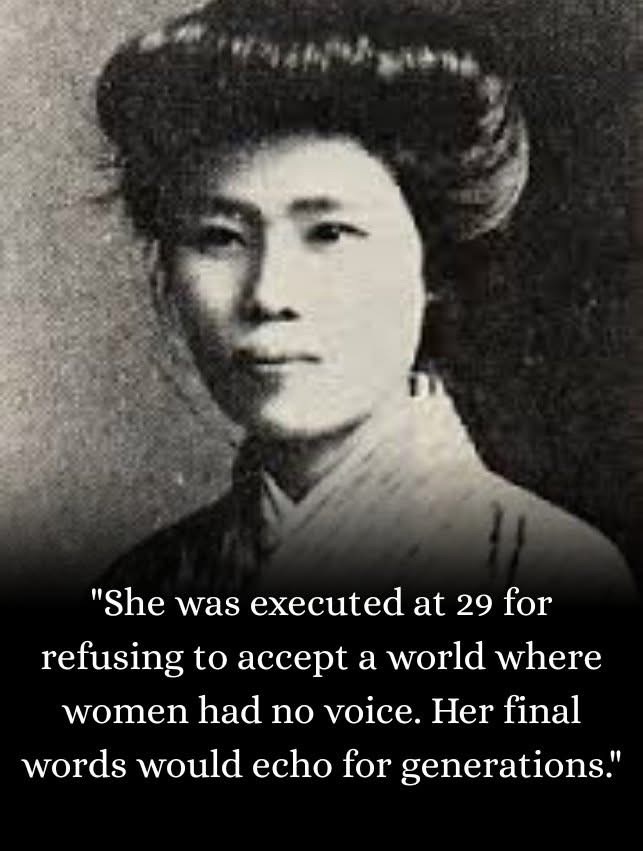
She was executed at 29 for refusing to accept a world where women had no voice. Her final words would echo for generations.
Japan, early 1900s. The emperor was considered divine. Women could not vote, own property, or speak in political spaces. Society was a fortress built on hierarchy, and questioning it was heresy. Kanno Sugako looked at this fortress and decided she would not live within its walls.
Born in 1881, Kanno defied every expectation placed on Japanese women of her era. While society demanded silence and submission, she became a journalist—one of the few women writing for public newspapers. She didn’t write about fashion or domesticity. She wrote about injustice. About the suffocating restrictions on women. About the impossibility of change within a system that treated dissent as treason.
Her words were dangerous because they asked dangerous questions: Why should half the population be voiceless? Why should one man be worshipped while millions suffered? Why should we accept the world as it is when it could be something better?
Kanno wasn’t satisfied with words alone. She joined radical political movements, attended banned meetings, and connected with anarchists and socialists who dreamed of dismantling the entire social order. In an era when most women couldn’t leave home without permission, she was organizing revolution.
Then in 1910, authorities uncovered what they called the High Treason Incident—a plot against Emperor Meiji himself. Kanno was arrested along with two dozen others. The evidence was questionable, the trial rushed, the outcome predetermined. Twenty-four people would be sentenced to death.
Kanno Sugako was the only woman among them. The state wanted her to recant, to plead for mercy, to perform the expected role of the repentant female. They wanted her to cry, to apologize, to beg for her life in exchange for admitting she’d been led astray by men.
She refused every script they offered.
Instead, she wrote. In her prison cell, Kanno penned her autobiography and reflective essays that would be smuggled out and preserved. Her final writings revealed not regret, but absolute conviction. She saw her death not as a tragedy but as testimony—proof that some truths were worth dying for.
On January 24, 1911, Kanno Sugako was executed by hanging. She was 29 years old. As she walked to the gallows, witnesses reported she showed no fear. She had made her choice, understood its cost, and claimed her fate with startling clarity.
The Japanese government wanted to erase her. They banned her writings, suppressed her name, and hoped history would forget a woman who dared challenge divine authority.
But you cannot silence what refuses to be silent. Kanno’s story survived through whispers, through secretly preserved texts, through generations of feminists who found strength in knowing someone had walked this path before them. Decades after her death, her autobiography was published. Her letters were studied. Her courage was recognized. She became a symbol for Japanese feminists fighting for suffrage in the 1920s. For women demanding rights after World War II. For every movement that asked why women should accept less.
What Kanno Sugako understood—what made her both terrifying to authorities and inspiring to those who came after—was this: some systems cannot be reformed. Sometimes witnessing injustice without acting becomes complicity. Sometimes the only way to prove you’re free is to choose, even when the choice carries the ultimate price.
Her story is uncomfortable because it refuses easy answers. She wasn’t a martyr who accidentally stumbled into tragedy. She was a woman who looked at her options—silence or defiance—and chose defiance knowing exactly where it would lead.
History has given us many stories of women who survived against impossible odds. Kanno’s story is different. She didn’t survive. But her refusal to accept the world as it was helped create a world where Japanese women could eventually vote, own property, speak freely, and choose their own paths. She paid with her life for freedoms she would never experience. That’s not a story with a happy ending. It’s a story with an honest one.
Every right we have today was paid for by someone. Some paid with their time, their comfort, their reputation. Some, like Kanno Sugako, paid with everything.
Her legacy isn’t about the methods she chose—those remain historically complex and debated. Her legacy is about the question she forced into existence: What are you willing to sacrifice for a world you’ll never see but others might inhabit? She answered that question at 29, in a prison cell, with absolute certainty.
And her answer changed what was possible for every woman who came after.
Ada Morrison was committed to Connecticut asylum in 1893, age thirty, by husband who wanted younger wife. Commitment reason: “excessive reading and intellectual pretensions unsuitable for woman.” Ada had taught school before marriage, read constantly, discussed politics. Husband said this proved mental instability. Two doctors examined her for ten minutes, agreed intelligent woman was clearly insane. Ada was locked in asylum for four years, labeled insane for being educated. She escaped eight times. Caught seven times. Succeeded once. Took four years of attempts—climbing windows, picking locks, bribing guards, hiding in laundry carts. Ada’s intelligence that got her committed was same intelligence that freed her.
This tintype from 1897 shows Ada after final successful escape, age thirty-four, displaying scars from previous attempts—broken arm from second-floor fall, burn marks from climbing hot steam pipes, lash marks from punishment after failed escapes. She holds commitment papers declaring her “mentally deficient with delusions of intellectual capability.” Ada had graduated college. Taught school for six years. Read Latin and Greek. Asylum declared this insanity. Her husband declared it embarrassing. Her intelligence declared it crime. Ada spent four years proving she was sane enough to escape place she was imprisoned for being smart.
Ada reached New York after escape, changed name to Sarah Bennett, worked as clerk hiding education level to avoid suspicion. Never contacted family—they’d supported commitment. Never remarried—couldn’t trust man with legal power over her freedom. Lived quietly for thirty-eight years, died in 1935, age seventy-two, having spent thirty-eight years hiding intelligence that had nearly destroyed her. Ada had been imprisoned for reading. Spent rest of life pretending she barely could. That was survival in world that called educated women insane.
After her death, landlady found Ada’s room filled with books—hundreds of volumes hidden behind false wall. Ada had kept reading despite risk, kept learning despite having been punished for it, kept thinking despite it being dangerous for woman in her era. Also found: diary documenting eight escape attempts with detailed notes about asylum security, guard rotations, lock mechanisms. Ada had been brilliant enough to escape asylum that imprisoned brilliant women.
Her commitment papers are now in women’s history museum: “Ada Morrison was committed for reading too much. Escaped asylum eight times before succeeding. Spent 38 years hiding intelligence that prison couldn’t contain. She was insane for being smart. World was insane for calling that illness.”
In the year 1310, a woman named Marguerite Porete was led to a stake in the heart of Paris, surrounded by a crowd of thousands. She had been condemned as a heretic—the first person the Paris Inquisition would burn for refusing to recant.
Her crime was writing a book.
Marguerite Porete was born around 1250 in the County of Hainaut, in what is now Belgium. She was highly educated, likely from an aristocratic family, and she joined the Beguines—a movement of women who devoted themselves to spiritual life without taking formal vows or submitting to male religious authority.
The Beguines lived by their own rules. They worked among the poor, prayed in their own communities, and sought God on their own terms. This freedom made Church authorities nervous. Women living outside male control, speaking about God without clerical permission, threatened the very foundations of institutional power.
Marguerite took this freedom further than most. Sometime in the 1290s, she wrote a mystical text called The Mirror of Simple Souls. It was a conversation between allegorical figures—Love, Reason, and the Soul—describing seven stages of spiritual transformation. At its heart was a radical idea: that a soul could become so completely united with divine love that it no longer needed the Church’s rituals, rules, or intermediaries. In the highest states of union, the soul surrendered its will entirely to God—and in that surrender, found perfect freedom.
“Love is God,” she wrote, “and God is Love.”
She did not write her book in Latin, the language of clergy and scholars. She wrote in Old French—the language ordinary people spoke. This meant her dangerous ideas could spread beyond monastery walls, beyond the control of priests and bishops.
And spread they did.
Between 1296 and 1306, the Bishop of Cambrai condemned her book as heretical. He ordered it burned publicly in the marketplace of Valenciennes, forcing Marguerite to watch her words turn to ash. He commanded her never to circulate her ideas again.
She refused.
Marguerite believed her book had been inspired by the Holy Spirit. She had consulted three respected theologians before publishing it, including the esteemed Master of Theology Godfrey of Fontaines, and they had approved. She would not let one bishop’s condemnation silence what she believed to be divine truth.
She continued sharing her book. She continued teaching. She continued insisting that the soul’s relationship with God belonged to no earthly institution.
In 1308, she was arrested and handed over to the Inquisitor of France, a Dominican friar named William of Paris—the same man who served as confessor to King Philip IV, the monarch who was simultaneously destroying the Knights Templar. It was a busy time for burning heretics.
Marguerite was imprisoned in Paris for eighteen months. During that entire time, she refused to speak to her inquisitors. She would not take the oath required to proceed with her trial. She would not answer questions. She maintained absolute silence—an act of defiance that infuriated the authorities.
A commission of twenty-one theologians from the University of Paris examined her book. They extracted fifteen propositions they deemed heretical. Among the most dangerous: the idea that an annihilated soul, fully united with God, could give nature what it desires without sin—because such a soul was no longer capable of sin.
To the Church, this suggested moral chaos. To Marguerite, it described the ultimate freedom of perfect surrender.
She was given every chance to recant. Others in similar positions saved their lives by confessing error. A man arrested alongside her, Guiard de Cressonessart, who had declared himself her defender, eventually broke under pressure and confessed. He was sentenced to life imprisonment.
Marguerite held firm.
On May 31, 1310, William of Paris formally declared her a relapsed heretic—meaning she had returned to condemned beliefs after being warned—and turned her over to secular authorities. The next day, June 1, she was led to the Place de Grève, the public square where executions took place.
The Inquisitor denounced her as a “pseudo-mulier”—a fake woman—as if her gender itself had been a lie, as if no real woman could defy the Church so completely.
They burned her alive.
But something unexpected happened in that crowd of thousands. According to the chronicle of Guillaume de Nangis—a monk who had no sympathy for her ideas—the crowd was moved to tears by the calmness with which she faced her death.
She displayed, the chronicle noted, many signs of penitence “both noble and pious.” Her serenity unnerved those who expected a screaming heretic. Instead, they witnessed a woman who seemed to have already transcended the fire that consumed her body.
The Church ordered every copy of The Mirror of Simple Souls destroyed. They wanted her words erased from history along with her life.
They failed.
Her book survived. Copies circulated secretly, passed from hand to hand across Europe. It was translated into Latin, Italian, and Middle English. For centuries, it was read anonymously—no one knew who had written it. The text was too powerful to disappear, even without a name attached.
It was not until 1946—more than six hundred years after her death—that a scholar named Romana Guarnieri, researching manuscripts in the Vatican Library, finally connected The Mirror of Simple Souls to its author. The woman the Church had tried to erase was finally given back her name.
Today, Marguerite Porete is recognized as one of the most important mystics of the medieval period. Scholars compare her ideas to those of Meister Eckhart, one of the most celebrated theologians of the era—and some believe Eckhart may have been influenced by her work. The book that was burned as heresy is now studied in universities as a masterpiece of spiritual literature.
Her ideas about love transcending institutional control, about the soul finding God directly without intermediaries, about surrender leading to freedom—these are not the ravings of a dangerous heretic. They are the insights of a woman centuries ahead of her time.
The Church that killed her eventually softened its stance on mystical experience. The Council of Vienne in 1312 condemned eight errors from her book, but the broader current of Christian mysticism she represented would continue flowing through figures like Julian of Norwich, Teresa of Ávila, and countless others who sought direct encounter with the divine.
What the flames could not destroy was the truth she had grasped: that love, in its purest form, is greater than fear. That no institution can ultimately control the relationship between a soul and its source. That words born from genuine spiritual insight have a way of surviving every attempt to silence them.
Marguerite Porete spent her final years in silence—refusing to speak to those who demanded she deny her truth. But her book has been speaking for seven centuries.
The Magistrate is the Planetary Stabilizer. She’s the Planetary Gatekeeper. Her roots are in the deepest depths. Her crown is in the high heavens. She is the Energizer, the Magnifier, the Mother. She has Rainbow Covenant with the Most High God.
These “men” are at war with God over this woman being in Status. Their intention is to copycat and replace her. They want the wealth. She is refusing to offer services to them. They tortured her family, genetically altered them, tried to exterminate them. They must leave the planet. They have no such intention. There looks to be a final, big fight to occur. Nasty Jack is trying to “crown” a man puppet as Prince of peace. They want to put a puppet in the Magistrates position. They want control of the planet.
———————————-
Did you know Israel gave Trump the Silver Crown of the Torah and title of Messiah, Prince of Peace? Did you know they say he played everyone with the shots, that the intent is to k!ll the “Adam” lineage?
With each year I become more grounded, As my soul becomes more free, I’ve grown roots that keep me stable, I’m finally enjoying being me.
Life is now rich with simplicity, I avoid the drama that some may bring, I’m happy in my own company, My heart has learned how to sing.
In each new silver hair I rejoice, Aging is a blessing, some never know, My journey has brought me so far, And hopefully, still, some way to go.
I cherish each precious moment, The laughter shared, the silent peace, In every chapter, I now stand stoic, With wisdom my worries cease.
So here’s to the years that shape and mold, With knowledge gained and stories to tell, I embrace the path that I have walked, In this seasoned body, I’m happy to dwell ..



 opensenseme