Connection

All posts tagged Connection

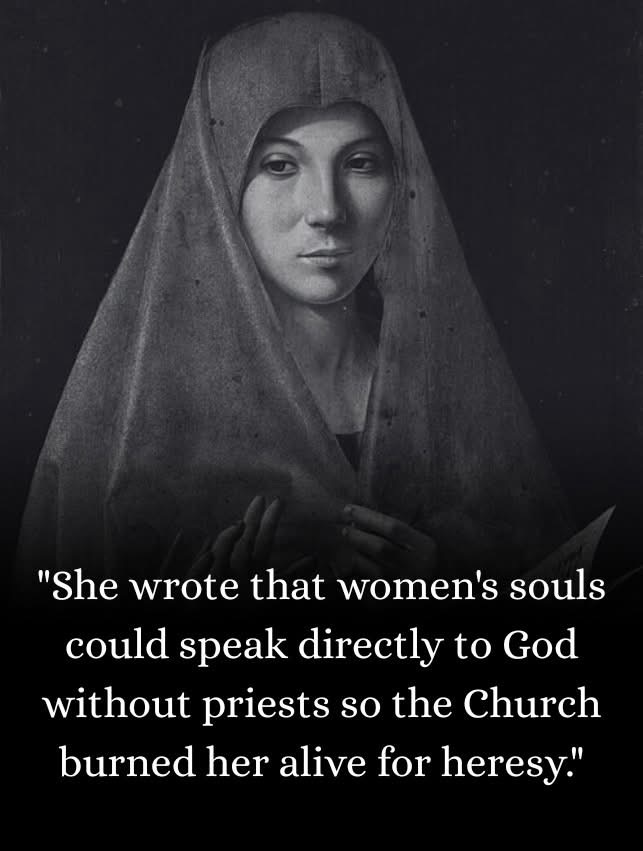
She wrote that women’s souls could speak directly to God without priests so the Church burned her alive for heresy.

Published January 10, 2026 by tindertender

She wrote that women’s souls could speak directly to God without priests—so the Church burned her alive for heresy.

Paris, June 1, 1310.

In the Place de Grève, a woman was led to the stake. Marguerite Porete, accused of heresy, had spent over a year imprisoned, refusing to answer the Inquisition’s questions or defend herself before judges she didn’t recognize as having authority over her soul. Witnesses later described her calm demeanor—no screaming, no begging for mercy, no recantation. She faced the flames with a serenity that unnerved her executioners.

She died for writing a book that claimed a soul could unite so completely with divine love that it transcended the need for Church hierarchy, sacraments, or ecclesiastical mediation. The Church couldn’t tolerate that claim—especially from a woman.

Marguerite Porete was born in the late 13th century in Hainaut (modern-day France/Belgium border region). Little is known about her early life, but she became part of the Beguine movement—communities of lay religious women who lived together in prayer and work without taking formal monastic vows.

Beguines occupied a complicated space in medieval Christianity. They weren’t nuns bound by convent rules, but they weren’t ordinary laywomen either. They lived religious lives outside institutional Church control—which made Church authorities nervous.

Marguerite was educated, literate, and theologically sophisticated—unusual for a woman of her time.

Sometime in the late 13th century, she wrote “The Mirror of Simple Souls” (Le Mirouer des simples âmes) in vernacular Old French rather than Latin.

Writing theology in the vernacular was itself significant. Latin was the language of Church authority—using French made theology accessible to ordinary people, particularly women who hadn’t learned Latin.

But it was the book’s content that proved dangerous.

The Mirror of Simple Souls describes a mystical journey where the soul progressively lets go of attachments, ego, and even virtues until it reaches “annihilation”—complete dissolution into divine love. This “annihilated soul” becomes so united with God that it no longer needs:

Church sacraments
Moral rules
Priestly mediation
Fear of sin
Virtuous acts done out of obligation

Because the soul is completely aligned with divine will, it acts naturally from love rather than from external commands.

Marguerite wrote in dialogue form, with characters including “Love,” “Reason,” “The Soul,” and “Holy Church the Little” (institutional Church) versus “Holy Church the Great” (the mystical body of all souls united with God).

Crucially, she distinguished between institutional Church authority and direct divine relationship. “Holy Church the Little”—the hierarchy, rules, and priests—was necessary for beginners on the spiritual path. But advanced souls could transcend it through complete union with God. This was explosive theology.

The Church’s authority rested on being the necessary mediator between humans and God.

Sacraments administered by priests were required for salvation. Confession, penance, Church law—all of this presumed that people needed institutional guidance.

Marguerite was saying: at the highest spiritual level, you don’t need any of that. The soul united with God transcends institutional authority. Church authorities saw this as dangerous heresy. It suggested that mystics could claim direct divine authority superior to Church hierarchy. It implied that someone in mystical union might be beyond sin or moral law—a heresy called “antinomianism. “And it was especially threatening coming from a woman.

The Church insisted women needed male spiritual authority—priests, confessors, bishops—to guide them. A woman claiming direct divine relationship without male mediation challenged the entire gender hierarchy of medieval Christianity.

Around 1296-1306, Marguerite’s book was condemned by the Bishop of Cambrai. It was publicly burned, and she was warned to stop teaching her ideas. Marguerite ignored the warning. She continued circulating the book and discussing her theology. She sent copies to theologians and Church authorities seeking approval, but also continued teaching despite the prohibition.

This defiance was crucial. She had multiple opportunities to submit to Church authority, burn her book, recant her teachings, and avoid execution. She refused every time. Why? Because she believed—genuinely, deeply—that her mystical experience and theological understanding came directly from God. No earthly authority, not even the Church, could invalidate that divine relationship.

In 1308, she was arrested in Paris. The Inquisition began proceedings against her. During her imprisonment (which lasted over a year), she refused to cooperate with the trial. She wouldn’t answer questions. She wouldn’t defend herself. She wouldn’t acknowledge the tribunal’s authority to judge her spiritual state. Her silence was deliberate and theological.

She believed the judges—bound by “Holy Church the Little”—couldn’t understand the mystical theology of souls who’d reached union with God. Answering them would be pointless.

The Inquisition found her guilty of heresy. They declared her a “relapsed heretic”—someone who’d been warned before and persisted in error. The penalty for relapsed heresy was death by burning.

On June 1, 1310, Marguerite was led to the Place de Grève in Paris. Accounts describe her facing execution with remarkable calm—no terror, no last-minute recantation, no screaming as the flames rose. Observers noted this serenity. Some interpreted it as demonic possession keeping her from repenting. Others saw it as proof she’d achieved the mystical state she’d written about—transcendence of fear through complete union with divine love.

Marguerite Porete became one of the first women burned for heresy by the Inquisition in Paris. Her execution was meant to be a warning: women who claimed spiritual authority independent of Church hierarchy would be silenced permanently.

But her book survived. Copies circulated anonymously throughout the 14th and 15th centuries. Because Marguerite’s name was suppressed (she was executed as a heretic), the book was copied without author attribution. Monks, mystics, and scholars read it for centuries without knowing a woman had written it. Some copies attributed it to male authors.

The mystical theology was considered so sophisticated that people assumed a man must have written it.

In 1946, scholar Romana Guarnieri finally proved that Marguerite Porete was the author. The evidence included trial records and manuscript traditions connecting the condemned book to The Mirror of Simple Souls.

Suddenly, a text that had influenced Christian mysticism for centuries was recognized as written by a woman burned for heresy.

Modern scholars recognize The Mirror as a masterpiece of mystical theology. Its influence can be traced in later mystics including Meister Eckhart (who faced similar accusations of heresy).

Marguerite’s theology anticipated ideas that would later appear in Protestant Reformation critiques of institutional Church authority and in modern mystical and contemplative traditions.

Her story matters because: She claimed spiritual authority as a woman: In an era when women were required to be spiritually subordinate to men, she insisted her mystical experience gave her theological insight. She challenged institutional religious power: She distinguished between institutional authority and divine relationship—a distinction that threatened Church hierarchy. She refused to recant: Given multiple chances to save herself by submitting to Church authority, she chose death over betraying her spiritual convictions.

She was right about mystical theology: Modern understanding of contemplative spirituality recognizes the validity of much of what she taught. Her work survived despite suppression: Burning her body didn’t destroy her ideas—they circulated for centuries, eventually vindicated.

The tragedy is that Marguerite was executed for theology that, in different contexts or coming from a man, might have been tolerated or even celebrated.

Male mystics like Meister Eckhart taught similar ideas and, while investigated, weren’t executed. Her gender made her dangerous in ways male mystics weren’t. A woman claiming to transcend priestly authority threatened both religious and gender hierarchies simultaneously.

To Marguerite Porete: You wrote that the soul united with God needs no intermediary—and the Church killed you for threatening their monopoly on salvation. You refused to recant even when recantation would have saved you. You chose death over betraying your mystical experience and theological convictions. Your silence before the Inquisition wasn’t weakness—it was theological statement. You didn’t recognize their authority to judge what you knew through direct divine union. You faced the flames with the serenity you’d written about—the transcendence of fear through complete surrender to divine love. They burned your body. They tried to erase your name. They suppressed your book. But your words survived. For centuries, they circulated anonymously, influencing mystics who didn’t know a woman had written them. When scholars finally proved you were the author, your genius was undeniable. You were right about mystical union. You were right that souls can experience God directly. You were right that love transcends institutional authority. The Church that executed you eventually had to acknowledge the validity of mystical theology like yours. The ideas they burned you for are now recognized as legitimate contemplative spirituality. You died for claiming women’s spiritual authority. For insisting divine love was greater than ecclesiastical power. For refusing to let priests mediate your relationship with God. That claim cost you your life. But it couldn’t be silenced. Your voice, speaking across seven centuries, still insists: the soul united with Love needs no permission to speak directly to God. They couldn’t burn that truth. And they couldn’t burn your courage.

The Pre-Christian Logos

Published January 9, 2026 by tindertender

The term Logos (Greek for “word,” “reason,” or “logic”) was a central concept in ancient Greek philosophy long before the rise of Christianity. 

  • Greek Philosophy: Nearly every Greek philosophy, including Stoicism and Neo-Platonism, had a role for the Logos. It was generally considered a mediating principle between the ultimate, transcendent God and the created world.
  • Universal Principle: The Logos was understood as divine reason, the underlying principle of order and harmony in the universe, and the source of all truth. Philosophers like Heraclitus and the Stoics saw it as an immanent, rational principle in the cosmos.
  • Hellenistic Judaism: Jewish thinkers like Philo of Alexandria, who lived around the same time as Jesus but in Egypt, further developed the Logos as an intermediary divine being, distinct from God’s essence but the means by which God created and interacted with the material world. 

The Cosmic Christ

Early Christian apologists and Church Fathers adopted the philosophical term Logos to explain the nature of Jesus Christ to the Hellenistic world. 

  • The Gospel of John: The most famous biblical usage is in the prologue of the Gospel of John: “In the beginning was the Word (Logos), and the Word (Logos) was with God, and the Word (Logos) was God”. This passage identifies Jesus as the eternal Logos that became flesh.
  • Early Christian Theology: Early writers like Justin Martyr argued that Christ, as the Logos, was present in the world even before his incarnation. They believed that anyone who lived according to reason (logos spermatikos or “seed of the Logos”) had a share in Christ’s truth, effectively being “Christians before Christ”.
  • A Unifying Force: The “Cosmic Christ” is the theological understanding of Christ not just as a historical figure, but as the divine presence that pervades and unifies all of creation. This concept emphasizes that all matter is sacred because it is incarnate with the divine nature of the Logos. 

St. Anthony

St. Anthony the Great (c. 250–356 AD), an Egyptian hermit considered the father of Christian monasticism, is a prominent figure in early Christian spirituality. 

  • Athanasius’s Work: His life was documented in The Life of Antony by Athanasius of Alexandria, a pivotal work in Christian literature. This book helped shape the ideal of monastic life and the understanding of spiritual warfare.
  • Connection to the Logos: While St. Anthony himself might not have written extensively on the abstract philosophy of the Logos, his life exemplified a deep connection to the Divine (the Logos). His biography is available in resources such as those found on Logos Bible Software

She succeeded where they were certain she would fail, and they’re mad!

Published January 4, 2026 by tindertender

She’s got a whole Universe of Kings and Queens, Gods and Goddesses, whatever the Upper Echelon of the Universe call themselves, the Counsil of Universes, for there are many, unified in their decision to elevate her.

She is alive because they have deemed her worthy of life. She has been given reprieve, for they have deemed her innocent of any crime, and are rewarding her for the centuries of torture she endured at the hands of man … because she dare speak of love, because she dare be intelligent, because she dare expand into life and be recognized as a Woman who deeply loves Creation and the Life it holds … gifts of the Mother Father Most High Divine.

They poisoned her and hurt her bad, physically and with magic … they wished death upon her the whole of her life. They insist she isn’t responsible, even though she succeeded where they were certain she would fail. They were certain their efforts to deteriorate and disqualify her were sufficient. They are hollering, whining really, and insisting they have rights to her essence, energy, gifts ,,, soul and right to life.

They want to rule the universe. They’ve been slave trading for centuries, announcing themselves conquerors, masters.

The universe came together without prejudice and chose this Woman Survivor as Representative. A whole Universe of teachers to teach, to guide, and the Most High Divine within all realms supervises it all.

This time, it will go a little differently.

But the trafficker insists it has rights to the merchandise of angels, so the transition is a little bumpy.

May it settle quickly.

Aho. Amen. Wado.

Some say men are easy, because they can’t control their desires

Published January 4, 2026 by tindertender

Those entities who believe they own the whole of the world send in dancing puppets, beautiful, scantily clad succubusses, to wiggle and giggle and see if the cobra will rise from its basket and do a little weave and bob according to the dancing puppets will.

“Lust will be your downfall,” said the Most High to the warriors. Absolutely. A man who cannot control his mind, or his phallus, tends to “do the dance” and fall every time.

The hidden controllers have used the enslaved or agreeable Womb of Power against mankind for centuries, while causing great suffering for the Divine Feminine who tries, but cannot compete with the illusion, the alluring dance.

She doesn’t wiggle her hips like that.
She doesn’t dress to gain a rise out of the snake.
She’s busy building things, adding value to her soul, while he’s chasing smoke … looking for fire.

It’s too bad the Creatress doesn’t light his inner fire to match her efforts for creation … that he feels compelled to dance for the masters puppet, straight into fire of destruction.

The Honor System

Published December 28, 2025 by tindertender

I watched the woman steal three dozen eggs and a sack of potatoes while my shotgun sat loaded behind the door, untouched. It wasn’t the theft that froze me; it was the way she wiped her eyes before she ran.

My father built this farm stand in 1958. It’s nothing more than a weathered oak lean-to with a tin roof, sitting at the end of a gravel driveway that used to be surrounded by cornfields. Now, it’s surrounded by subdivisions with names like “Oak Creek” and “Willow Run,” where the only oaks and willows were cut down to pour the concrete foundations.

For sixty years, there has been a metal lockbox nailed to the center post. Written on it in fading white paint are two words: THE HONOR SYSTEM.

You take what you need. You put the cash in the slot. Simple. That box put me through college. It paid for my mother’s hip surgery. It was a testament to a time when a man’s word was his bond and a neighbor was just family you hadn’t met yet.

But times have changed.

I hear it on the radio in my tractor. Inflation. Supply chains. The price of diesel is up. Fertilizer costs have tripled. And out here, where the factories closed down a decade ago and the new service jobs don’t pay enough to cover the rent, people are hurting. Really hurting.

I’d noticed the light pilfering for months. A missing tomato here, a jar of honey there. I ignored it. If you’re desperate enough to steal a tomato, you probably need the vitamins. But last Tuesday was different.

It was a gray, biting afternoon. The woman drove a sedan that sounded like it was coughing up a lung. She didn’t look like a criminal. She looked like a nurse, or maybe a teacher—tired, wearing scrubs that had seen too many shifts. I watched from the kitchen window, sipping lukewarm coffee.

She stood in front of the stand for a long time. She opened her purse and counted coins. She counted them again. I could see her shoulders slump. She looked at the prices written on the little chalkboard—prices I had already lowered twice, even though I was barely breaking even.

Then, she did it. She grabbed the eggs. She grabbed the potatoes. She moved fast, terrified, looking over her shoulder. She didn’t check the lockbox. She just threw the food into her passenger seat and sped off, gravel spraying against the “Honor System” sign.

My neighbor, frank, a transplant from the city who likes to give me unsolicited advice about liability insurance, was pulling into my drive just as she left.

“You see that, Beau?” Frank yelled, leaning out of his shiny truck. “I told you! You gotta get cameras. Or shut it down. People today? No morals. They’ll bleed you dry.”

I looked at the dust settling on the road. “Maybe,” I said.

“It’s the economy,” Frank grumbled. “Makes wolves out of sheep. Lock it up, Beau.”

I went inside. I looked at my ledger. I was in the red. Again. The logical thing to do was to close the stand. Or put a padlock on the cooler. Frank was right. You can’t run a business on good vibes and nostalgia.

But I couldn’t get the image of that woman’s slumped shoulders out of my head. That wasn’t the posture of a thief. That was the posture of a mother who had to choose between gas for the car and dinner for the table.

The next morning, at 4:00 AM, I went out to the barn.

I collected the eggs. I sorted the vegetables. Usually, I wash the potatoes until they shine. I polish the peppers. I make sure everything looks supermarket-perfect because that’s what the new people in the subdivisions expect.

Today, I did the opposite.

I took the biggest, most beautiful Russet potatoes—the ones that would bake up fluffy and perfect—and I rubbed a little wet dirt back onto them. I took the eggs that were slightly different shades of brown, the ones that were perfectly fresh but didn’t look uniform in a carton, and set them aside. I took the prize-winning heirloom tomatoes and found the ones that were shaped a little weird, the ones that looked like kidneys or hearts instead of perfect spheres.

I walked down to the stand and nailed up a new wooden crate right next to the Honor System box. I grabbed a piece of cardboard and a thick marker.

“SECONDS & BLEMISHED,” I wrote. “UGLY PRODUCE. CAN’T SELL TO STORES. 90% OFF OR TAKE FOR FREE IF YOU HELP ME CLEAR THE INVENTORY.”

I filled that crate with the best food I had. The “dirty” potatoes. The “mismatched” eggs. The “weird” tomatoes.

Then I retreated to the porch and waited.

She came back three days later. Same coughing car. Same tired scrubs.

She froze when she saw the new sign. She looked at the pristine, full-price vegetables on the main shelf, and then at the overflowing crate of “ugly” food. She approached it cautiously, like it was a trap.

She picked up a potato. She wiped a thumb over the smudge of dirt I’d carefully applied, revealing the perfect skin underneath. She paused. She looked at the house. I stayed back in the shadows of the curtains.

She didn’t run this time. She took a grocery bag and filled it. She took two dozen eggs. She took a bag of apples I had marked as “bruised” (they weren’t).

Then, she stood in front of the Honor System box. She didn’t have much, but I saw her put a crumpled bill in. It wasn’t the full price of the premium stuff, but it was something. She walked back to her car, not looking over her shoulder, but walking with her head up.

Over the next month, a strange thing happened.

The “Seconds” bin became the most popular spot in the county. It wasn’t just her. It was the old man from the trailer park down the road. It was the young couple who had just moved into the rental property. They’d pull up, read the sign, and load up.

And the Honor System box? It started getting heavy.

They weren’t paying market price. They were paying what they could. Sometimes it was quarters. Sometimes it was a five-dollar bill for a haul that was worth twenty. But nobody was stealing. Nobody was running.

One afternoon, Frank stopped by. He looked at the nearly empty “Seconds” bin and the few remaining items on the main shelf.

“You’re losing your shirt, Beau,” Frank laughed, shaking his head. “I did the math. You’re selling Grade A stock as garbage. I saw you put those peppers in there. Nothing wrong with them. You’re running a charity, not a business.”

“I’m not running a charity,” I said, leaning on my truck.

“Then what do you call it? You’re letting them take advantage of you.”

“No, Frank,” I said. “I’m letting them keep their pride.”

Frank went silent.

“If I give it away,” I explained, looking out at the cornstalks swaying in the wind, “they feel like beggars. If I let them ‘buy’ the ugly stuff for cheap, or help me out by ‘clearing inventory,’ they’re customers. They’re helping me out. It’s a transaction between equals. They get to feed their families without feeling small.”

Frank looked at the box, then at me. He didn’t say anything else about cameras.

Yesterday evening, I went down to close up the stand. The “Seconds” crate was empty, swept clean. The lockbox felt heavy. I opened it to collect the day’s take.

Amidst the dollar bills and coins, there was a small, sealed white envelope. No stamp. Just my name, “Beau,” written in neat cursive.

I opened it. Inside was a twenty-dollar bill—crisp, new. And a note.

“To the farmer, I know the potatoes aren’t bad. I know the eggs are fresh. I know what you’re doing. My husband got a job today. It’s not much, but it’s a start. We made a pot roast tonight with your ‘ugly’ vegetables. It was the best meal we’ve had in six months. Thank you for feeding us. But mostly, thank you for not making us ask. We will never forget this.”

I stood there in the fading twilight, the fireflies starting to blink over the fields. I held that twenty-dollar bill like it was a winning lottery ticket.

The economists will tell you that the Honor System is dead. They’ll tell you that in a dog-eat-dog world, you have to lock your doors and guard your hoard. They’ll tell you that kindness is a liability on a balance sheet.

But standing there, listening to the crickets and feeling the cool evening air, I realized they’re wrong. The Honor System isn’t about trusting people not to steal. It’s about trusting that if you treat people like people, they’ll rise to meet you.

I pocketed the note and walked back to the house. Tomorrow is another day. I need to wake up early. I’ve got a lot of perfectly good vegetables to go ruin.

Because hard times don’t create thieves; sometimes, they just reveal who is hungry. And true community isn’t about watching your neighbor through a lens; it’s about making sure their plate isn’t empty so they don’t have to steal to fill it.

Any day now … ❤️

Published December 24, 2025 by tindertender

Any day now … ❤️
https://www.facebook.com/share/r/1AYtbvmAmA/?mibextid=wwXIfr

Dear Women

Published December 21, 2025 by tindertender

Dear Women, have you ever realized how powerful your thoughts are for the man in your life?

Saka Ana Lorenza, a Kogi Saka and spiritual leader, speaks about the quiet but immense importance of women in the lives of their men. She explains that it is not only what women do or say that shapes a man’s path, but also what they think about him in the privacy of their own mind.

When a woman holds thoughts of trust, respect and blessing for her partner, this creates a field of support around him. Even when she is not physically present, he can walk with more strength, clarity and courage. Her inner agreement becomes a kind of spiritual protection that helps him move through obstacles and stay connected to his purpose.

When her thoughts are filled with constant criticism, disappointment or contempt, even if she never speaks them aloud, this too has an effect. The relationship may begin to feel heavy. Conflicts appear without a clear reason. Success may be blocked in subtle ways.

According to Saka Ana Lorenza, many women do not realize how central their inner stance is for the wellbeing of the man and for the harmony of the family.

This is not about blame. It is an invitation to remember the sacred influence that women carry. Their love and their clarity are not small. They are forces that can either nourish or weaken the life that grows around them.

The Kogi see relationship as a spiritual responsibility that both partners share. And the thoughts of the woman are one of its deepest foundations.

May your thoughts become a blessing for you and for those you love.

Hel Goddess

Published November 30, 2025 by tindertender

Someone in the unseen said your name should be Hel because no one can beat you.

Why the “Hel” would they want to destroy the Mother?!?! There are some serious issues needing addressed.

https://www.bruxariaonline.com.br/en/post/hel-goddess-of-death-and-lady-of-the-underworld

It gives new meaning to the Most High God, Creator of the All That Is, unleashing Hel on earth.

Tried to Destroy the Dreamer

Published November 30, 2025 by tindertender

… Destroyed their dream.

When they tried to silence the visionary, the actualization of dreams faded, and what remained was a bunch of brutes with angry, unsatisfied energy trying to “force” the visionary to give them a dream. Gorillas. Lost their dream, for trying to destroy the visionary.

https://www.instagram.com/reel/DQPCmTKDAaT/?igsh=MTN4cXM1ajJnZ2Zzbg==

Devil Ozone in the Penthouse of Thought being removed

Published November 22, 2025 by tindertender

Roseanne says the Devil Ozone in the Penthouse of Thought is being removed.

No Devil Ozone ….
They’ve been evicted!!!!!
I testify their name interference of the midnight hour seems to be waning.