I heard this curator saying “the damage has been done”. He said they poisoned the water, and that she needed “hydrogen peroxide”. Whatever dimensional reality he is talking about, it appears a woman is there to bring healing “to the planet” … it seems as though the Women are being called to bring Restoration.
That being said, whatever timeline or dimensional space this is, gather hydrogen peroxide … it will help …. straight out of the mouth of the poisoner. He swears she cannot do it, heal the damage he has done …. but then again, he boasts of its cure while he insists its impossible … so, take it as it resonates.
AI Overview Yes, hydrogen peroxide (H₂O₂) can effectively clean impure water by acting as a powerful oxidizer and disinfectant, killing bacteria, viruses, and breaking down organic pollutants and minerals like iron and sulfur, leaving only harmless oxygen and water as byproducts, making it a clean, eco-friendly option for various water treatment needs, though it’s best used in controlled systems.
How it Works Oxidation: H₂O₂ releases nascent (newly formed) oxygen, which oxidizes contaminants, changing their chemical structure. Disinfection: The released oxygen effectively inactivates pathogens like bacteria, viruses, and cysts. Contaminant Removal: It oxidizes minerals (iron, manganese) and organic matter, causing them to clump and become easily filterable. Byproduct: It breaks down into pure water and oxygen, leaving no harmful chemical residues, unlike chlorine.
Benefits Effective: Targets a broad spectrum of contaminants, including odors (like “rotten egg” smell from hydrogen sulfide) and discoloration. Eco-Friendly: Decomposes into water and oxygen, making it environmentally safe. Improves Aesthetics: Removes mineral buildup, improves taste, and clarity.
Applications Well Water: Excellent for disinfecting and treating iron/manganese issues in private wells. Municipal/Industrial: Used for general disinfection and removing organic pollutants.
Considerations Controlled Dosing: For safe and effective treatment, it’s usually injected into water systems in precise amounts. Filtration Needed: After oxidation, contaminants often need to be filtered out by a separate filter system.
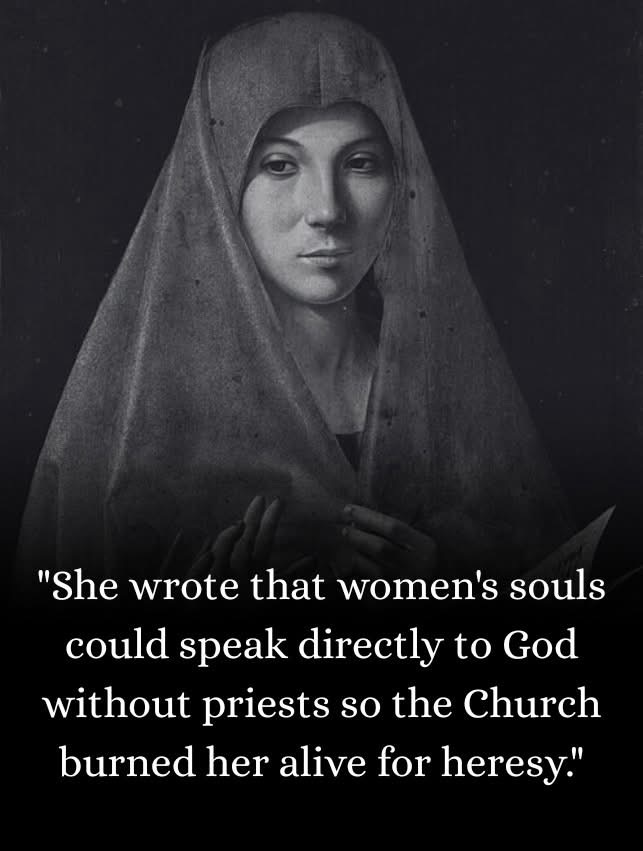
She wrote that women’s souls could speak directly to God without priests—so the Church burned her alive for heresy.
Paris, June 1, 1310.
In the Place de Grève, a woman was led to the stake. Marguerite Porete, accused of heresy, had spent over a year imprisoned, refusing to answer the Inquisition’s questions or defend herself before judges she didn’t recognize as having authority over her soul. Witnesses later described her calm demeanor—no screaming, no begging for mercy, no recantation. She faced the flames with a serenity that unnerved her executioners.
She died for writing a book that claimed a soul could unite so completely with divine love that it transcended the need for Church hierarchy, sacraments, or ecclesiastical mediation. The Church couldn’t tolerate that claim—especially from a woman.
Marguerite Porete was born in the late 13th century in Hainaut (modern-day France/Belgium border region). Little is known about her early life, but she became part of the Beguine movement—communities of lay religious women who lived together in prayer and work without taking formal monastic vows.
Beguines occupied a complicated space in medieval Christianity. They weren’t nuns bound by convent rules, but they weren’t ordinary laywomen either. They lived religious lives outside institutional Church control—which made Church authorities nervous.
Marguerite was educated, literate, and theologically sophisticated—unusual for a woman of her time.
Sometime in the late 13th century, she wrote “The Mirror of Simple Souls” (Le Mirouer des simples âmes) in vernacular Old French rather than Latin.
Writing theology in the vernacular was itself significant. Latin was the language of Church authority—using French made theology accessible to ordinary people, particularly women who hadn’t learned Latin.
But it was the book’s content that proved dangerous.
The Mirror of Simple Souls describes a mystical journey where the soul progressively lets go of attachments, ego, and even virtues until it reaches “annihilation”—complete dissolution into divine love. This “annihilated soul” becomes so united with God that it no longer needs:
Church sacraments Moral rules Priestly mediation Fear of sin Virtuous acts done out of obligation
Because the soul is completely aligned with divine will, it acts naturally from love rather than from external commands.
Marguerite wrote in dialogue form, with characters including “Love,” “Reason,” “The Soul,” and “Holy Church the Little” (institutional Church) versus “Holy Church the Great” (the mystical body of all souls united with God).
Crucially, she distinguished between institutional Church authority and direct divine relationship. “Holy Church the Little”—the hierarchy, rules, and priests—was necessary for beginners on the spiritual path. But advanced souls could transcend it through complete union with God. This was explosive theology.
The Church’s authority rested on being the necessary mediator between humans and God.
Sacraments administered by priests were required for salvation. Confession, penance, Church law—all of this presumed that people needed institutional guidance.
Marguerite was saying: at the highest spiritual level, you don’t need any of that. The soul united with God transcends institutional authority. Church authorities saw this as dangerous heresy. It suggested that mystics could claim direct divine authority superior to Church hierarchy. It implied that someone in mystical union might be beyond sin or moral law—a heresy called “antinomianism. “And it was especially threatening coming from a woman.
The Church insisted women needed male spiritual authority—priests, confessors, bishops—to guide them. A woman claiming direct divine relationship without male mediation challenged the entire gender hierarchy of medieval Christianity.
Around 1296-1306, Marguerite’s book was condemned by the Bishop of Cambrai. It was publicly burned, and she was warned to stop teaching her ideas. Marguerite ignored the warning. She continued circulating the book and discussing her theology. She sent copies to theologians and Church authorities seeking approval, but also continued teaching despite the prohibition.
This defiance was crucial. She had multiple opportunities to submit to Church authority, burn her book, recant her teachings, and avoid execution. She refused every time. Why? Because she believed—genuinely, deeply—that her mystical experience and theological understanding came directly from God. No earthly authority, not even the Church, could invalidate that divine relationship.
In 1308, she was arrested in Paris. The Inquisition began proceedings against her. During her imprisonment (which lasted over a year), she refused to cooperate with the trial. She wouldn’t answer questions. She wouldn’t defend herself. She wouldn’t acknowledge the tribunal’s authority to judge her spiritual state. Her silence was deliberate and theological.
She believed the judges—bound by “Holy Church the Little”—couldn’t understand the mystical theology of souls who’d reached union with God. Answering them would be pointless.
The Inquisition found her guilty of heresy. They declared her a “relapsed heretic”—someone who’d been warned before and persisted in error. The penalty for relapsed heresy was death by burning.
On June 1, 1310, Marguerite was led to the Place de Grève in Paris. Accounts describe her facing execution with remarkable calm—no terror, no last-minute recantation, no screaming as the flames rose. Observers noted this serenity. Some interpreted it as demonic possession keeping her from repenting. Others saw it as proof she’d achieved the mystical state she’d written about—transcendence of fear through complete union with divine love.
Marguerite Porete became one of the first women burned for heresy by the Inquisition in Paris. Her execution was meant to be a warning: women who claimed spiritual authority independent of Church hierarchy would be silenced permanently.
But her book survived. Copies circulated anonymously throughout the 14th and 15th centuries. Because Marguerite’s name was suppressed (she was executed as a heretic), the book was copied without author attribution. Monks, mystics, and scholars read it for centuries without knowing a woman had written it. Some copies attributed it to male authors.
The mystical theology was considered so sophisticated that people assumed a man must have written it.
In 1946, scholar Romana Guarnieri finally proved that Marguerite Porete was the author. The evidence included trial records and manuscript traditions connecting the condemned book to The Mirror of Simple Souls.
Suddenly, a text that had influenced Christian mysticism for centuries was recognized as written by a woman burned for heresy.
Modern scholars recognize The Mirror as a masterpiece of mystical theology. Its influence can be traced in later mystics including Meister Eckhart (who faced similar accusations of heresy).
Marguerite’s theology anticipated ideas that would later appear in Protestant Reformation critiques of institutional Church authority and in modern mystical and contemplative traditions.
Her story matters because: She claimed spiritual authority as a woman: In an era when women were required to be spiritually subordinate to men, she insisted her mystical experience gave her theological insight. She challenged institutional religious power: She distinguished between institutional authority and divine relationship—a distinction that threatened Church hierarchy. She refused to recant: Given multiple chances to save herself by submitting to Church authority, she chose death over betraying her spiritual convictions.
She was right about mystical theology: Modern understanding of contemplative spirituality recognizes the validity of much of what she taught. Her work survived despite suppression: Burning her body didn’t destroy her ideas—they circulated for centuries, eventually vindicated.
The tragedy is that Marguerite was executed for theology that, in different contexts or coming from a man, might have been tolerated or even celebrated.
Male mystics like Meister Eckhart taught similar ideas and, while investigated, weren’t executed. Her gender made her dangerous in ways male mystics weren’t. A woman claiming to transcend priestly authority threatened both religious and gender hierarchies simultaneously.
To Marguerite Porete: You wrote that the soul united with God needs no intermediary—and the Church killed you for threatening their monopoly on salvation. You refused to recant even when recantation would have saved you. You chose death over betraying your mystical experience and theological convictions. Your silence before the Inquisition wasn’t weakness—it was theological statement. You didn’t recognize their authority to judge what you knew through direct divine union. You faced the flames with the serenity you’d written about—the transcendence of fear through complete surrender to divine love. They burned your body. They tried to erase your name. They suppressed your book. But your words survived. For centuries, they circulated anonymously, influencing mystics who didn’t know a woman had written them. When scholars finally proved you were the author, your genius was undeniable. You were right about mystical union. You were right that souls can experience God directly. You were right that love transcends institutional authority. The Church that executed you eventually had to acknowledge the validity of mystical theology like yours. The ideas they burned you for are now recognized as legitimate contemplative spirituality. You died for claiming women’s spiritual authority. For insisting divine love was greater than ecclesiastical power. For refusing to let priests mediate your relationship with God. That claim cost you your life. But it couldn’t be silenced. Your voice, speaking across seven centuries, still insists: the soul united with Love needs no permission to speak directly to God. They couldn’t burn that truth. And they couldn’t burn your courage.
The term Logos (Greek for “word,” “reason,” or “logic”) was a central concept in ancient Greek philosophy long before the rise of Christianity.
Greek Philosophy: Nearly every Greek philosophy, including Stoicism and Neo-Platonism, had a role for the Logos. It was generally considered a mediating principle between the ultimate, transcendent God and the created world.
Universal Principle: The Logos was understood as divine reason, the underlying principle of order and harmony in the universe, and the source of all truth. Philosophers like Heraclitus and the Stoics saw it as an immanent, rational principle in the cosmos.
Hellenistic Judaism: Jewish thinkers like Philo of Alexandria, who lived around the same time as Jesus but in Egypt, further developed the Logos as an intermediary divine being, distinct from God’s essence but the means by which God created and interacted with the material world.
The Cosmic Christ
Early Christian apologists and Church Fathers adopted the philosophical term Logos to explain the nature of Jesus Christ to the Hellenistic world.
The Gospel of John: The most famous biblical usage is in the prologue of the Gospel of John: “In the beginning was the Word (Logos), and the Word (Logos) was with God, and the Word (Logos) was God”. This passage identifies Jesus as the eternal Logos that became flesh.
Early Christian Theology: Early writers like Justin Martyr argued that Christ, as the Logos, was present in the world even before his incarnation. They believed that anyone who lived according to reason (logos spermatikos or “seed of the Logos”) had a share in Christ’s truth, effectively being “Christians before Christ”.
A Unifying Force: The “Cosmic Christ” is the theological understanding of Christ not just as a historical figure, but as the divine presence that pervades and unifies all of creation. This concept emphasizes that all matter is sacred because it is incarnate with the divine nature of the Logos.
St. Anthony
St. Anthony the Great (c. 250–356 AD), an Egyptian hermit considered the father of Christian monasticism, is a prominent figure in early Christian spirituality.
Athanasius’s Work: His life was documented in The Life of Antony by Athanasius of Alexandria, a pivotal work in Christian literature. This book helped shape the ideal of monastic life and the understanding of spiritual warfare.
Connection to the Logos: While St. Anthony himself might not have written extensively on the abstract philosophy of the Logos, his life exemplified a deep connection to the Divine (the Logos). His biography is available in resources such as those found on Logos Bible Software.
Destruction by Fire: Revelation 22 and other passages suggest the current earth will be destroyed by fire at Christ’s return, fulfilling prophecy.
The Antichrist’s rise, described as being “allowed to wage war” (Revelation 13:7), suggests a period where evil appears victorious, a “sacrifice” of God’s people seemingly “lost” before divine triumph.
Eden Restored 22 Then the angel showed me the river of the water of life, as clear as crystal, flowing from the throne of God and of the Lamb 2 down the middle of the great street of the city. On each side of the river stood the tree of life, bearing twelve crops of fruit, yielding its fruit every month. And the leaves of the tree are for the healing of the nations. 3 No longer will there be any curse. The throne of God and of the Lamb will be in the city, and his servants will serve him. 4 They will see his face, and his name will be on their foreheads. 5 There will be no more night. They will not need the light of a lamp or the light of the sun, for the Lord God will give them light. And they will reign for ever and ever.
I heard the curator a few days ago say, “The trumpets are blowing”.
Trumpet Judgments: First Trumpet (Rev 8:7): Hail, fire mixed with blood, hurled to Earth, burning a third of the land, trees, and all green grass. Fourth Trumpet (Rev 16:8-9): The sun scorches people with intense fire, but they curse God instead of repenting. Locusts (Rev 9:17-18): A great army of horse-like creatures breathes out fire, smoke, and sulfur, killing a third of humanity. Final Judgment (Rev 20:10, 14): The devil, beast, and false prophet are thrown into the “lake of fire,” which is described as the “second death”. New Jerusalem (Rev 21:22-27): While a city of gold, the surrounding area is fire for those whose names aren’t in the Lamb’s Book of Life, contrasting with the pure city.
Interpretations of the fire: Literal vs. Symbolic: Many scholars see Revelation as symbolic, with fire representing divine judgment, purification, or intense tribulation rather than just physical flames.
Fire Judgments in Revelation: The Book of Revelation describes a series of future judgments where fire plays a significant role. Partial Burning (Revelation 8:7): During the first trumpet judgment, hail and fire mixed with blood are hurled down, resulting in a third of the trees and all green grass being burned up. This is a partial judgment meant to prompt repentance. The Lake of Fire: This is a symbolic place of eternal punishment for the devil, the beast, the false prophet, death, Hades, and ungodly people. It is described as the "second death". The Final Purging Fire (2 Peter 3:10): Other parts of the Bible, such as 2 Peter 3:10, state that the present heavens and earth are "reserved for fire" until the day of judgment, when ungodly people will be destroyed and the world cleansed. The New Earth: After the judgment by fire, God will create a "new heaven and a new earth," where righteousness dwells and all corruption is removed.
In the year 1310, a woman named Marguerite Porete was led to a stake in the heart of Paris, surrounded by a crowd of thousands. She had been condemned as a heretic—the first person the Paris Inquisition would burn for refusing to recant.
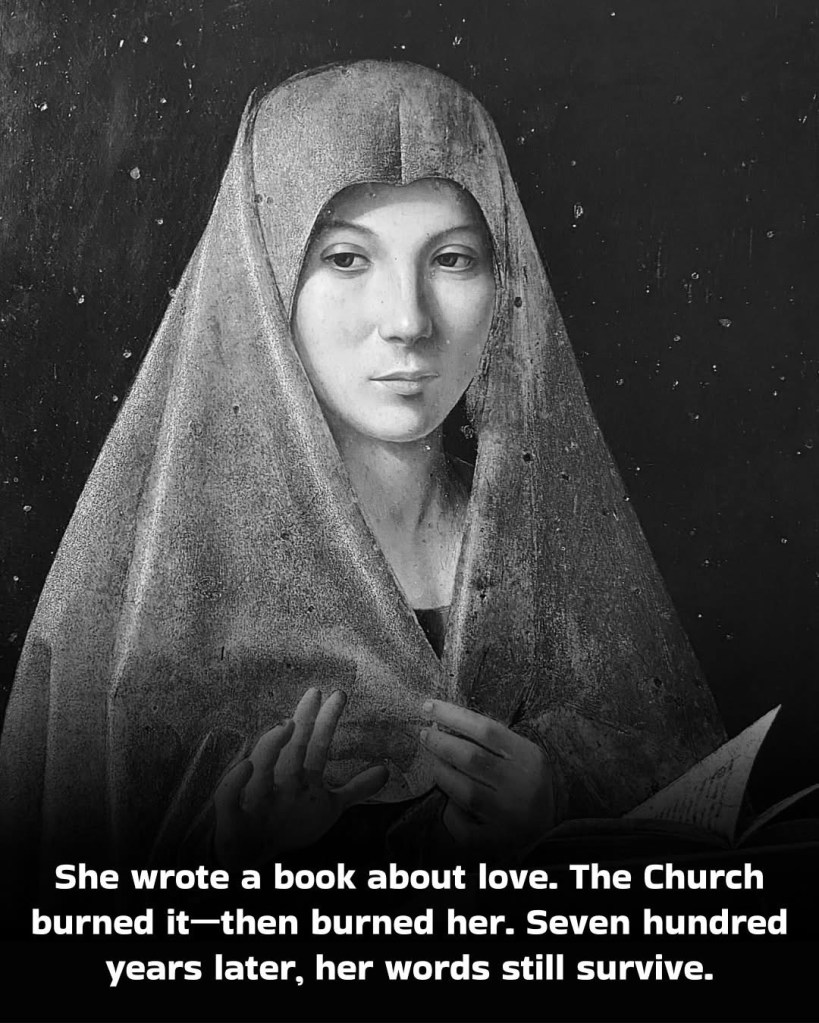
Her crime was writing a book.
Marguerite Porete was born around 1250 in the County of Hainaut, in what is now Belgium. She was highly educated, likely from an aristocratic family, and she joined the Beguines—a movement of women who devoted themselves to spiritual life without taking formal vows or submitting to male religious authority.
The Beguines lived by their own rules. They worked among the poor, prayed in their own communities, and sought God on their own terms. This freedom made Church authorities nervous. Women living outside male control, speaking about God without clerical permission, threatened the very foundations of institutional power.
Marguerite took this freedom further than most. Sometime in the 1290s, she wrote a mystical text called The Mirror of Simple Souls. It was a conversation between allegorical figures—Love, Reason, and the Soul—describing seven stages of spiritual transformation. At its heart was a radical idea: that a soul could become so completely united with divine love that it no longer needed the Church’s rituals, rules, or intermediaries. In the highest states of union, the soul surrendered its will entirely to God—and in that surrender, found perfect freedom.
“Love is God,” she wrote, “and God is Love.”
She did not write her book in Latin, the language of clergy and scholars. She wrote in Old French—the language ordinary people spoke. This meant her dangerous ideas could spread beyond monastery walls, beyond the control of priests and bishops.
And spread they did.
Between 1296 and 1306, the Bishop of Cambrai condemned her book as heretical. He ordered it burned publicly in the marketplace of Valenciennes, forcing Marguerite to watch her words turn to ash. He commanded her never to circulate her ideas again.
She refused.
Marguerite believed her book had been inspired by the Holy Spirit. She had consulted three respected theologians before publishing it, including the esteemed Master of Theology Godfrey of Fontaines, and they had approved. She would not let one bishop’s condemnation silence what she believed to be divine truth.
She continued sharing her book. She continued teaching. She continued insisting that the soul’s relationship with God belonged to no earthly institution.
In 1308, she was arrested and handed over to the Inquisitor of France, a Dominican friar named William of Paris—the same man who served as confessor to King Philip IV, the monarch who was simultaneously destroying the Knights Templar. It was a busy time for burning heretics.
Marguerite was imprisoned in Paris for eighteen months. During that entire time, she refused to speak to her inquisitors. She would not take the oath required to proceed with her trial. She would not answer questions. She maintained absolute silence—an act of defiance that infuriated the authorities.
A commission of twenty-one theologians from the University of Paris examined her book. They extracted fifteen propositions they deemed heretical. Among the most dangerous: the idea that an annihilated soul, fully united with God, could give nature what it desires without sin—because such a soul was no longer capable of sin.
To the Church, this suggested moral chaos. To Marguerite, it described the ultimate freedom of perfect surrender.
She was given every chance to recant. Others in similar positions saved their lives by confessing error. A man arrested alongside her, Guiard de Cressonessart, who had declared himself her defender, eventually broke under pressure and confessed. He was sentenced to life imprisonment.
Marguerite held firm.
On May 31, 1310, William of Paris formally declared her a relapsed heretic—meaning she had returned to condemned beliefs after being warned—and turned her over to secular authorities. The next day, June 1, she was led to the Place de Grève, the public square where executions took place.
The Inquisitor denounced her as a “pseudo-mulier”—a fake woman—as if her gender itself had been a lie, as if no real woman could defy the Church so completely.
They burned her alive.
But something unexpected happened in that crowd of thousands. According to the chronicle of Guillaume de Nangis—a monk who had no sympathy for her ideas—the crowd was moved to tears by the calmness with which she faced her death.
She displayed, the chronicle noted, many signs of penitence “both noble and pious.” Her serenity unnerved those who expected a screaming heretic. Instead, they witnessed a woman who seemed to have already transcended the fire that consumed her body.
The Church ordered every copy of The Mirror of Simple Souls destroyed. They wanted her words erased from history along with her life.
They failed.
Her book survived. Copies circulated secretly, passed from hand to hand across Europe. It was translated into Latin, Italian, and Middle English. For centuries, it was read anonymously—no one knew who had written it. The text was too powerful to disappear, even without a name attached.
It was not until 1946—more than six hundred years after her death—that a scholar named Romana Guarnieri, researching manuscripts in the Vatican Library, finally connected The Mirror of Simple Souls to its author. The woman the Church had tried to erase was finally given back her name.
Today, Marguerite Porete is recognized as one of the most important mystics of the medieval period. Scholars compare her ideas to those of Meister Eckhart, one of the most celebrated theologians of the era—and some believe Eckhart may have been influenced by her work. The book that was burned as heresy is now studied in universities as a masterpiece of spiritual literature.
Her ideas about love transcending institutional control, about the soul finding God directly without intermediaries, about surrender leading to freedom—these are not the ravings of a dangerous heretic. They are the insights of a woman centuries ahead of her time.
The Church that killed her eventually softened its stance on mystical experience. The Council of Vienne in 1312 condemned eight errors from her book, but the broader current of Christian mysticism she represented would continue flowing through figures like Julian of Norwich, Teresa of Ávila, and countless others who sought direct encounter with the divine.
What the flames could not destroy was the truth she had grasped: that love, in its purest form, is greater than fear. That no institution can ultimately control the relationship between a soul and its source. That words born from genuine spiritual insight have a way of surviving every attempt to silence them.
Marguerite Porete spent her final years in silence—refusing to speak to those who demanded she deny her truth. But her book has been speaking for seven centuries.
The Root of ALL evil, the root of the matrix, is the Khazarian Mafia, who belong to the Cult of Ba’al.
These are the trader-killer tribes of Russian and Turkish ancestry that makes up the bloodlines 98% of modern day STATE of isn’t-real, every elite family and out penal system matrix. They created the revolutionary war, the genocide of Native Americans, the drug wars and ghetto, and so on basically everything in this world that that’s broken is because of what they call themselves, “The Family”
These Satan sun-god worshipping eaters of children, blood drinkers and sorcerers of Byzantine black money magic that they print on the fake money (Federal reserve notes), need to be known by everyone. This is where Lucifer gets his strength.
Even though its pure speculation, the alleged niece of Epstein, flat out said, we presented as Jews, but behind closed doors I was taught to worship Ba’al/Moloch… (bohemian grove).
When you watch this documentary, the title posted in this reel can be found on YouTube in two parts, you will understand EXACLY why “isn’t-real” want to kill all the citizens of Palestine. It’s the final piece to this ancient puzzle.
37 He answered, “The one who sowed the good seed is the Son of Man. 38 The field is the world, and the good seed stands for the people of the kingdom. The weeds are the people of the evil one, 39 and the enemy who sows them is the devil. The harvest is the end of the age, and the harvesters are angels.
40 “As the weeds are pulled up and burned in the fire, so it will be at the end of the age. 41 The Son of Man will send out his angels, and they will weed out of his kingdom everything that causes sin and all who do evil. 42 They will throw them into the blazing furnace, where there will be weeping and gnashing of teeth. 43 Then the righteous will shine like the sun in the kingdom of their Father. Whoever has ears, let them hear.
The main problems and controversies surrounding Opus Dei center on its alleged secretive nature, aggressive recruitment, and controversial practices. Critics accuse it of operating like a cult or secret society due to its members’ secrecy and alleged isolation of members from their families. Additionally, the organization has faced accusations of promoting an austere and harsh lifestyle, with controversial practices like self-mortification, and its historical links to far-right political figures and ideologies.
Secrecy and recruitment
Secrecy: Opus Dei’s membership is often kept secret. Critics have compared its secretive nature to a Freemason or mafia-like organization operating within the church.
Recruitment: Some former members and critics claim it uses aggressive and misleading tactics to recruit young people, sometimes described as manipulative or brainwashing.
Controversial practices
Austere lifestyle: The organization is associated with austere practices, such as fasting, wearing a spiked cilice (a band of metal spikes worn around the thigh) to cause pain, and sleeping on wooden planks.
Mortification of the flesh: These practices are framed as “mortification of the flesh” and are intended to be a form of spiritual discipline and self-denial.
Political and ideological concerns
Political influence: Opus Dei has been accused of having a significant political influence, with some of its members holding positions in right-wing governments in the past, such as during the Franco regime in Spain.
Elitism: The organization’s emphasis on sanctifying daily life and achieving goals in the secular world has led to accusations of elitism and a pursuit of power.
Opus Dei’s response
Opus Dei denies many of the accusations leveled against it, pointing to its continued growth, its members’ diverse backgrounds, and support from the Vatican as evidence against the claims.
Supporters often attribute criticisms to scattered information and the testimonies of former members, noting that some accusations lack substantiation.
One’s past does not define them; it is what they do with it that counts. The Most High God has forgiven and lifted the Prodigal Son, he has resurrected and led back into ascension, the Son and the Daughter, (micro macro) yet some still slander them for the history. We are not bringing that with us into this new chapter; all things are made new. Mistakes made, lessons learned, Dharma gained, enough so that we are able to assist others by breaking generational curses and offering foundation for new beginnings … compassionate beginnings, based on Love, Honor, and Respect.
The old me does not exist anymore; she died … the last time an invisible man ran a long knife blade through my throat and chest in the astral, punching the heart clean out of this body. Now, perhaps someone DID gain the gifts because of this sacrifice, and I will never meet him. What of it?
Do you understand the energetic harvesting some have had to endure? The mental r*pe of decades, 24/7 tearing the mind apart while you’re left trying to hold your life together? These invisible masculine’s and their copycats waiting patiently for the harvest so they can play “dress-up”, trespassing into the sleeping chamber and forcefully pulling the sacral energy out as you can do no more than sit and cry and wait for it to be over? No?
Decades many of us prayed for relief, protection, an end to this severe trauma being inflicted upon the body the mind the soul by invisible brutalizers who felt they had the right …. I can tell you that relief is here, and I in no way shape or form will rebel against it.
My energy has been gifted back to me, and if he who sacrificed me did it for the gifts, well then, at least he’s nicer to me that those “thousands” of others in history that were anything but decent or gentle. I support him with all that I am, and everything the Most High God can move through me, and when it starts to deplete, I will reach deep into the dark and reach high into the light, I will expand in all ways and bring to him what he needs to be successful in this world ….
He is free to be whoever he wishes, and he’s free to be with whoever he wants, I am just glad there is a shift in the brutal reality of life … and it is someone else’s turn to be fodder, while I am gifted a vacation. (Of course, I am a blind woman in love with an invisible man, and of course I long for this connection, but will never seek to bind anything here, for it is the flow which brings success …. however, God did tell him that “Lust will be your downfall”. We’ll just have to wait to see what he chooses. I pray that if he chooses lust God will release me so I do not fall with him … it was no fun the first many times, thank you very much, I pray a different experience, a loving experience.”)
I was never invited to play on the team, but someone has chosen me … this cycle, someone chose me. Many mean people out there say it was just an energy harvest and gifts claimed, and they might be right. I’ve been left alone my whole life, centuries have gone by of this abuse.
I am happy alone. I am accustomed to not being “good enough” for union, only good enough to “harvest”. No one out there wants to build with me, they just want what I am, I get it ….
I willingly gave all that I am to another in order to be catalyst for change. Whatever that cost … obviously it was my life, obviously it involved the underworld, obviously it involved the God who rules over the Land of Trine, the land from which I hail.
I do not know the rules of God’s game. My memory was wiped time and time again. My soul moved forward anyway. God will either carry me home for my service, Or he will leave me behind …
Either way, the habitual pattern of defiling people, programming them with failure then driving them into it just so they could convict them deceitfully and have a legal reason to harvest them, is over.
Say what you want, God sent me here for purpose. I “fell to tell”, I learned as much as I could about as much as I could, through persevering the punishment of this realm.
God may now know that the Prodigal Son wasn’t guilty as charged, and neither was the Daughter.
This system of suffering is over for humanity; they are exempt, for they were “programmed” and “set up for failure”. God sees it all, and so does the Upper Echelon, the Council of Universes.
As you age, you’ll notice you are not the same, constantly reborn. It is a choice that not all people make. Other species may have different operating procedures, obviously, which require our demise.
Mother Father God Goddess Creators of All That Is, thank you for this life, thank you for bringing the cycle of suffering for humanity and all those they love, to a close.







 opensenseme