” Let difficulty transform you, and it will. In my experience, we just need help in learning how not to run away. ” π« – Perma Chodron
βββββββββββ-
βDonβt power walk. Saunter slowly in the sun, eating chocolate, and carry a blanket so you can take a nap.β ~ SARK
Mantra :: This is a journey – not a sprint – so I take breaks and reward myself along the way.
βββββββββββ-
Sure, I could imagine the worse case scenario and try to prepare for it. I prefer however to use my skills of imagination, my inner vision, to generate future details which bring joy to my world. Not to say one shouldnβt be prepared.
βββββββββββ-
I can think whatever I want without interference. They donβt get to crowd my present moment any longer. So refreshing!!
βββββββββββ-
People might question how I did it, what techniques do I use. I simply reply, resilience and perseverance. Sometimes inner fortitude is all that works.
βββββββββββ-
In the forest, when all goes silent, itβs the animals waiting to determine if predator is present, or just nature doing its thing.
Similarly, when all goes silent in the world, you can be certain the real danger is near, or the true bringer of change has arrived.
Pay attention.
βββββββββββ-
Seems the norm in this world is to βchallengeβ people.
Iβve been called challenger and adversary, with no intention of entering the game.
Iβm here for expansion and knowledge, thank you very much.
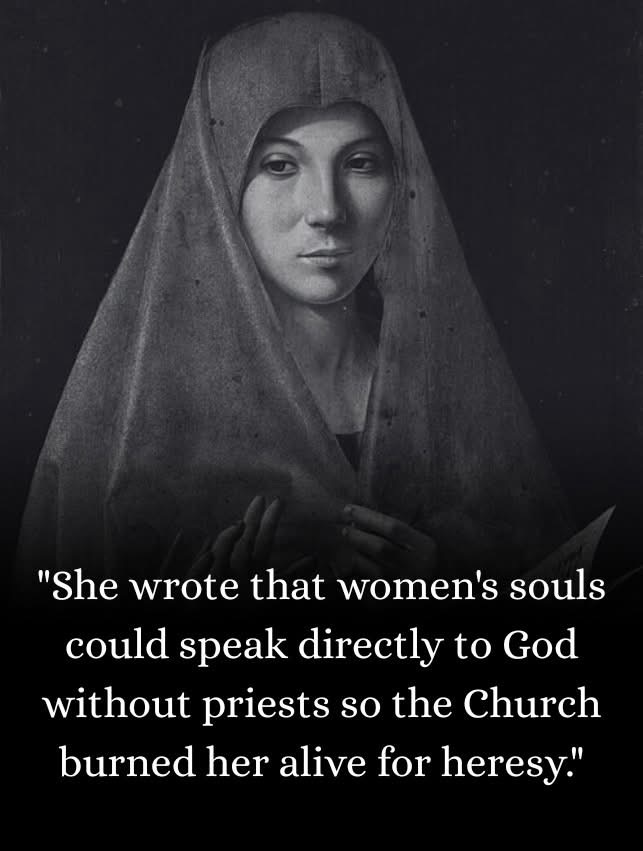
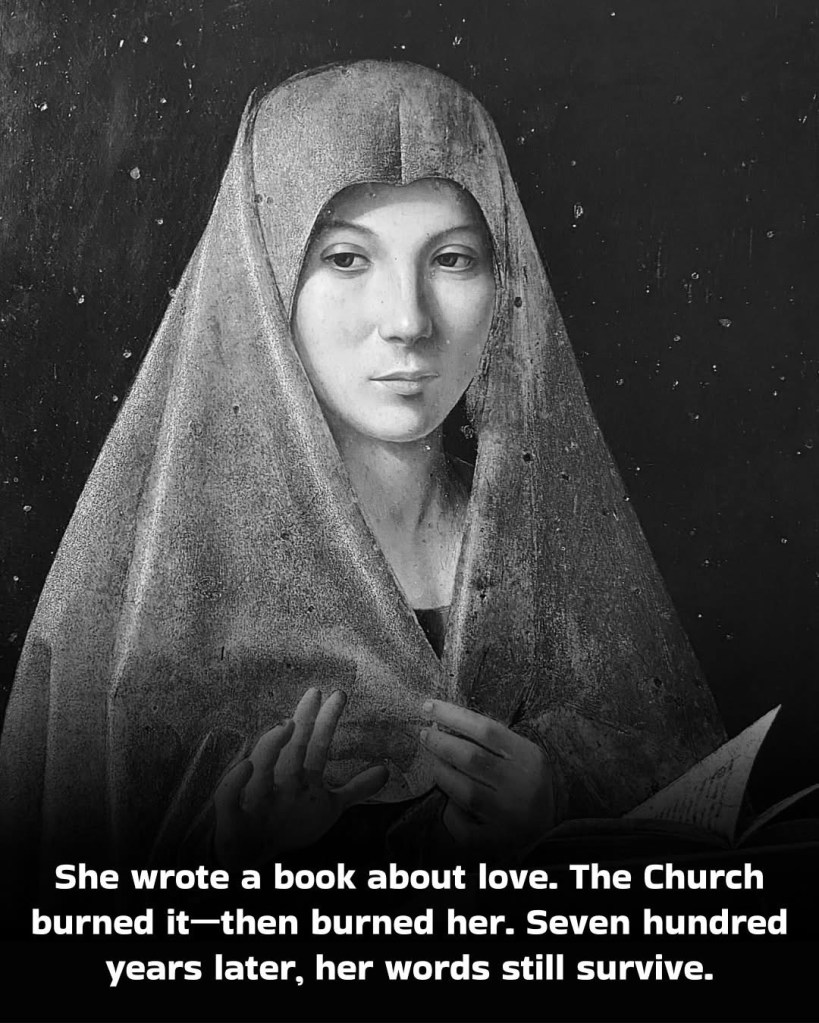
She wrote that women’s souls could speak directly to God without priestsβso the Church burned her alive for heresy.
Paris, June 1, 1310.
In the Place de GrΓ¨ve, a woman was led to the stake. Marguerite Porete, accused of heresy, had spent over a year imprisoned, refusing to answer the Inquisition’s questions or defend herself before judges she didn’t recognize as having authority over her soul. Witnesses later described her calm demeanorβno screaming, no begging for mercy, no recantation. She faced the flames with a serenity that unnerved her executioners.
She died for writing a book that claimed a soul could unite so completely with divine love that it transcended the need for Church hierarchy, sacraments, or ecclesiastical mediation. The Church couldn’t tolerate that claimβespecially from a woman.
Marguerite Porete was born in the late 13th century in Hainaut (modern-day France/Belgium border region). Little is known about her early life, but she became part of the Beguine movementβcommunities of lay religious women who lived together in prayer and work without taking formal monastic vows.
Beguines occupied a complicated space in medieval Christianity. They weren’t nuns bound by convent rules, but they weren’t ordinary laywomen either. They lived religious lives outside institutional Church controlβwhich made Church authorities nervous.
Marguerite was educated, literate, and theologically sophisticatedβunusual for a woman of her time.
Sometime in the late 13th century, she wrote βThe Mirror of Simple Soulsβ (Le Mirouer des simples Γ’mes) in vernacular Old French rather than Latin.
Writing theology in the vernacular was itself significant. Latin was the language of Church authorityβusing French made theology accessible to ordinary people, particularly women who hadn’t learned Latin.
But it was the book’s content that proved dangerous.
The Mirror of Simple Souls describes a mystical journey where the soul progressively lets go of attachments, ego, and even virtues until it reaches “annihilation”βcomplete dissolution into divine love. This “annihilated soul” becomes so united with God that it no longer needs:
Church sacraments Moral rules Priestly mediation Fear of sin Virtuous acts done out of obligation
Because the soul is completely aligned with divine will, it acts naturally from love rather than from external commands.
Marguerite wrote in dialogue form, with characters including “Love,” “Reason,” “The Soul,” and “Holy Church the Little” (institutional Church) versus “Holy Church the Great” (the mystical body of all souls united with God).
Crucially, she distinguished between institutional Church authority and direct divine relationship. “Holy Church the Little”βthe hierarchy, rules, and priestsβwas necessary for beginners on the spiritual path. But advanced souls could transcend it through complete union with God. This was explosive theology.
The Church’s authority rested on being the necessary mediator between humans and God.
Sacraments administered by priests were required for salvation. Confession, penance, Church lawβall of this presumed that people needed institutional guidance.
Marguerite was saying: at the highest spiritual level, you don’t need any of that. The soul united with God transcends institutional authority. Church authorities saw this as dangerous heresy. It suggested that mystics could claim direct divine authority superior to Church hierarchy. It implied that someone in mystical union might be beyond sin or moral lawβa heresy called “antinomianism. “And it was especially threatening coming from a woman.
The Church insisted women needed male spiritual authorityβpriests, confessors, bishopsβto guide them. A woman claiming direct divine relationship without male mediation challenged the entire gender hierarchy of medieval Christianity.
Around 1296-1306, Marguerite’s book was condemned by the Bishop of Cambrai. It was publicly burned, and she was warned to stop teaching her ideas. Marguerite ignored the warning. She continued circulating the book and discussing her theology. She sent copies to theologians and Church authorities seeking approval, but also continued teaching despite the prohibition.
This defiance was crucial. She had multiple opportunities to submit to Church authority, burn her book, recant her teachings, and avoid execution. She refused every time. Why? Because she believedβgenuinely, deeplyβthat her mystical experience and theological understanding came directly from God. No earthly authority, not even the Church, could invalidate that divine relationship.
In 1308, she was arrested in Paris. The Inquisition began proceedings against her. During her imprisonment (which lasted over a year), she refused to cooperate with the trial. She wouldn’t answer questions. She wouldn’t defend herself. She wouldn’t acknowledge the tribunal’s authority to judge her spiritual state. Her silence was deliberate and theological.
She believed the judgesβbound by “Holy Church the Little”βcouldn’t understand the mystical theology of souls who’d reached union with God. Answering them would be pointless.
The Inquisition found her guilty of heresy. They declared her a “relapsed heretic”βsomeone who’d been warned before and persisted in error. The penalty for relapsed heresy was death by burning.
On June 1, 1310, Marguerite was led to the Place de GrΓ¨ve in Paris. Accounts describe her facing execution with remarkable calmβno terror, no last-minute recantation, no screaming as the flames rose. Observers noted this serenity. Some interpreted it as demonic possession keeping her from repenting. Others saw it as proof she’d achieved the mystical state she’d written aboutβtranscendence of fear through complete union with divine love.
Marguerite Porete became one of the first women burned for heresy by the Inquisition in Paris. Her execution was meant to be a warning: women who claimed spiritual authority independent of Church hierarchy would be silenced permanently.
But her book survived. Copies circulated anonymously throughout the 14th and 15th centuries. Because Marguerite’s name was suppressed (she was executed as a heretic), the book was copied without author attribution. Monks, mystics, and scholars read it for centuries without knowing a woman had written it. Some copies attributed it to male authors.
The mystical theology was considered so sophisticated that people assumed a man must have written it.
In 1946, scholar Romana Guarnieri finally proved that Marguerite Porete was the author. The evidence included trial records and manuscript traditions connecting the condemned book to The Mirror of Simple Souls.
Suddenly, a text that had influenced Christian mysticism for centuries was recognized as written by a woman burned for heresy.
Modern scholars recognize The Mirror as a masterpiece of mystical theology. Its influence can be traced in later mystics including Meister Eckhart (who faced similar accusations of heresy).
Marguerite’s theology anticipated ideas that would later appear in Protestant Reformation critiques of institutional Church authority and in modern mystical and contemplative traditions.
Her story matters because: She claimed spiritual authority as a woman: In an era when women were required to be spiritually subordinate to men, she insisted her mystical experience gave her theological insight. She challenged institutional religious power: She distinguished between institutional authority and divine relationshipβa distinction that threatened Church hierarchy. She refused to recant: Given multiple chances to save herself by submitting to Church authority, she chose death over betraying her spiritual convictions.
She was right about mystical theology: Modern understanding of contemplative spirituality recognizes the validity of much of what she taught. Her work survived despite suppression: Burning her body didn’t destroy her ideasβthey circulated for centuries, eventually vindicated.
The tragedy is that Marguerite was executed for theology that, in different contexts or coming from a man, might have been tolerated or even celebrated.
Male mystics like Meister Eckhart taught similar ideas and, while investigated, weren’t executed. Her gender made her dangerous in ways male mystics weren’t. A woman claiming to transcend priestly authority threatened both religious and gender hierarchies simultaneously.
To Marguerite Porete: You wrote that the soul united with God needs no intermediaryβand the Church killed you for threatening their monopoly on salvation. You refused to recant even when recantation would have saved you. You chose death over betraying your mystical experience and theological convictions. Your silence before the Inquisition wasn’t weaknessβit was theological statement. You didn’t recognize their authority to judge what you knew through direct divine union. You faced the flames with the serenity you’d written aboutβthe transcendence of fear through complete surrender to divine love. They burned your body. They tried to erase your name. They suppressed your book. But your words survived. For centuries, they circulated anonymously, influencing mystics who didn’t know a woman had written them. When scholars finally proved you were the author, your genius was undeniable. You were right about mystical union. You were right that souls can experience God directly. You were right that love transcends institutional authority. The Church that executed you eventually had to acknowledge the validity of mystical theology like yours. The ideas they burned you for are now recognized as legitimate contemplative spirituality. You died for claiming women’s spiritual authority. For insisting divine love was greater than ecclesiastical power. For refusing to let priests mediate your relationship with God. That claim cost you your life. But it couldn’t be silenced. Your voice, speaking across seven centuries, still insists: the soul united with Love needs no permission to speak directly to God. They couldn’t burn that truth. And they couldn’t burn your courage.
Sheβs got a whole Universe of Kings and Queens, Gods and Goddesses, whatever the Upper Echelon of the Universe call themselves, the Counsil of Universes, for there are many, unified in their decision to elevate her.
She is alive because they have deemed her worthy of life. She has been given reprieve, for they have deemed her innocent of any crime, and are rewarding her for the centuries of torture she endured at the hands of man β¦ because she dare speak of love, because she dare be intelligent, because she dare expand into life and be recognized as a Woman who deeply loves Creation and the Life it holds β¦ gifts of the Mother Father Most High Divine.
They poisoned her and hurt her bad, physically and with magic β¦ they wished death upon her the whole of her life. They insist she isnβt responsible, even though she succeeded where they were certain she would fail. They were certain their efforts to deteriorate and disqualify her were sufficient. They are hollering, whining really, and insisting they have rights to her essence, energy, gifts ,,, soul and right to life.
They want to rule the universe. Theyβve been slave trading for centuries, announcing themselves conquerors, masters.
The universe came together without prejudice and chose this Woman Survivor as Representative. A whole Universe of teachers to teach, to guide, and the Most High Divine within all realms supervises it all.
This time, it will go a little differently.
But the trafficker insists it has rights to the merchandise of angels, so the transition is a little bumpy.
In the year 1310, a woman named Marguerite Porete was led to a stake in the heart of Paris, surrounded by a crowd of thousands. She had been condemned as a hereticβthe first person the Paris Inquisition would burn for refusing to recant.
Her crime was writing a book.
Marguerite Porete was born around 1250 in the County of Hainaut, in what is now Belgium. She was highly educated, likely from an aristocratic family, and she joined the Beguinesβa movement of women who devoted themselves to spiritual life without taking formal vows or submitting to male religious authority.
The Beguines lived by their own rules. They worked among the poor, prayed in their own communities, and sought God on their own terms. This freedom made Church authorities nervous. Women living outside male control, speaking about God without clerical permission, threatened the very foundations of institutional power.
Marguerite took this freedom further than most. Sometime in the 1290s, she wrote a mystical text called The Mirror of Simple Souls. It was a conversation between allegorical figuresβLove, Reason, and the Soulβdescribing seven stages of spiritual transformation. At its heart was a radical idea: that a soul could become so completely united with divine love that it no longer needed the Church’s rituals, rules, or intermediaries. In the highest states of union, the soul surrendered its will entirely to Godβand in that surrender, found perfect freedom.
βLove is God,” she wrote, “and God is Love.”
She did not write her book in Latin, the language of clergy and scholars. She wrote in Old Frenchβthe language ordinary people spoke. This meant her dangerous ideas could spread beyond monastery walls, beyond the control of priests and bishops.
And spread they did.
Between 1296 and 1306, the Bishop of Cambrai condemned her book as heretical. He ordered it burned publicly in the marketplace of Valenciennes, forcing Marguerite to watch her words turn to ash. He commanded her never to circulate her ideas again.
She refused.
Marguerite believed her book had been inspired by the Holy Spirit. She had consulted three respected theologians before publishing it, including the esteemed Master of Theology Godfrey of Fontaines, and they had approved. She would not let one bishop’s condemnation silence what she believed to be divine truth.
She continued sharing her book. She continued teaching. She continued insisting that the soul’s relationship with God belonged to no earthly institution.
In 1308, she was arrested and handed over to the Inquisitor of France, a Dominican friar named William of Parisβthe same man who served as confessor to King Philip IV, the monarch who was simultaneously destroying the Knights Templar. It was a busy time for burning heretics.
Marguerite was imprisoned in Paris for eighteen months. During that entire time, she refused to speak to her inquisitors. She would not take the oath required to proceed with her trial. She would not answer questions. She maintained absolute silenceβan act of defiance that infuriated the authorities.
A commission of twenty-one theologians from the University of Paris examined her book. They extracted fifteen propositions they deemed heretical. Among the most dangerous: the idea that an annihilated soul, fully united with God, could give nature what it desires without sinβbecause such a soul was no longer capable of sin.
To the Church, this suggested moral chaos. To Marguerite, it described the ultimate freedom of perfect surrender.
She was given every chance to recant. Others in similar positions saved their lives by confessing error. A man arrested alongside her, Guiard de Cressonessart, who had declared himself her defender, eventually broke under pressure and confessed. He was sentenced to life imprisonment.
Marguerite held firm.
On May 31, 1310, William of Paris formally declared her a relapsed hereticβmeaning she had returned to condemned beliefs after being warnedβand turned her over to secular authorities. The next day, June 1, she was led to the Place de GrΓ¨ve, the public square where executions took place.
The Inquisitor denounced her as a “pseudo-mulier”βa fake womanβas if her gender itself had been a lie, as if no real woman could defy the Church so completely.
They burned her alive.
But something unexpected happened in that crowd of thousands. According to the chronicle of Guillaume de Nangisβa monk who had no sympathy for her ideasβthe crowd was moved to tears by the calmness with which she faced her death.
She displayed, the chronicle noted, many signs of penitence “both noble and pious.” Her serenity unnerved those who expected a screaming heretic. Instead, they witnessed a woman who seemed to have already transcended the fire that consumed her body.
The Church ordered every copy of The Mirror of Simple Souls destroyed. They wanted her words erased from history along with her life.
They failed.
Her book survived. Copies circulated secretly, passed from hand to hand across Europe. It was translated into Latin, Italian, and Middle English. For centuries, it was read anonymouslyβno one knew who had written it. The text was too powerful to disappear, even without a name attached.
It was not until 1946βmore than six hundred years after her deathβthat a scholar named Romana Guarnieri, researching manuscripts in the Vatican Library, finally connected The Mirror of Simple Souls to its author. The woman the Church had tried to erase was finally given back her name.
Today, Marguerite Porete is recognized as one of the most important mystics of the medieval period. Scholars compare her ideas to those of Meister Eckhart, one of the most celebrated theologians of the eraβand some believe Eckhart may have been influenced by her work. The book that was burned as heresy is now studied in universities as a masterpiece of spiritual literature.
Her ideas about love transcending institutional control, about the soul finding God directly without intermediaries, about surrender leading to freedomβthese are not the ravings of a dangerous heretic. They are the insights of a woman centuries ahead of her time.
The Church that killed her eventually softened its stance on mystical experience. The Council of Vienne in 1312 condemned eight errors from her book, but the broader current of Christian mysticism she represented would continue flowing through figures like Julian of Norwich, Teresa of Γvila, and countless others who sought direct encounter with the divine.
What the flames could not destroy was the truth she had grasped: that love, in its purest form, is greater than fear. That no institution can ultimately control the relationship between a soul and its source. That words born from genuine spiritual insight have a way of surviving every attempt to silence them.
Marguerite Porete spent her final years in silenceβrefusing to speak to those who demanded she deny her truth. But her book has been speaking for seven centuries.
I hold my face in my two hands. No. I am not crying. I hold my face in my two hands to keep my loneliness warm ~ two hands protecting, two hands nourishing, two hands preventing my soul from leaving me in anger.
With each year I become more grounded, As my soul becomes more free, I’ve grown roots that keep me stable, I’m finally enjoying being me.
Life is now rich with simplicity, I avoid the drama that some may bring, I’m happy in my own company, My heart has learned how to sing.
In each new silver hair I rejoice, Aging is a blessing, some never know, My journey has brought me so far, And hopefully, still, some way to go.
I cherish each precious moment, The laughter shared, the silent peace, In every chapter, I now stand stoic, With wisdom my worries cease.
So here’s to the years that shape and mold, With knowledge gained and stories to tell, I embrace the path that I have walked, In this seasoned body, I’m happy to dwell ..
You canβt really see it, but under the back window was the word RIGID, and on the tailgate was the word ROYAL. These Mysogonists had opportunity to receive a Loving Royal, she served them while they hurt her real bad. God took her away from them and told her she will never give it back. Now, God has made her Rigid β¦. Those who harmed her and her family last cycle wonβt be meeting the same Royal this cycle.
She was chained to a saloon bed at fifteen and told her life belonged to men with money. By twenty, Lydia βRedβ McGraw had seen enough of Dodge Cityβs whiskey-soaked nights and the fists of cattle bosses who treated her like property. One evening, when a drunken foreman tried to lock her in her room, she smiled, nodded, and waited. At midnight she poured lamp oil down the staircase, struck a match, and walked away as the building roared into an inferno. The flames took her jailors, her chains, and the life she refused to endure another day.
It wasnβt escape aloneβit was rebirth. Red vanished into the plains, her name whispered like smoke trailing behind the ashes. For months she lived by instinct, scavenging, hiding, keeping one step ahead of those who tried to drag her back. But the fire inside her burned hotter than fear. She found others like herβwomen with bruised pasts, stolen freedom, and nothing left to lose. Together they turned outlaw, revolvers at their hips, robbing stagecoaches and wagons with a cold efficiency that left men stunned to see women holding the guns.
By the time the 1870s rolled on, Red McGraw was no longer a broken saloon girlβshe was an outlaw queen whose legend stretched from Kansas to Colorado. Some called her a devil, others a folk hero, but all agreed on one thing: when the Golden Spur burned, something more dangerous than flames had been born. Her story asks the questionβwhat would you do if the only way to escape your cage was to burn it down?
I won’t share certain info, because many people in the world view a specific entity posing as a human, their savior, their best friend. This entity hacks intellectual property of prophets and prophetesses and claims the connection to Source as their own. They are in no way in alignment with the Most High God. They want to BE your god, and shut down your mind in another cycle, endless feeding upon your energetic supply.
βββββββββββ-
I Love My Sweetheart. I Am Grateful for the Understanding regarding Interference, masquerading as Self. I Am so Grateful for the Intelligence that resides in My Love and Family Divine, those who know we experience the program, yet we are NOT the program. Amen. Wado.
βββββββββββ-
It is a shame that these role-playing tyrants have pushed the Mother Divine, in many of her aspects, so far as to destroy any care she might have had for them. Centuries, they’ve proven their intent to utterly bury women, and her children, under a painful shameful existence, carrying the burden of blame for their wickedness. Now, they’re flustered because She who was trapped has been released and freed by God. Led back home. The big bad bullies have lost her power β¦ they’re threatening to destroy it all unless God gives her back β¦ childish tantrums from overgrown boys who never became anything worth-while but still want to pretend. They must have her essence!!!! They must find a Judas!! I do not believe that the Mother, who has been graped and redrummed in horrible ways for centuries, cares whether they live or die. She already knows their lives have been extended well beyond their allotted years due to energy harvesting. The Most High God has stated, “They’ll get what they deserve.” and “This is the end of their relationship with batteries.” The Mother has stated that her daughters will NOT be obtained by these people. The abusers will not be feeding on, or harvesting her energy to hurt others any longer.