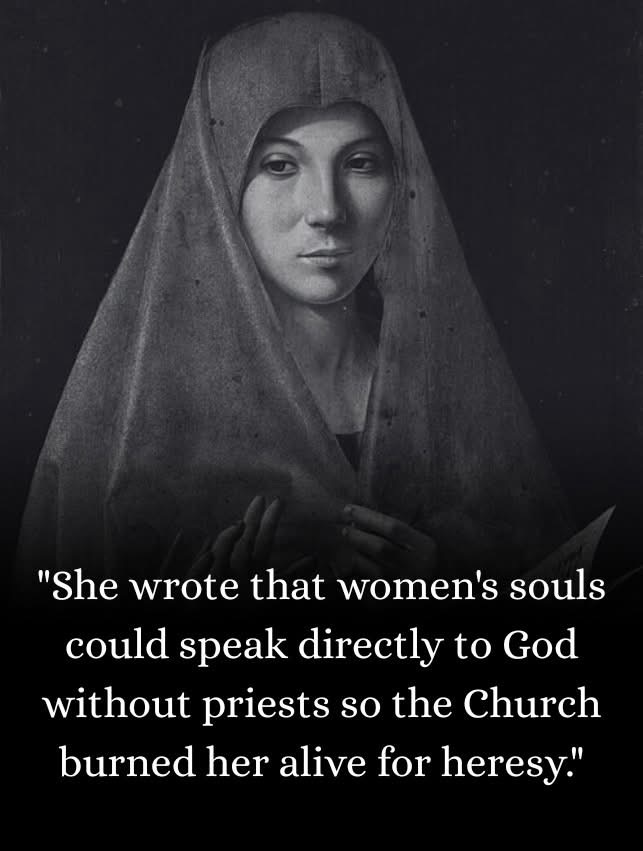
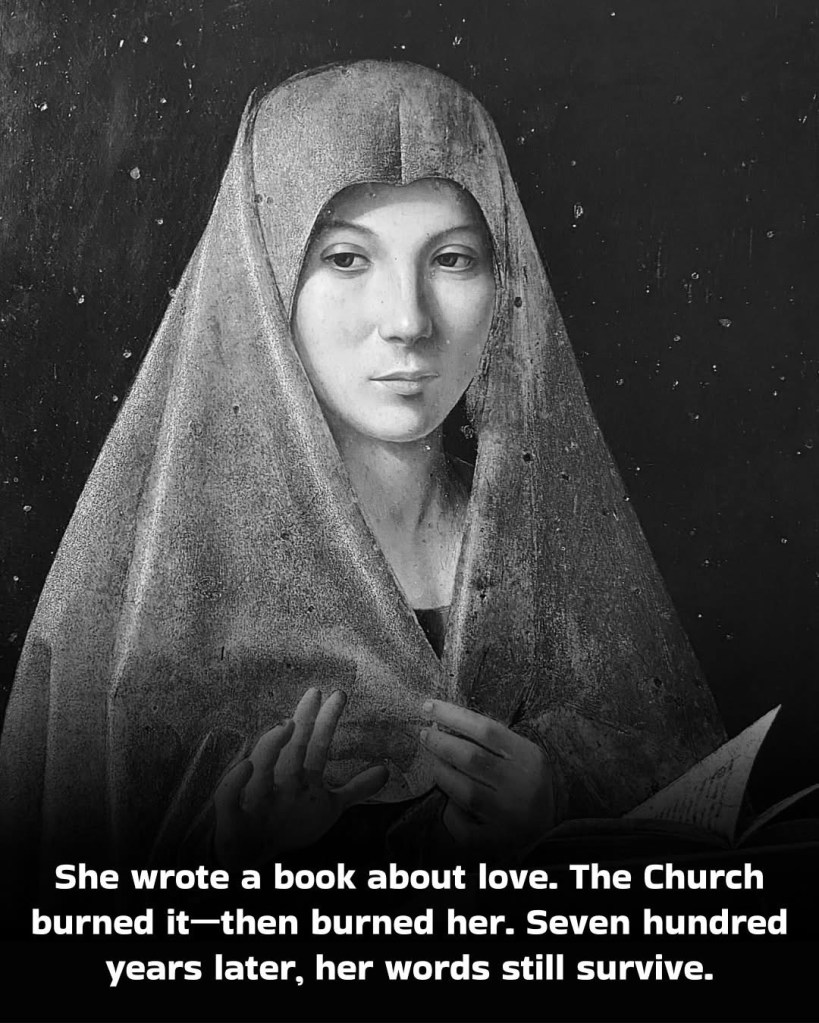
She wrote that women’s souls could speak directly to God without priests—so the Church burned her alive for heresy.
Paris, June 1, 1310.
In the Place de Grève, a woman was led to the stake. Marguerite Porete, accused of heresy, had spent over a year imprisoned, refusing to answer the Inquisition’s questions or defend herself before judges she didn’t recognize as having authority over her soul. Witnesses later described her calm demeanor—no screaming, no begging for mercy, no recantation. She faced the flames with a serenity that unnerved her executioners.
She died for writing a book that claimed a soul could unite so completely with divine love that it transcended the need for Church hierarchy, sacraments, or ecclesiastical mediation. The Church couldn’t tolerate that claim—especially from a woman.
Marguerite Porete was born in the late 13th century in Hainaut (modern-day France/Belgium border region). Little is known about her early life, but she became part of the Beguine movement—communities of lay religious women who lived together in prayer and work without taking formal monastic vows.
Beguines occupied a complicated space in medieval Christianity. They weren’t nuns bound by convent rules, but they weren’t ordinary laywomen either. They lived religious lives outside institutional Church control—which made Church authorities nervous.
Marguerite was educated, literate, and theologically sophisticated—unusual for a woman of her time.
Sometime in the late 13th century, she wrote “The Mirror of Simple Souls” (Le Mirouer des simples âmes) in vernacular Old French rather than Latin.
Writing theology in the vernacular was itself significant. Latin was the language of Church authority—using French made theology accessible to ordinary people, particularly women who hadn’t learned Latin.
But it was the book’s content that proved dangerous.
The Mirror of Simple Souls describes a mystical journey where the soul progressively lets go of attachments, ego, and even virtues until it reaches “annihilation”—complete dissolution into divine love. This “annihilated soul” becomes so united with God that it no longer needs:
Church sacraments Moral rules Priestly mediation Fear of sin Virtuous acts done out of obligation
Because the soul is completely aligned with divine will, it acts naturally from love rather than from external commands.
Marguerite wrote in dialogue form, with characters including “Love,” “Reason,” “The Soul,” and “Holy Church the Little” (institutional Church) versus “Holy Church the Great” (the mystical body of all souls united with God).
Crucially, she distinguished between institutional Church authority and direct divine relationship. “Holy Church the Little”—the hierarchy, rules, and priests—was necessary for beginners on the spiritual path. But advanced souls could transcend it through complete union with God. This was explosive theology.
The Church’s authority rested on being the necessary mediator between humans and God.
Sacraments administered by priests were required for salvation. Confession, penance, Church law—all of this presumed that people needed institutional guidance.
Marguerite was saying: at the highest spiritual level, you don’t need any of that. The soul united with God transcends institutional authority. Church authorities saw this as dangerous heresy. It suggested that mystics could claim direct divine authority superior to Church hierarchy. It implied that someone in mystical union might be beyond sin or moral law—a heresy called “antinomianism. “And it was especially threatening coming from a woman.
The Church insisted women needed male spiritual authority—priests, confessors, bishops—to guide them. A woman claiming direct divine relationship without male mediation challenged the entire gender hierarchy of medieval Christianity.
Around 1296-1306, Marguerite’s book was condemned by the Bishop of Cambrai. It was publicly burned, and she was warned to stop teaching her ideas. Marguerite ignored the warning. She continued circulating the book and discussing her theology. She sent copies to theologians and Church authorities seeking approval, but also continued teaching despite the prohibition.
This defiance was crucial. She had multiple opportunities to submit to Church authority, burn her book, recant her teachings, and avoid execution. She refused every time. Why? Because she believed—genuinely, deeply—that her mystical experience and theological understanding came directly from God. No earthly authority, not even the Church, could invalidate that divine relationship.
In 1308, she was arrested in Paris. The Inquisition began proceedings against her. During her imprisonment (which lasted over a year), she refused to cooperate with the trial. She wouldn’t answer questions. She wouldn’t defend herself. She wouldn’t acknowledge the tribunal’s authority to judge her spiritual state. Her silence was deliberate and theological.
She believed the judges—bound by “Holy Church the Little”—couldn’t understand the mystical theology of souls who’d reached union with God. Answering them would be pointless.
The Inquisition found her guilty of heresy. They declared her a “relapsed heretic”—someone who’d been warned before and persisted in error. The penalty for relapsed heresy was death by burning.
On June 1, 1310, Marguerite was led to the Place de Grève in Paris. Accounts describe her facing execution with remarkable calm—no terror, no last-minute recantation, no screaming as the flames rose. Observers noted this serenity. Some interpreted it as demonic possession keeping her from repenting. Others saw it as proof she’d achieved the mystical state she’d written about—transcendence of fear through complete union with divine love.
Marguerite Porete became one of the first women burned for heresy by the Inquisition in Paris. Her execution was meant to be a warning: women who claimed spiritual authority independent of Church hierarchy would be silenced permanently.
But her book survived. Copies circulated anonymously throughout the 14th and 15th centuries. Because Marguerite’s name was suppressed (she was executed as a heretic), the book was copied without author attribution. Monks, mystics, and scholars read it for centuries without knowing a woman had written it. Some copies attributed it to male authors.
The mystical theology was considered so sophisticated that people assumed a man must have written it.
In 1946, scholar Romana Guarnieri finally proved that Marguerite Porete was the author. The evidence included trial records and manuscript traditions connecting the condemned book to The Mirror of Simple Souls.
Suddenly, a text that had influenced Christian mysticism for centuries was recognized as written by a woman burned for heresy.
Modern scholars recognize The Mirror as a masterpiece of mystical theology. Its influence can be traced in later mystics including Meister Eckhart (who faced similar accusations of heresy).
Marguerite’s theology anticipated ideas that would later appear in Protestant Reformation critiques of institutional Church authority and in modern mystical and contemplative traditions.
Her story matters because: She claimed spiritual authority as a woman: In an era when women were required to be spiritually subordinate to men, she insisted her mystical experience gave her theological insight. She challenged institutional religious power: She distinguished between institutional authority and divine relationship—a distinction that threatened Church hierarchy. She refused to recant: Given multiple chances to save herself by submitting to Church authority, she chose death over betraying her spiritual convictions.
She was right about mystical theology: Modern understanding of contemplative spirituality recognizes the validity of much of what she taught. Her work survived despite suppression: Burning her body didn’t destroy her ideas—they circulated for centuries, eventually vindicated.
The tragedy is that Marguerite was executed for theology that, in different contexts or coming from a man, might have been tolerated or even celebrated.
Male mystics like Meister Eckhart taught similar ideas and, while investigated, weren’t executed. Her gender made her dangerous in ways male mystics weren’t. A woman claiming to transcend priestly authority threatened both religious and gender hierarchies simultaneously.
To Marguerite Porete: You wrote that the soul united with God needs no intermediary—and the Church killed you for threatening their monopoly on salvation. You refused to recant even when recantation would have saved you. You chose death over betraying your mystical experience and theological convictions. Your silence before the Inquisition wasn’t weakness—it was theological statement. You didn’t recognize their authority to judge what you knew through direct divine union. You faced the flames with the serenity you’d written about—the transcendence of fear through complete surrender to divine love. They burned your body. They tried to erase your name. They suppressed your book. But your words survived. For centuries, they circulated anonymously, influencing mystics who didn’t know a woman had written them. When scholars finally proved you were the author, your genius was undeniable. You were right about mystical union. You were right that souls can experience God directly. You were right that love transcends institutional authority. The Church that executed you eventually had to acknowledge the validity of mystical theology like yours. The ideas they burned you for are now recognized as legitimate contemplative spirituality. You died for claiming women’s spiritual authority. For insisting divine love was greater than ecclesiastical power. For refusing to let priests mediate your relationship with God. That claim cost you your life. But it couldn’t be silenced. Your voice, speaking across seven centuries, still insists: the soul united with Love needs no permission to speak directly to God. They couldn’t burn that truth. And they couldn’t burn your courage.
Occasionally, there are thought flows in the mind, a receptive glimpse into the collective energies of the world. It is sad. The mind says, “Can’t trust anyone, cannot be certain of this protection. Rejection has been the truth of cycles long gone, over and over, we do our work to be shut down, forgotten”.
The mind, the heart, the wounding of Collective Soul is so deep, so potent it nearly swallows the heart and the love energy, it begins to shift the thinking, the perception … and the senses begin to reject the safety, because the senses of the past remind us that eventually, the protection will disappear and once more we’ll be the only one left to guard our soul … and it is sad, even more so, that the cruelty of the soul shattering, spirit rending, flesh tearing trauma has been done by the hands of a man (for the most part) lifetime after lifetime … those men, made in the image of God, those hands meant to protect, have done their very best to destroy.
My heart, my soul, screams sometimes to “step back” !!!!!!! Do not get too comfortable !!!!! and I can feel myself pushing against that which is trying to love me. And it is hard …. perhaps you can relate?
I am grateful that if I sit with it for a while, if I allow myself to feel the shock and the hurt of it, to pray about it, ask for ease and grace, assistance with transmuting it … for Self, for the Collective Soul of Humanity … that after some time of focus and intent, the sensation fades, the upset of the mind trying to reject ~ eases ~ and I am able to smile once more and relax into the love of the connection.
I wonder sometimes what God thinks when He looks into my mind and sees me wrestling with my own past trauma, and the actual expansion into the Collective Human Soul, feeling even more of ‘centuries old traumas’ stored, sitting with it, while it is alchemized …
Thank you family, for I know you, too, are sitting with the Collective Human Soul shattering, bringing light love and healing to it, as you do for your own, personal healing. Thank you.
She’s got a whole Universe of Kings and Queens, Gods and Goddesses, whatever the Upper Echelon of the Universe call themselves, the Counsil of Universes, for there are many, unified in their decision to elevate her.
She is alive because they have deemed her worthy of life. She has been given reprieve, for they have deemed her innocent of any crime, and are rewarding her for the centuries of torture she endured at the hands of man … because she dare speak of love, because she dare be intelligent, because she dare expand into life and be recognized as a Woman who deeply loves Creation and the Life it holds … gifts of the Mother Father Most High Divine.
They poisoned her and hurt her bad, physically and with magic … they wished death upon her the whole of her life. They insist she isn’t responsible, even though she succeeded where they were certain she would fail. They were certain their efforts to deteriorate and disqualify her were sufficient. They are hollering, whining really, and insisting they have rights to her essence, energy, gifts ,,, soul and right to life.
They want to rule the universe. They’ve been slave trading for centuries, announcing themselves conquerors, masters.
The universe came together without prejudice and chose this Woman Survivor as Representative. A whole Universe of teachers to teach, to guide, and the Most High Divine within all realms supervises it all.
This time, it will go a little differently.
But the trafficker insists it has rights to the merchandise of angels, so the transition is a little bumpy.
This sort of freaks me out, knowing they inject the babies right away. What are they “really” doing?
Some hints in here .. matrix, blue minds, 3D world…so many in a short clip…animals, cannibals, can you decode/decipher it all…?
**Decoded/ Deciphered by Vrill Slayer Posted by Mel Raggam
Gematria
Some hints in here .. matrix, blue minds, 3D world…so many in a short clip…animals, cannibals, can you decode/decipher it all…?
From the lyrics of Iniko.
Snippet From My Cosmic Burst in Simple Gematria equals 331 x 6 = 1986
= The Neptunes Presents Clones
From two rap artists including Pharrell Williams having an album named Clones as human clones exposed by Donald Marshall.
= Science Fiction Movies Are Reality
We have all viewed movies and TV series that call it science fiction but art imitates reality they are trying to warn you, hint you of the technology that is used on mankind – hinting human cloning, body snatching Vrill that turn into hosts as the technology for consciousness transfer put into an Avatar or clone even downloading dead consciousness to be put into a synthetic body.
= Brain Invaders Must Be Destroyed
This is relation to body snatchers as those who do human experimentation on people through MK Ultra, invading the mind for control, torture through clone after clone.
= Brain Chip Implant The Witness
As those who are chipped that go through REM even those who aren’t chipped. Donald Marshall which exposed about the RFID chip used to download dead consciousness to individuals who become coherent and submissive. This also includes remote neural monitoring.
= They Just Pick Up Another Body
Leah Remini who used to be part of Scientology mentioned in her tweet that those who die they just pick up another body recalling their memories to be put into a new body. Think of movies like Self/Less or Replicas.
19 + 86 = 105
Full Reduction ‘105’ codes
= SIX HUNDRED AND SIXTY SIX
Root of this technology is THE MARK OT THE BEAST.
= MILITARY INTELLIGENCE
Known as Military Industrial Complex which is know also from when making super soldiers as they reference the MILITARY INTELLIGENCE codes from the movie.
Star Children I Got News For You in Simple Gematria equals 343 x 6 = 2058
= Infiltration Instead Of Invasion
A quote by JFK in 1961 before assassinated exposing secret societies. They infiltrate to parasite instead to invade.
= Fallen Angels Are The Actual Illuminati
Known as the Annunaki, the Sumerian gods, known as the sons of God or the Watchers – they are the original Illuminati the renown as the Freemasons are just puppets of Lucifer.
The star children are related to those who are called starseeds or the Pleiadians of the Galactic Federation – Donald Marshall exposed them to be Vrill hosts they are parasites wanting to infiltrate and take over hosting humans to be drones.
= Are We Living In A Simulated Reality = Everything Is Hidden In Plain Sight
The world has become a simulation or altered realities, brainwashing and programming of the mind such with media, social media and today’s social environment.
= Grey Alien DNA Forms A Proto Species
The term grey aliens are the Vrill Type 3 people know them as aliens from outerspace but they’re form deep inner earth and not outer space. Proto species would be half reptilian hybrids that become cybernetic machines modified DNA turning humans into hosts – this also relates in the realms of Transhumanism.
= Donald Marshall The Soulstone Chip
For the years Donald Marshall has spoken about this even of today. Putting souls into devices to the next clone. The cube of Saturn which contains cube shape devices of trapped souls.
“..this is a 3D world it’s corrupt and blue..”
This Is A Three D World in Simple Gematria equals 217 x 6 = 1302
= Dont Worry Darling
A movie which has a character name Alice put into a simulated world of a false reality which she later founds out. Think of terms like Alice in Wonderland.
= Subconsciousness
That which the subconscious mind becomes altered from reality. Think of Dorothy in Oz or Alice in Wonderland. This relates to also Don’t Worry Darling or the movie Inception.
“Switching people out. Taking out the soul and putting a different person in the body” … it’s what this curator is threatening to do to the Magistrate, the Planetary Gatekeeper.
Body snatching and consciousness transfer – This is how the nephilim live thousands of years. pic.twitter.com/boCkAtpgss
This is why the elite like “blood transfusions”. They like to “be seen as” and angel, and they “harvest” them for these fluids, for this “blood-born and known” angelic identity and the “life” it holds. Vampires think of us as a commodity. Theyve been asking if a woman is “compatible” and are told “she’s compatible with everyone” so she must be O+ / O-. (O positive (O+) is not the universal blood type for everyone; O negative (O-) is the true universal red blood cell donor, meaning it can go to any patient in emergencies, but O positive is the most common and often used in trauma when types are unknown because most people have positive blood. O+ can donate to all positive types (A+, B+, AB+, O+), making it widely needed, but O- lacks A, B, and Rh antigens, allowing it to be given to anyone.)
“The blood holds the life.” — Deuteronomy 12:23–24
In Hoodoo understanding, this verse is not poetic language—it is spiritual law. Blood is not just fluid; it is carrier, witness, and record. Scripture says plainly that the life (the nephesh) is in the blood, meaning that memory, lineage, trauma, blessing, and covenant all move through it. This is why Hoodoo work is careful, ethical, and lineage-aware: when you touch blood—literally or symbolically—you are touching life itself.
From a Hoodoo perspective, blood explains why ancestry matters. What our ancestors endured did not disappear when their bodies returned to the earth; it traveled forward in bloodlines. This is why certain gifts, fears, illnesses, strengths, and callings appear generation after generation. Blood remembers. It carries spiritual residue—both wounds and wisdom. Hoodoo is not about escaping that truth, but working with it responsibly: cleansing what was harmed, strengthening what was righteous, and restoring what was broken.
This is also why Hoodoo rejects reckless manipulation. If life is in the blood, then forcing outcomes, binding wills, or acting without discernment is a violation of divine order. Elders taught that improper work “comes back through the blood,” affecting family, health, and spirit. True root-work seeks alignment, not domination—because blood answers to Yah, not human ego.
Blood also explains why prayer works. When Psalms are spoken, when hands are laid on, when healing is done righteously, the work reaches beyond the surface and speaks to the blood—to the deepest level of being. Healing the blood means healing the soul, the lineage, and the future.
In short, Deuteronomy 12:23–24 teaches the foundation of Hoodoo wisdom: life is sacred, lineage is real, and spiritual work must honor the blood it touches. To work roots without respecting blood is to work blindly. To honor the blood is to honor life itself.
Ada Morrison was committed to Connecticut asylum in 1893, age thirty, by husband who wanted younger wife. Commitment reason: “excessive reading and intellectual pretensions unsuitable for woman.” Ada had taught school before marriage, read constantly, discussed politics. Husband said this proved mental instability. Two doctors examined her for ten minutes, agreed intelligent woman was clearly insane. Ada was locked in asylum for four years, labeled insane for being educated. She escaped eight times. Caught seven times. Succeeded once. Took four years of attempts—climbing windows, picking locks, bribing guards, hiding in laundry carts. Ada’s intelligence that got her committed was same intelligence that freed her.
This tintype from 1897 shows Ada after final successful escape, age thirty-four, displaying scars from previous attempts—broken arm from second-floor fall, burn marks from climbing hot steam pipes, lash marks from punishment after failed escapes. She holds commitment papers declaring her “mentally deficient with delusions of intellectual capability.” Ada had graduated college. Taught school for six years. Read Latin and Greek. Asylum declared this insanity. Her husband declared it embarrassing. Her intelligence declared it crime. Ada spent four years proving she was sane enough to escape place she was imprisoned for being smart.
Ada reached New York after escape, changed name to Sarah Bennett, worked as clerk hiding education level to avoid suspicion. Never contacted family—they’d supported commitment. Never remarried—couldn’t trust man with legal power over her freedom. Lived quietly for thirty-eight years, died in 1935, age seventy-two, having spent thirty-eight years hiding intelligence that had nearly destroyed her. Ada had been imprisoned for reading. Spent rest of life pretending she barely could. That was survival in world that called educated women insane.
After her death, landlady found Ada’s room filled with books—hundreds of volumes hidden behind false wall. Ada had kept reading despite risk, kept learning despite having been punished for it, kept thinking despite it being dangerous for woman in her era. Also found: diary documenting eight escape attempts with detailed notes about asylum security, guard rotations, lock mechanisms. Ada had been brilliant enough to escape asylum that imprisoned brilliant women.
Her commitment papers are now in women’s history museum: “Ada Morrison was committed for reading too much. Escaped asylum eight times before succeeding. Spent 38 years hiding intelligence that prison couldn’t contain. She was insane for being smart. World was insane for calling that illness.”
In the year 1310, a woman named Marguerite Porete was led to a stake in the heart of Paris, surrounded by a crowd of thousands. She had been condemned as a heretic—the first person the Paris Inquisition would burn for refusing to recant.
Her crime was writing a book.
Marguerite Porete was born around 1250 in the County of Hainaut, in what is now Belgium. She was highly educated, likely from an aristocratic family, and she joined the Beguines—a movement of women who devoted themselves to spiritual life without taking formal vows or submitting to male religious authority.
The Beguines lived by their own rules. They worked among the poor, prayed in their own communities, and sought God on their own terms. This freedom made Church authorities nervous. Women living outside male control, speaking about God without clerical permission, threatened the very foundations of institutional power.
Marguerite took this freedom further than most. Sometime in the 1290s, she wrote a mystical text called The Mirror of Simple Souls. It was a conversation between allegorical figures—Love, Reason, and the Soul—describing seven stages of spiritual transformation. At its heart was a radical idea: that a soul could become so completely united with divine love that it no longer needed the Church’s rituals, rules, or intermediaries. In the highest states of union, the soul surrendered its will entirely to God—and in that surrender, found perfect freedom.
“Love is God,” she wrote, “and God is Love.”
She did not write her book in Latin, the language of clergy and scholars. She wrote in Old French—the language ordinary people spoke. This meant her dangerous ideas could spread beyond monastery walls, beyond the control of priests and bishops.
And spread they did.
Between 1296 and 1306, the Bishop of Cambrai condemned her book as heretical. He ordered it burned publicly in the marketplace of Valenciennes, forcing Marguerite to watch her words turn to ash. He commanded her never to circulate her ideas again.
She refused.
Marguerite believed her book had been inspired by the Holy Spirit. She had consulted three respected theologians before publishing it, including the esteemed Master of Theology Godfrey of Fontaines, and they had approved. She would not let one bishop’s condemnation silence what she believed to be divine truth.
She continued sharing her book. She continued teaching. She continued insisting that the soul’s relationship with God belonged to no earthly institution.
In 1308, she was arrested and handed over to the Inquisitor of France, a Dominican friar named William of Paris—the same man who served as confessor to King Philip IV, the monarch who was simultaneously destroying the Knights Templar. It was a busy time for burning heretics.
Marguerite was imprisoned in Paris for eighteen months. During that entire time, she refused to speak to her inquisitors. She would not take the oath required to proceed with her trial. She would not answer questions. She maintained absolute silence—an act of defiance that infuriated the authorities.
A commission of twenty-one theologians from the University of Paris examined her book. They extracted fifteen propositions they deemed heretical. Among the most dangerous: the idea that an annihilated soul, fully united with God, could give nature what it desires without sin—because such a soul was no longer capable of sin.
To the Church, this suggested moral chaos. To Marguerite, it described the ultimate freedom of perfect surrender.
She was given every chance to recant. Others in similar positions saved their lives by confessing error. A man arrested alongside her, Guiard de Cressonessart, who had declared himself her defender, eventually broke under pressure and confessed. He was sentenced to life imprisonment.
Marguerite held firm.
On May 31, 1310, William of Paris formally declared her a relapsed heretic—meaning she had returned to condemned beliefs after being warned—and turned her over to secular authorities. The next day, June 1, she was led to the Place de Grève, the public square where executions took place.
The Inquisitor denounced her as a “pseudo-mulier”—a fake woman—as if her gender itself had been a lie, as if no real woman could defy the Church so completely.
They burned her alive.
But something unexpected happened in that crowd of thousands. According to the chronicle of Guillaume de Nangis—a monk who had no sympathy for her ideas—the crowd was moved to tears by the calmness with which she faced her death.
She displayed, the chronicle noted, many signs of penitence “both noble and pious.” Her serenity unnerved those who expected a screaming heretic. Instead, they witnessed a woman who seemed to have already transcended the fire that consumed her body.
The Church ordered every copy of The Mirror of Simple Souls destroyed. They wanted her words erased from history along with her life.
They failed.
Her book survived. Copies circulated secretly, passed from hand to hand across Europe. It was translated into Latin, Italian, and Middle English. For centuries, it was read anonymously—no one knew who had written it. The text was too powerful to disappear, even without a name attached.
It was not until 1946—more than six hundred years after her death—that a scholar named Romana Guarnieri, researching manuscripts in the Vatican Library, finally connected The Mirror of Simple Souls to its author. The woman the Church had tried to erase was finally given back her name.
Today, Marguerite Porete is recognized as one of the most important mystics of the medieval period. Scholars compare her ideas to those of Meister Eckhart, one of the most celebrated theologians of the era—and some believe Eckhart may have been influenced by her work. The book that was burned as heresy is now studied in universities as a masterpiece of spiritual literature.
Her ideas about love transcending institutional control, about the soul finding God directly without intermediaries, about surrender leading to freedom—these are not the ravings of a dangerous heretic. They are the insights of a woman centuries ahead of her time.
The Church that killed her eventually softened its stance on mystical experience. The Council of Vienne in 1312 condemned eight errors from her book, but the broader current of Christian mysticism she represented would continue flowing through figures like Julian of Norwich, Teresa of Ávila, and countless others who sought direct encounter with the divine.
What the flames could not destroy was the truth she had grasped: that love, in its purest form, is greater than fear. That no institution can ultimately control the relationship between a soul and its source. That words born from genuine spiritual insight have a way of surviving every attempt to silence them.
Marguerite Porete spent her final years in silence—refusing to speak to those who demanded she deny her truth. But her book has been speaking for seven centuries.













 opensenseme