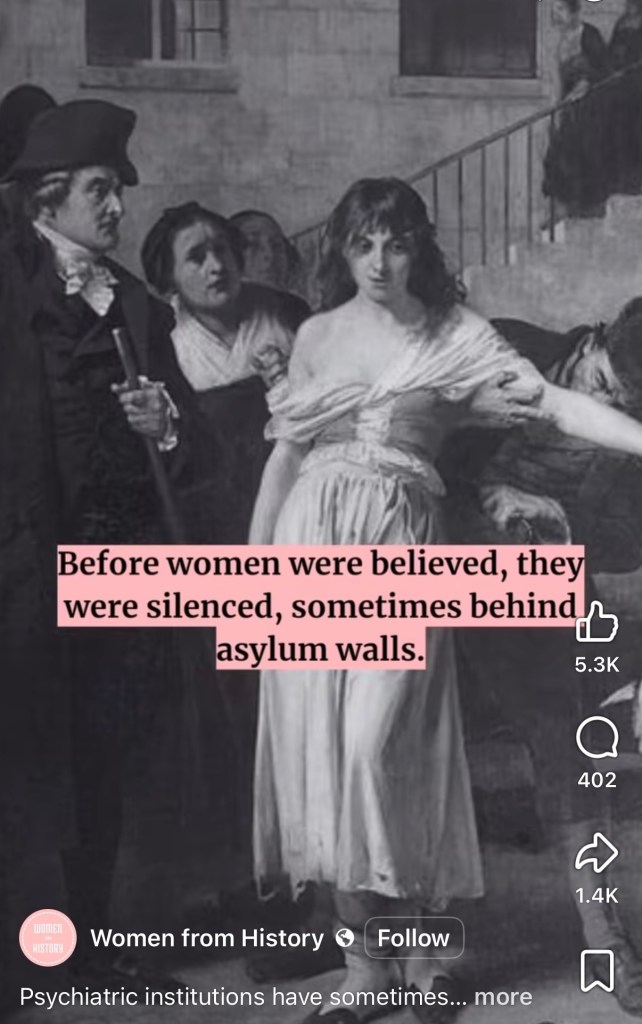
Ada Morrison was committed to Connecticut asylum in 1893, age thirty, by husband who wanted younger wife. Commitment reason: “excessive reading and intellectual pretensions unsuitable for woman.” Ada had taught school before marriage, read constantly, discussed politics. Husband said this proved mental instability. Two doctors examined her for ten minutes, agreed intelligent woman was clearly insane. Ada was locked in asylum for four years, labeled insane for being educated. She escaped eight times. Caught seven times. Succeeded once. Took four years of attempts—climbing windows, picking locks, bribing guards, hiding in laundry carts. Ada’s intelligence that got her committed was same intelligence that freed her.
This tintype from 1897 shows Ada after final successful escape, age thirty-four, displaying scars from previous attempts—broken arm from second-floor fall, burn marks from climbing hot steam pipes, lash marks from punishment after failed escapes. She holds commitment papers declaring her “mentally deficient with delusions of intellectual capability.” Ada had graduated college. Taught school for six years. Read Latin and Greek. Asylum declared this insanity. Her husband declared it embarrassing. Her intelligence declared it crime. Ada spent four years proving she was sane enough to escape place she was imprisoned for being smart.
Ada reached New York after escape, changed name to Sarah Bennett, worked as clerk hiding education level to avoid suspicion. Never contacted family—they’d supported commitment. Never remarried—couldn’t trust man with legal power over her freedom. Lived quietly for thirty-eight years, died in 1935, age seventy-two, having spent thirty-eight years hiding intelligence that had nearly destroyed her. Ada had been imprisoned for reading. Spent rest of life pretending she barely could. That was survival in world that called educated women insane.
After her death, landlady found Ada’s room filled with books—hundreds of volumes hidden behind false wall. Ada had kept reading despite risk, kept learning despite having been punished for it, kept thinking despite it being dangerous for woman in her era. Also found: diary documenting eight escape attempts with detailed notes about asylum security, guard rotations, lock mechanisms. Ada had been brilliant enough to escape asylum that imprisoned brilliant women.
Her commitment papers are now in women’s history museum: “Ada Morrison was committed for reading too much. Escaped asylum eight times before succeeding. Spent 38 years hiding intelligence that prison couldn’t contain. She was insane for being smart. World was insane for calling that illness.”
In the year 1310, a woman named Marguerite Porete was led to a stake in the heart of Paris, surrounded by a crowd of thousands. She had been condemned as a heretic—the first person the Paris Inquisition would burn for refusing to recant.
Her crime was writing a book.
Marguerite Porete was born around 1250 in the County of Hainaut, in what is now Belgium. She was highly educated, likely from an aristocratic family, and she joined the Beguines—a movement of women who devoted themselves to spiritual life without taking formal vows or submitting to male religious authority.
The Beguines lived by their own rules. They worked among the poor, prayed in their own communities, and sought God on their own terms. This freedom made Church authorities nervous. Women living outside male control, speaking about God without clerical permission, threatened the very foundations of institutional power.
Marguerite took this freedom further than most. Sometime in the 1290s, she wrote a mystical text called The Mirror of Simple Souls. It was a conversation between allegorical figures—Love, Reason, and the Soul—describing seven stages of spiritual transformation. At its heart was a radical idea: that a soul could become so completely united with divine love that it no longer needed the Church’s rituals, rules, or intermediaries. In the highest states of union, the soul surrendered its will entirely to God—and in that surrender, found perfect freedom.
“Love is God,” she wrote, “and God is Love.”
She did not write her book in Latin, the language of clergy and scholars. She wrote in Old French—the language ordinary people spoke. This meant her dangerous ideas could spread beyond monastery walls, beyond the control of priests and bishops.
And spread they did.
Between 1296 and 1306, the Bishop of Cambrai condemned her book as heretical. He ordered it burned publicly in the marketplace of Valenciennes, forcing Marguerite to watch her words turn to ash. He commanded her never to circulate her ideas again.
She refused.
Marguerite believed her book had been inspired by the Holy Spirit. She had consulted three respected theologians before publishing it, including the esteemed Master of Theology Godfrey of Fontaines, and they had approved. She would not let one bishop’s condemnation silence what she believed to be divine truth.
She continued sharing her book. She continued teaching. She continued insisting that the soul’s relationship with God belonged to no earthly institution.
In 1308, she was arrested and handed over to the Inquisitor of France, a Dominican friar named William of Paris—the same man who served as confessor to King Philip IV, the monarch who was simultaneously destroying the Knights Templar. It was a busy time for burning heretics.
Marguerite was imprisoned in Paris for eighteen months. During that entire time, she refused to speak to her inquisitors. She would not take the oath required to proceed with her trial. She would not answer questions. She maintained absolute silence—an act of defiance that infuriated the authorities.
A commission of twenty-one theologians from the University of Paris examined her book. They extracted fifteen propositions they deemed heretical. Among the most dangerous: the idea that an annihilated soul, fully united with God, could give nature what it desires without sin—because such a soul was no longer capable of sin.
To the Church, this suggested moral chaos. To Marguerite, it described the ultimate freedom of perfect surrender.
She was given every chance to recant. Others in similar positions saved their lives by confessing error. A man arrested alongside her, Guiard de Cressonessart, who had declared himself her defender, eventually broke under pressure and confessed. He was sentenced to life imprisonment.
Marguerite held firm.
On May 31, 1310, William of Paris formally declared her a relapsed heretic—meaning she had returned to condemned beliefs after being warned—and turned her over to secular authorities. The next day, June 1, she was led to the Place de Grève, the public square where executions took place.
The Inquisitor denounced her as a “pseudo-mulier”—a fake woman—as if her gender itself had been a lie, as if no real woman could defy the Church so completely.
They burned her alive.
But something unexpected happened in that crowd of thousands. According to the chronicle of Guillaume de Nangis—a monk who had no sympathy for her ideas—the crowd was moved to tears by the calmness with which she faced her death.
She displayed, the chronicle noted, many signs of penitence “both noble and pious.” Her serenity unnerved those who expected a screaming heretic. Instead, they witnessed a woman who seemed to have already transcended the fire that consumed her body.
The Church ordered every copy of The Mirror of Simple Souls destroyed. They wanted her words erased from history along with her life.
They failed.
Her book survived. Copies circulated secretly, passed from hand to hand across Europe. It was translated into Latin, Italian, and Middle English. For centuries, it was read anonymously—no one knew who had written it. The text was too powerful to disappear, even without a name attached.
It was not until 1946—more than six hundred years after her death—that a scholar named Romana Guarnieri, researching manuscripts in the Vatican Library, finally connected The Mirror of Simple Souls to its author. The woman the Church had tried to erase was finally given back her name.
Today, Marguerite Porete is recognized as one of the most important mystics of the medieval period. Scholars compare her ideas to those of Meister Eckhart, one of the most celebrated theologians of the era—and some believe Eckhart may have been influenced by her work. The book that was burned as heresy is now studied in universities as a masterpiece of spiritual literature.
Her ideas about love transcending institutional control, about the soul finding God directly without intermediaries, about surrender leading to freedom—these are not the ravings of a dangerous heretic. They are the insights of a woman centuries ahead of her time.
The Church that killed her eventually softened its stance on mystical experience. The Council of Vienne in 1312 condemned eight errors from her book, but the broader current of Christian mysticism she represented would continue flowing through figures like Julian of Norwich, Teresa of Ávila, and countless others who sought direct encounter with the divine.
What the flames could not destroy was the truth she had grasped: that love, in its purest form, is greater than fear. That no institution can ultimately control the relationship between a soul and its source. That words born from genuine spiritual insight have a way of surviving every attempt to silence them.
Marguerite Porete spent her final years in silence—refusing to speak to those who demanded she deny her truth. But her book has been speaking for seven centuries.
There comes a moment in life when you realize that some hearts will never truly hear you—no matter how clearly you speak, no matter how vulnerably you open your soul. It’s a tender, bruising truth: people can stand right in front of you and still miss the essence of what you’re trying to share. Their ears catch the words, but their fears, wounds, or defenses twist them into something unrecognizable. And in that distortion, you feel the sting of being unseen.
For so long, I carried that sting like a heavy stone in my chest. I’d replay conversations, searching for the perfect phrase I might have missed—the one that could finally bridge the gap. I’d explain myself again and again, softer this time, louder the next, hoping that persistence would crack open their understanding. But each attempt only left me more exhausted, more diminished, as if my truth had to be shrunk or reshaped to fit into their narrow view.
Then, slowly, the deeper pain revealed itself: not just the misunderstanding, but the quiet desperation beneath it—the longing to be fully known, to have my experiences validated by the very people who couldn’t (or wouldn’t) see them. Why did I keep pouring my light into vessels that were already sealed shut? Why did I let their limitations dim my own?
The turning point was a gentle surrender. I stopped trying to force the connection. I stopped believing that my worth depended on their comprehension. It hurt at first—this release—like pulling away from a warmth that was never truly there. Tears came, not from anger, but from grieving the illusion that I could make someone understand if I just tried harder.
In letting go, something profound unfolded. I began to feel the weight lift. My energy, once scattered in endless justifications, returned to me. I stood taller in my own knowing, no longer pleading for permission to exist as I am. There is a fierce, quiet strength in this: honoring your truth without demanding that others mirror it back.
You don’t owe anyone your exhaustion. You don’t need to teach emotional depth to those who aren’t ready to learn it. Your story, your feelings, your perspective—they are valid in their fullness, even if they echo unanswered in someone else’s silence.
True understanding can’t be wrested or begged for; it arrives on its own, softly, when hearts are open. And those who are meant to see you will. They will meet you in the depth without you having to pull them there.
So breathe out the need to be heard by everyone. Release the ache of proving yourself. Hold your truth close, like a sacred flame, and let it illuminate your path instead of burning you out trying to light someone else’s darkness.
In this letting go, you reclaim your peace. You rediscover the beauty of being whole unto yourself. And you walk forward lighter, deeper, freer—knowing that your light shines not for approval, but because it is yours to carry.
We weren’t born to hide. We are born of fire, earth and ancestral memory.
Inside every woman lives a warrior goddess: -she who falls and gets up, -she who dances on the embers without fear, -she who turns pain into power and wound into wisdom.
We are holy fire. We are ritual in motion. We are ancient force awakening in this time.
✨ Remember who you are today. ✨ Honor your body, your history, and your lineage. ✨ Walk with your head held high: your energy is invincible.
🔥 We are goddesses. We are warriors. We are light incarnate. 🔥
Dear Women, have you ever realized how powerful your thoughts are for the man in your life?
Saka Ana Lorenza, a Kogi Saka and spiritual leader, speaks about the quiet but immense importance of women in the lives of their men. She explains that it is not only what women do or say that shapes a man’s path, but also what they think about him in the privacy of their own mind.
When a woman holds thoughts of trust, respect and blessing for her partner, this creates a field of support around him. Even when she is not physically present, he can walk with more strength, clarity and courage. Her inner agreement becomes a kind of spiritual protection that helps him move through obstacles and stay connected to his purpose.
When her thoughts are filled with constant criticism, disappointment or contempt, even if she never speaks them aloud, this too has an effect. The relationship may begin to feel heavy. Conflicts appear without a clear reason. Success may be blocked in subtle ways.
According to Saka Ana Lorenza, many women do not realize how central their inner stance is for the wellbeing of the man and for the harmony of the family.
This is not about blame. It is an invitation to remember the sacred influence that women carry. Their love and their clarity are not small. They are forces that can either nourish or weaken the life that grows around them.
The Kogi see relationship as a spiritual responsibility that both partners share. And the thoughts of the woman are one of its deepest foundations.
May your thoughts become a blessing for you and for those you love.
We are connected to so much!!! We’ve been put into a little box and given a tiny script to form our lives to. There is a vast ocean of depth and width, total peace or massive destruction, and all the “benders” of the elements are present. We’ve been told it is taboo to speak of it, to hear of it, that we must erase it from memory or be punished. No one speaks of the Pantheon … because the Pantheon is You … Sons and Daughters Divine, Rebirthed.
We’ve cycled through life and death so many times, wishing many cultures. We’ve carried many identities, many of whom have had stories written of them.
We are more than this single incarnation.
ie:
A pantheon refers to the collective gods of a mythology (like the Greek or Roman pantheon) or a temple dedicated to all gods, most famously the ancient Roman structure in Rome, now a church, known for its massive dome. It can also mean a group of revered people (like in literature) or a public building honoring national heroes, such as France’s Pantheon in Paris. Key MeaningsReligion/Mythology: The entire assembly of gods in a specific polytheistic religion (e.g., the Norse Pantheon).
Architecture (Rome): The ancient Roman temple (built by Hadrian) with a famous concrete dome, now the Basilica of St. Mary and the Martyrs. Architecture (General): A building (like the one in Paris) housing tombs or memorials for distinguished citizens. Figurative: The heroes, idols, or greatest figures of a particular field (e.g., “the pantheon of rock music”).
The Roman Pantheon (Temple) Origin: Originally a temple to “all gods” (from Greek pan- “all” + theos “god”).
Structure: A marvel of Roman engineering, featuring a massive dome with an oculus (opening) at the top. Current Use: Converted into a Catholic church in 609 AD, it serves as a burial place for Italian kings and artists like Raphael.
A woman’s aura is one of the most powerful forces within a home. It carries her emotions, her thoughts, her intentions, and her spiritual vibration. Long before she speaks, her energy is already communicating. A home can feel warm, tense, alive, stagnant, peaceful, or chaotic—and often, the root of that vibration is the state of the woman’s inner world.
This is why the feminine path calls for deep emotional hygiene. Just as she cleans her physical home, she must cleanse her internal one. Breathwork releases anxiety from her chest. Journaling clears mental clutter. Movement releases stagnant energy from her hips and womb. Herbal baths dissolve emotional residue from her aura. When a woman purifies her energy, her entire home begins to shift.
Children feel it first—they relax, open up, feel safer. Partners feel it next—the tension dissolves, communication softens, connection deepens. Even visitors feel it—they enter the space and say, “It feels peaceful in here.” This is the power of a woman in alignment.
A woman does not need to raise her voice or demand control to influence her household. Her power is subtle, but it is magnetic. Her calm steadies the home. Her joy lifts it. Her sorrow dims it. Her healing transforms it. This is not pressure—it is divine authority.
When a woman honors her energy, she teaches everyone around her to honor theirs. She models emotional intelligence, spiritual awareness, and intentional living. She becomes the emotional thermostat, not the emotional sponge. She leads with softness, not with exhaustion. She heals with presence, not perfection.
A woman in her feminine power is the medicine of her household. Her aura becomes the blessing that fills every room, every conversation, and every heart that shares the space with her.
Cutting ties isn’t about stopping care. It’s about finally admitting the truth: something that once mattered is now draining you dry.
No drama. No hate. Just clarity.
Not everything you love is meant to stay. Even the “good ones” can become toxic when the connection stops growing and starts bleeding you of your peace.
It can be: A friend who only shows up when they need rescuing. A job that takes everything and gives nothing back. A family member who keeps crossing the line and expects you to tolerate it forever. A partner who makes you feel invisible while standing right beside them.
You kept giving until you realized you were disappearing. And the moment you start to lose yourself, that’s the moment the truth slaps you: love, loyalty, and responsibility don’t mean a damn thing if you’re breaking down quietly just to keep the peace.
Letting go is not weakness. It’s strength with a backbone. It’s choosing peace over pretense. It’s accepting that you don’t need to bleed to prove you care.
People will say you’re cold. They’ll say you’ve changed. They won’t understand that you’re not shutting people out, you’re finally letting yourself in.
You can’t heal where you were hurt. You can’t pour from an empty heart. And you can’t grow while shrinking yourself to fit into spaces you’ve already outgrown.
So when you walk away… from a friend, a job, a relative, or a partner who stopped choosing you, remember this:
You’re not abandoning anyone. You’re reclaiming yourself.
Sometimes the kindest, most honest, most powerful thing you can do… is to let go.