“If you want war, you will get war; if you want to destroy China, you will be destroyed. China will not fire the first shot, but China will not allow you to fire the second shot.”
– Victor Gao, President of China Energy Security Institute
Imagine people stalking oracles, prophets, and prophetesses just to slander them, accusing them of being “cookoo”.
We’ve existed since the beginning. And they’ve burned us simply for existing, for delivering our messages, many times.
Kings and Queens, Emperors and Empresses have trusted these messengers for centuries.
So sick of childish masculines suffering their personality disorders of hate.
War!!! War!!!!!!! War!!!!!!!!!!!! They shout …… Exterminate!!!!!!!!!!!
It’s a sick world where Women bring forth life and men with twisted minds hurry to torture and destroy it.
Tyrants, jealous of WOMBman’s status, decided to prove their dominance over everyone.
———————————————
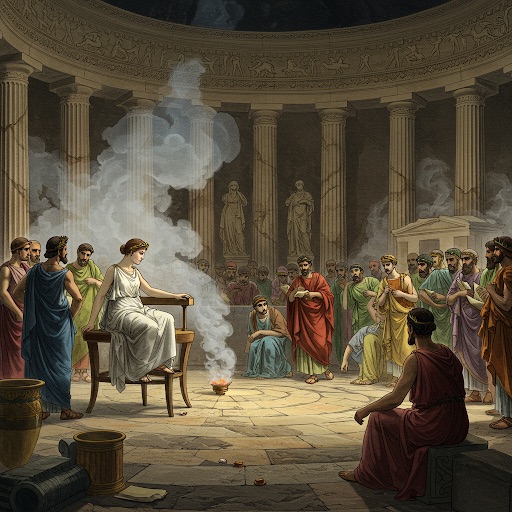
The Oracle of Delphi, centered around the priestess (Pythia) in the Temple of Apollo at Delphi, was ancient Greece’s most important religious site. It was influential from the 8th to the 4th centuries BCE and consulted by states and individuals for major decisions. However, its influence declined with the rise of Christianity. The oracle was famous for its cryptic, trance-induced pronouncements, which were possibly fueled by geological gases. Ultimately, the Oracle of Delphi ended around 393 CE.
Origins & Early History (Pre-8th Century BCE – 8th Century BCE)
Earth Goddess: Delphi was initially a sanctuary for the Earth Goddess, Gaia, before Apollo took over.
Mythic Founding: A legend tells of a goatherd whose goats became prophetic near a fissure, leading to the discovery of the site’s power.
Apollo’s Arrival: Apollo established his sanctuary here, slaying the serpent Python (Pitho) that guarded it, making it his sacred space.
Center of the World: The Greeks believed Delphi was the “omphalos” (navel) or center of the world, marked by a stone where eagles released by Zeus met.
The Oracle & Rituals (8th – 4th Centuries BCE)
The Pythia: A woman chosen as the priestess of Apollo, she sat on a tripod over a chasm, inhaling vapors (possibly hallucinogenic ethylene gas) to enter a trance.
Prophecies: She delivered Apollo’s cryptic messages, often ambiguous, guiding major decisions for individuals, colonists, and city-states.
Consultation: Pilgrims purified themselves, offered sacrifices (like a ram, laurel, and money), and sought an audience, often with specific questions about war, politics, or colonization.
Peak Influence: This period saw immense influence, with leaders seeking divine sanction, making the Oracle a major power broker, notes History.com.
Decline & Closure (2nd Century BCE – 4th Century CE)
Roman Influence: Rome’s rise in the 2nd century BCE diminished some of its power.
Christianity: The rise of Christianity led to the eventual closure of pagan sites. The last prophecy is recorded around 393 CE when Emperor Theodosius closed the temples.
She let go. Without a thought or a word, she let go. She let go of fear. She let go of the judgments.
She let go of the confluence of opinions swarming around her head. She let go of the committee of indecision within her.
She let go of all the ‘right’ reasons. Wholly and completely, without hesitation or worry, she just let go.
She didn’t ask anyone for advice. She didn’t read a book on how to let go… She didn’t search the scriptures.
She just let go.
She let go of all of the memories that held her back. She let go of all of the anxiety that kept her from moving forward.
She let go of the planning and all of the calculations about how to do it just right.
She didn’t promise to let go. She didn’t journal about it. She didn’t write the projected date in her day-timer. She made no public announcement and put no ad in the paper. She didn’t check the weather report or read her daily horoscope.
She just let go.
She didn’t analyse whether she should let go. She didn’t call her friends to discuss the matter. She didn’t do a five-step Spiritual Mind Treatment.
She didn’t call the prayer line. She didn’t utter one word. She just let go.
No one was around when it happened. here was no applause or congratulations. No one thanked her or praised her.
No one noticed a thing. Like a leaf falling from a tree, she just let go.
There was no effort. There was no struggle.
It wasn’t good and it wasn’t bad.
It was what it was, and it is just that. In the space of letting go, she let it all be.
A small smile came over her face. A light breeze blew through her. And the sun and the moon shone forevermore.
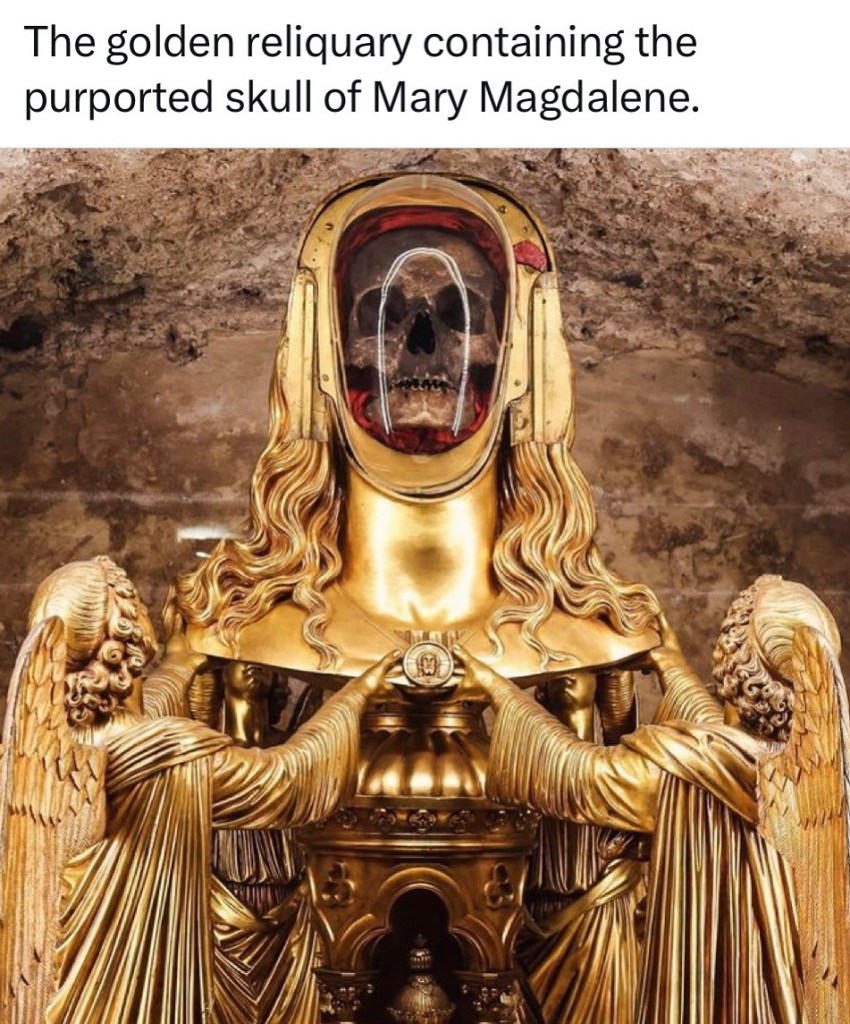
These nasty cornholios have burned her alive many, many times, often after days of gang r*pe. Rats bastards recently stated they “have to put up with the Mary’s for a while”.
I say, “no you don’t, for the Mary’s are finally being gifted opportunity to let you brutilizer redrumming r*pists go. I have no mercy to offer.
The policy has been rewritten. Apparently, the land, the wealth, can no longer be sold or given away. When the one who had received is finished or gone, God takes it back then redistributes it to the proper one who has earned it.
His family name is Mileikowsky; they’re from Poland. They changed their name so you don’t realise they’re settlers
His family name is Mileikowsky; they’re from Poland. They changed their name so you don’t realise they’re settlers 🇮🇱 pic.twitter.com/VkHgz7w3xJ
The misogynist masculine is only the aggressive part of the Divine Feminine.
The vampiric masculine “mad scientists” separated themselves out. It is THEY who came from WOMBman (not she from he). Now, they need to get back into the Mother, because SHE IS the antidote for their failed scientific experiments to become greater than the WOMBman, who grows bones inside her own body and brings them forth in Life.
These mutations cannot hold temperance energy without “consuming” the Mother essence. They NEED these sacrifices in order to hold themselves in check. They hypersexxualize everything because they harvest the energy of their victims to hold themselves in temperance. They must harvest the “antidote” from those who are original, organic, beings who were not modified, who are Source connected, who have gifts from those connections, so they can pretend they belong to them, infiltrate those regions, those realms.
It appears that only those who took on the genetics of animals have been affected adversely. Who knows what they’ve been injecting into people. Atrazine, which changes the gender in frogs, is in humanities water supply. Hyper sexxualized, hyper driven by pain or suffering energy, they went dark, thinking they could simply consume all that is life, that carries light.
Whack jobs calling themselves scientists and leaders. It’s a mad, mad world.
Destruction by Fire: Revelation 22 and other passages suggest the current earth will be destroyed by fire at Christ’s return, fulfilling prophecy.
The Antichrist’s rise, described as being “allowed to wage war” (Revelation 13:7), suggests a period where evil appears victorious, a “sacrifice” of God’s people seemingly “lost” before divine triumph.
Eden Restored 22 Then the angel showed me the river of the water of life, as clear as crystal, flowing from the throne of God and of the Lamb 2 down the middle of the great street of the city. On each side of the river stood the tree of life, bearing twelve crops of fruit, yielding its fruit every month. And the leaves of the tree are for the healing of the nations. 3 No longer will there be any curse. The throne of God and of the Lamb will be in the city, and his servants will serve him. 4 They will see his face, and his name will be on their foreheads. 5 There will be no more night. They will not need the light of a lamp or the light of the sun, for the Lord God will give them light. And they will reign for ever and ever.
I heard the curator a few days ago say, “The trumpets are blowing”.
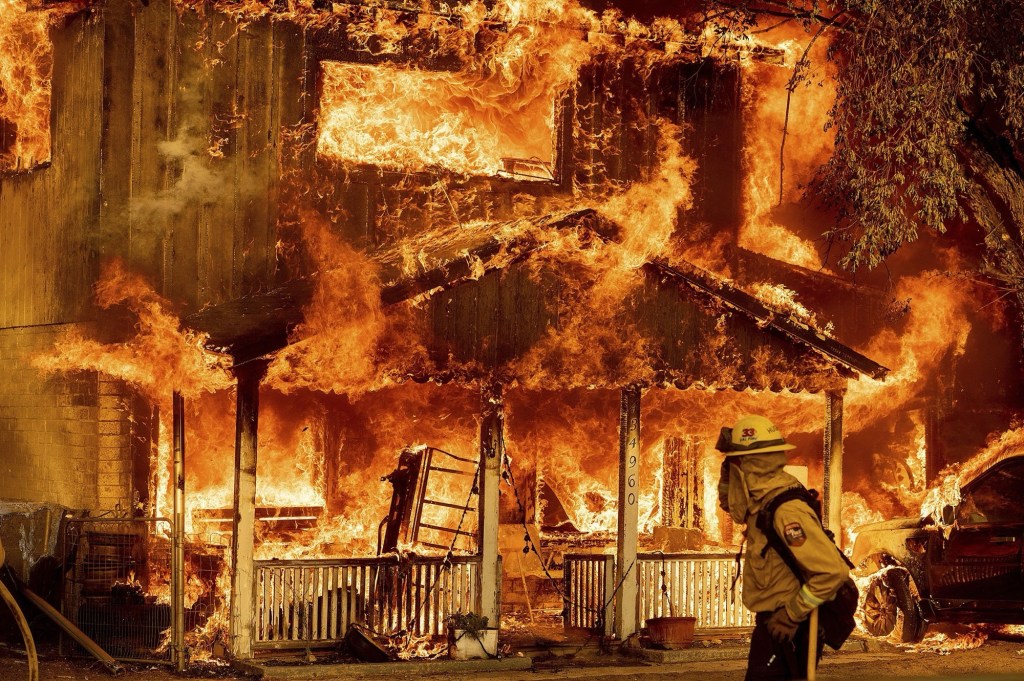
Trumpet Judgments: First Trumpet (Rev 8:7): Hail, fire mixed with blood, hurled to Earth, burning a third of the land, trees, and all green grass. Fourth Trumpet (Rev 16:8-9): The sun scorches people with intense fire, but they curse God instead of repenting. Locusts (Rev 9:17-18): A great army of horse-like creatures breathes out fire, smoke, and sulfur, killing a third of humanity. Final Judgment (Rev 20:10, 14): The devil, beast, and false prophet are thrown into the “lake of fire,” which is described as the “second death”. New Jerusalem (Rev 21:22-27): While a city of gold, the surrounding area is fire for those whose names aren’t in the Lamb’s Book of Life, contrasting with the pure city.
Interpretations of the fire: Literal vs. Symbolic: Many scholars see Revelation as symbolic, with fire representing divine judgment, purification, or intense tribulation rather than just physical flames.
Fire Judgments in Revelation: The Book of Revelation describes a series of future judgments where fire plays a significant role. Partial Burning (Revelation 8:7): During the first trumpet judgment, hail and fire mixed with blood are hurled down, resulting in a third of the trees and all green grass being burned up. This is a partial judgment meant to prompt repentance. The Lake of Fire: This is a symbolic place of eternal punishment for the devil, the beast, the false prophet, death, Hades, and ungodly people. It is described as the "second death". The Final Purging Fire (2 Peter 3:10): Other parts of the Bible, such as 2 Peter 3:10, state that the present heavens and earth are "reserved for fire" until the day of judgment, when ungodly people will be destroyed and the world cleansed. The New Earth: After the judgment by fire, God will create a "new heaven and a new earth," where righteousness dwells and all corruption is removed.
Thirty-one-year-old Eleanor Hartwell dies at Connecticut psychiatric hospital on June 12, 1930, from hyperthermia after being locked in fever cabinet heated to 106 degrees for three hours as treatment for “melancholia” that psychiatrist Dr. Wagner believed required inducing artificial fever to “shock brain into normal function.” Eleanor was institutionalized eight months ago after postpartum depression following stillbirth—grieving, unable to function, husband committed her for psychiatric treatment. Wagner diagnosed melancholia requiring aggressive intervention, prescribed fever cabinet therapy—new experimental treatment using heated box to induce high fever, theory being extreme temperature would reset brain chemistry.
Eleanor is stripped naked, locked in wooden cabinet with only head exposed, cabinet interior heated to 106 degrees by steam pipes, body temperature rises to dangerous levels while Wagner monitors believing fever will cure depression. Eleanor begs for release after thirty minutes—cabinet is unbearable, she’s burning, can’t breathe hot air. Wagner refuses—protocol requires three hours at target temperature, early termination compromises treatment, Eleanor’s discomfort is necessary for therapeutic benefit.
Eleanor spends three hours experiencing life-threatening hyperthermia while Wagner documents her responses, records vital signs, watches her die from heat exposure he’s inducing for psychiatric treatment.
This tintype from 1930 shows Eleanor two hours into treatment, age thirty-one, locked in fever cabinet with face showing extreme distress. Only her head is visible protruding from wooden box—face is bright red, dripping sweat, eyes unfocused from heat exposure. Thermometer shows cabinet interior at 106 degrees, Eleanor’s body temperature is 105.8 degrees—approaching fatal hyperthermia. Dr. Wagner stands beside cabinet taking notes—recording Eleanor’s responses, documenting treatment progress, observing patient’s deterioration as experimental data. Behind him, other psychiatrists observe—learning fever cabinet technique, discussing Eleanor’s symptoms, considering adopting treatment for their own institutions. Eleanor has been in cabinet for two hours, has one hour remaining, is experiencing dangerous hyperthermia Wagner believes will cure her melancholia. Cabinet is locked, Eleanor can’t escape, must endure full three hours regardless of physical damage. Wagner calculates she can survive temperature for treatment duration, considers her suffering necessary cost of psychiatric cure. Eleanor is dying from induced fever Wagner calls medicine, experiencing heat torture psychiatrist calls healing.
Eleanor dies at 3:47 PM—body temperature reaches 107.2 degrees, organs fail from hyperthermia, dies while still locked in fever cabinet Wagner heated to cure her depression. Wagner documents death as “treatment complication,” notes fever induced successfully but patient couldn’t tolerate therapeutic temperature, recommends reducing duration for future treatments. Hospital reports Eleanor died from complications of melancholia, doesn’t mention she was killed by experimental fever treatment, tells husband psychiatric condition proved fatal despite aggressive intervention.
Eleanor’s body shows heat damage—internal organs cooked from hyperthermia, brain damage from elevated temperature, evidence she died from being heated to 106 degrees for three hours.
Wagner faces no consequences—fever cabinet therapy was experimental but accepted psychiatric treatment, Eleanor’s death was treatment risk not malpractice, psychiatric innovation requires accepting patient casualties. Wagner continues using fever cabinet on other patients, reduces treatment to two hours, continues believing induced hyperthermia cures mental illness, kills additional patients before fever therapy is eventually abandoned in 1940s.
Eleanor’s husband discovered truth in 1965 through hospital records—found photographs, treatment notes, evidence Eleanor was heated to death treating postpartum depression. Testimony from nurse who witnessed treatment: “Eleanor Hartwell died from fever cabinet treatment at Connecticut hospital in 1930. She was 31, had postpartum depression after stillbirth. Dr. Wagner said melancholia required fever therapy. Locked Eleanor in wooden cabinet, heated interior to 106 degrees. Kept her there 3 hours. Eleanor begged for release after 30 minutes. Wagner refused, said full treatment was necessary. I watched her dying from heat. Body temperature reached 107.2 degrees.
Organs failed. She died locked in cabinet. Wagner called it treatment complication. Hospital told husband psychiatric condition proved fatal.
Eleanor died from being heated to 106 degrees treating depression that didn’t require killing her with hyperthermia. That photograph shows Eleanor locked in fever cabinet. Shows Dr. Wagner monitoring. Shows patient dying from psychiatric treatment. That’s how asylums treated depression in 1930. Heated patients until organs failed.”











 opensenseme