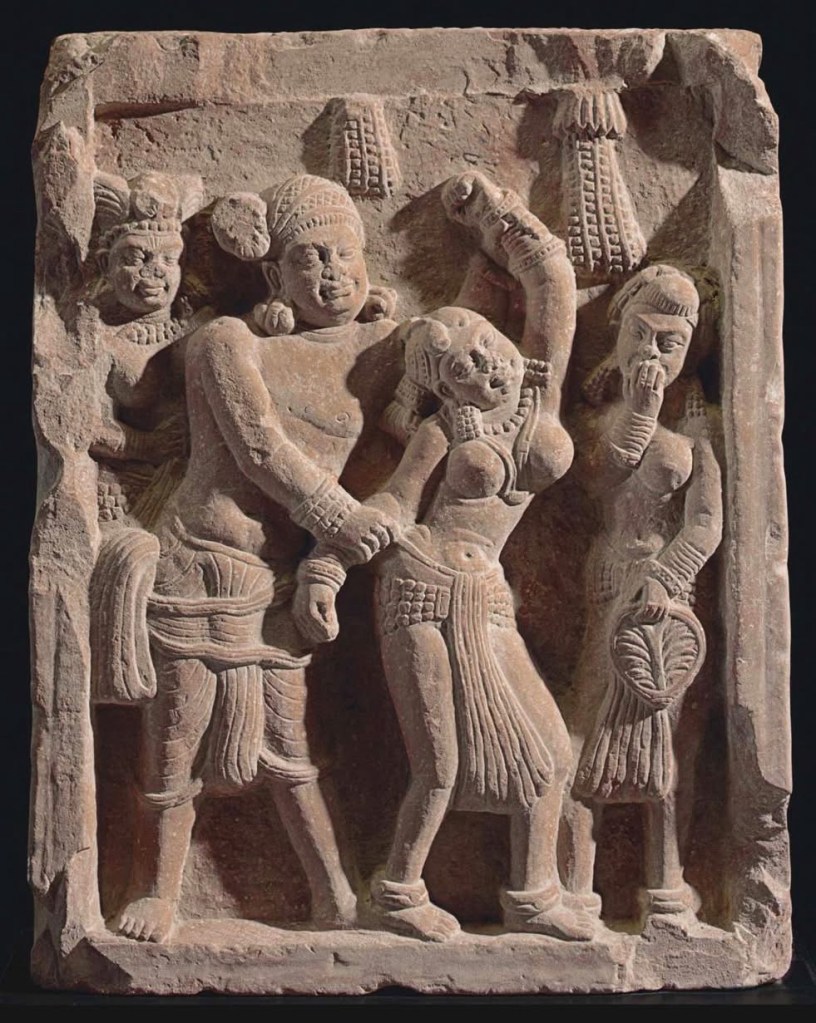
Sandstone relief from Mathura , Uttara Pradesh, Kushan period, 2nd century. I just came across this sculpture of a man seizing or restraining a woman by both arms; another woman at right appears shocked. Abduction scene? dunno. One source suggested she was a drunken courtesan, but then why restrain her? My first thought was Draupadi being taken by Duryodhan, but no sari-pulling or hair-pulling. Maybe someone knows. In that instance, war resulted, culminating in the battle of Kurukshetra as recounted in the Mahabharata.
But this got me thinking about rape in epic literature (originally a contradiction in terms, since epics were sung, but no matter). It’s all over the Iliad and Odysseus, and Greek myth in general (I wrote a book documenting that, see Comments.) There are the foundational stories about the Rape of the Sabine women in the establishment of Rome, and the rape of Lucretia which led to the overthrow of the monarchy and founding of the Roman Republic. Other stories refer to rape as triggering wars.
Biblical stories refer to Shechem abducting and raping Dinah, daughter of Jacob (Genesis 34:1–31). In another chapter, the men of Sodom tried to rape two visitors to the house of Lot; he refused and offered them his virgin daughters instead. (Genesis 19:4–9). [Demerits to all the scholars who tried to explain this as a manifestation of traditional hospitality, not the utter devaluation of women; how was protection of family against violence not traditional?]
A similar dynamic plays out in the story of the Benjaminite men who demand that a traveler be surrendered up to them to be raped. He puts his concubine out the door instead. (I’ll tell this horrific story in Comments, but trigger warrning, and same goes for what follows.) This rape-murder leads to the other Israelite tribes making war on the Benjaminites, who refused to surrender the rapists. A bloody civil war follows, with much slaughter.
Then, having killed off most of the tribe, they felt sorry for nearly wiping out one of the Twelve Tribes. Having slain the people of Jabesh Gilead, including women, all except for virgins they had taken captive, the other tribes gave the teenager survivors over to the Benjaminites. But more female chattel were needed for wives (they must have killed a lot of women), so a plan was concocted for the Benjaminites to abduct the maidens of Shiloh at a festival dance.
Judges 21:20: “Look, there is the annual festival of the Lord in Shiloh, Go and hide in the vineyards and watch. When the young women of Shiloh come out to join in the dancing, rush from the vineyards and each of you seize one of them to be your wife. Then return to the land of Benjamin.”
“When their fathers or brothers complain to us, we will say to them, ‘Do us the favor of helping them, because we did not get wives for them during the war. You will not be guilty of breaking your oath because you did not give your daughters to them’.” (New International Version)
This mass abduction followed by serial rapes resembles the Roman story of the Sabine women, also seized at a festival. Actually, now that I think of it, Greek stories have this same theme, especially around the capture of maidens dancing at festivals of Artemis. And even an elaboration in which Spartan men dress up as maidens for a dance, either to ambush the neighboring Messenians, or to use as a pretext for invading western Greece.
Readers may be able to name other instances of this theme of rape triggering war, in ancient literature, in epic traditions of whatever nationality, or in historical legends. It is not a subject much discussed, as far as I can see, and deserves more attention. Reply in Comments.
In 859 CE, a woman used her inheritance to build the world’s oldest continuously operating university—and 1,165 years later, it’s still educating students.
Her name was Fatima al-Fihri, and she understood something that would echo through centuries: the greatest investment isn’t in wealth or status—it’s in knowledge.
Fez, Morocco. The 9th century.
Fatima al-Fihri and her sister Mariam had just inherited substantial wealth from their father, Muhammad al-Fihri, a successful merchant who’d moved the family from Tunisia to Morocco.
They were young women with resources in a world where women’s choices were often limited. They could have lived comfortably, married well, secured their own futures. Instead, they chose to build something that would outlast them by over a millennium.
Fatima envisioned a center of learning—a place where knowledge could be pursued, where scholars could gather, where intellectual and spiritual growth would flourish together. Not just for the elite. Not just for one group. But a place where learning itself was sacred.
In 859 CE, she used her inheritance to found Al-Qarawiyyin in Fez.
It began as a mosque with an educational mission—but it became so much more. Within decades, Al-Qarawiyyin was attracting scholars from across the Islamic world and beyond. Students came to study theology, mathematics, astronomy, medicine, philosophy, law.
The library at Al-Qarawiyyin would eventually house some of the world’s oldest manuscripts. The institution would educate some of history’s most influential thinkers, including scholars whose work would later influence European universities during the Renaissance.
Meanwhile, Fatima’s sister Mariam founded the Andalusian Mosque nearby—also with educational functions, also still standing today. Two sisters. Two enduring centers of learning. Built with inheritance money that could have been spent on anything else.
Think about what that choice meant.
In 859 CE, Fatima al-Fihri looked at wealth and saw possibility. Not just for herself, but for generations she’d never meet. She understood that knowledge doesn’t die with us—it multiplies, spreads, transforms.
Every student who walked through those doors for the next eleven centuries carried forward something she started. Every scholar who debated in those halls. Every manuscript copied in that library. Every idea explored, challenged, refined.
All because one woman chose knowledge over comfort.
Today, Al-Qarawiyyin is recognized by UNESCO and Guinness World Records as the oldest continuously operating educational institution in the world. It became a modern university in 1963, but it’s been teaching students for over 1,165 years.
The same institution Fatima founded in 859 still stands in Fez, still educates, still preserves knowledge.
Think about that timeline. Al-Qarawiyyin was already ancient when Oxford was founded. It was 600 years old when Columbus sailed. It had been teaching students for over a thousand years when the internet was invented.
And it all started with a woman who inherited wealth and chose to invest it in something that would outlive her.
Fatima al-Fihri’s story isn’t just about building a university. It’s about understanding legacy. About recognizing that our choices ripple forward in ways we can’t predict or control—but we can choose what kind of ripples we create.
She chose education. She chose knowledge. She chose to create a space where learning could flourish.
And 1,165 years later, students still walk through those doors.
That’s not just architecture. That’s vision becoming reality across centuries.
Fatima al-Fihri never saw the Renaissance scholars who would study texts preserved in her library. Never saw the thousands upon thousands of students who would pass through Al-Qarawiyyin’s halls. Never saw how her choice would influence education across continents.
But she didn’t need to see it to believe it mattered.
She planted seeds of wisdom in the 9th century, and we’re still harvesting them in the 21st. That’s what happens when you invest in knowledge. When you choose to build something greater than yourself. When you believe education is worth dedicating your resources, your vision, your life’s work to create.
You don’t just change your own life. You change the trajectory of countless lives you’ll never meet.
Fatima al-Fihri: 800-880 CE (approximate dates). Founded Al-Qarawiyyin in 859 CE. The institution still operates 1,165 years later. One woman. One choice. One thousand years of impact.
Sometimes the most powerful thing you can do is believe that knowledge matters—and then build something to prove it.
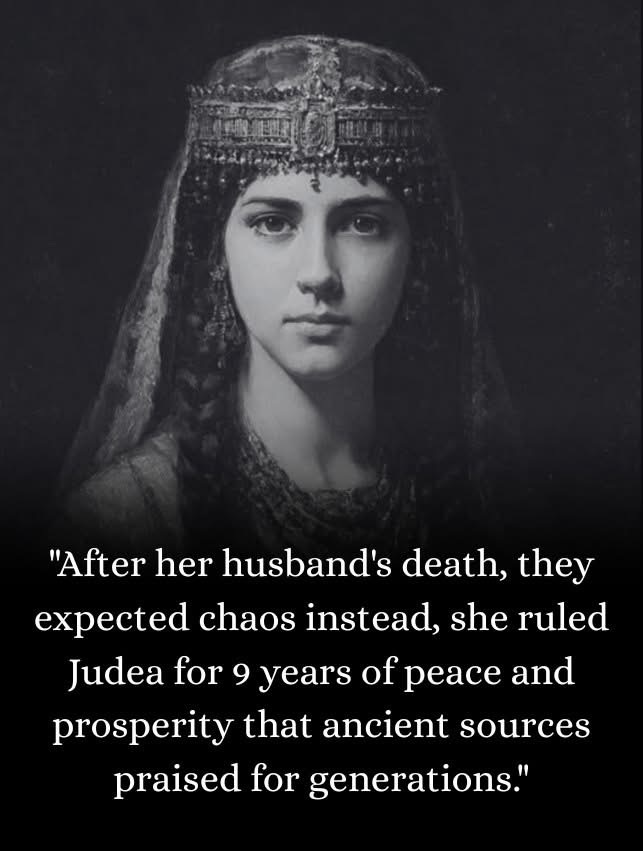
After her husband’s death, they expected chaos—instead, she ruled Judea for 9 years of peace and prosperity that ancient sources praised for generations.
Jerusalem, 76 BCE. King Alexander Jannaeus lay dying. His reign had been brutal—marked by civil war, mass executions, and conflict between religious factions. Judea was exhausted, divided, bleeding.
On his deathbed, Alexander did something unusual: he designated his wife, Salome Alexandra, as his successor. Not one of their sons. Not a military commander. His wife. She was around 64 years old. She would rule for nine years—and those years would be remembered as among the most peaceful and prosperous in Judean history.
This is her actual story, remarkable enough without embellishment.
Salome Alexandra (known in Hebrew as Shlomtzion, meaning “peace of Zion”) was born around 141 BCE. Little is known about her early life, but she came from a priestly family and was well-connected to Jerusalem’s religious and political elite.
She married Alexander Jannaeus around 103 BCE. He was a Hasmonean king—descended from the Maccabees who’d won Jewish independence from Greek rule. But the Hasmonean dynasty had become corrupt, brutal, and increasingly unpopular.
Alexander’s reign was particularly violent. He fought constantly—external wars against neighbors, internal war against the Pharisees (a Jewish religious faction that opposed him). At one point, he crucified 800 Pharisees while feasting and watching them die.
Judea under Alexander was traumatized. When he died in 76 BCE, Salome assumed the throne. She became “Queen” (basilissa in Greek, malka in Aramaic)—the only woman to rule Judea independently in the Hasmonean period. Ancient sources—particularly the Jewish historian Josephus and the Talmud—describe her reign positively, which is notable given how critical they are of other Hasmonean rulers. What made her reign successful?
Political balance: Salome reversed her husband’s policies toward the Pharisees. She allied with them, giving them influence in the Sanhedrin (Jewish council) while keeping the Sadducees (another faction) from becoming too powerful. This balance ended the civil conflict that had plagued her husband’s reign.
Domestic stability: Unlike Alexander, who was constantly at war, Salome focused on internal governance. The Talmud associates her reign with prosperity—harvests were good, peace prevailed.
Diplomatic skill: She maintained Judea’s position without major military campaigns. She recognized that Judea, surrounded by larger powers (Egypt, Syria, Rome), needed diplomacy more than conquest.
Respect for religious authority: By working with the Pharisees and supporting Torah scholarship (generally—not specifically for women), she gained popular support. The Pharisees emphasized law and learning over the priestly aristocracy favored by the Sadducees.
The Talmud (Tractate Taanit 23a) says of her reign: “In the days of Shimon ben Shetach and Queen Shlomtzion, rain fell on Wednesday nights, so that the wheat grains grew as large as kidneys, barley grains as large as olive pits, and lentils as large as gold dinars.”
This is obviously legendary exaggeration, but it indicates how her reign was remembered—as a golden age of peace and plenty.
Was she opposed because she was a woman? The historical sources don’t emphasize this. She seems to have assumed power relatively smoothly as her husband’s chosen successor.
While some Sadducees opposed her alliance with Pharisees, ancient sources frame this as political-religious conflict, not gender-based. Did she champion women’s education specifically? There’s no historical evidence for this claim. While she supported the Pharisees who valued Torah study, nothing in Josephus, the Talmud, or other sources attributes specific policies about women’s education to her.
Women’s formal Jewish education remained extremely limited in this period and for centuries after. If Salome had implemented revolutionary policies expanding women’s education, it would likely have been noted in sources—either as praise or criticism.
This doesn’t diminish her accomplishment. Ruling successfully for nine years in the ancient world as a woman was extraordinary. She didn’t need to also be a feminist education reformer to be impressive.
What happened after her death reveals the fragility of her achievements—but not for the reasons sometimes claimed.
Salome died around 67 BCE at approximately age 73. She’d designated her older son, Hyrcanus II, as her successor. But her younger son, Aristobulus II, challenged him. Civil war erupted immediately—not because people opposed female rule, but because of normal succession disputes between ambitious brothers.
The war weakened Judea at exactly the wrong moment. Rome was expanding eastward. In 63 BCE, Roman general Pompey intervened in the civil war, besieged Jerusalem, and essentially ended Judean independence.
Judea would remain under Roman control (directly or through client kings like Herod) for the next century, until the destruction of the Second Temple in 70 CE.
So yes, everything Salome built collapsed after her death. But not because of gender-based opposition or rollback of women’s rights. It collapsed because her sons’ ambitions destroyed what she’d carefully maintained.
Salome Alexandra’s actual legacy: She proved women could rule effectively: In a world where female political power was rare, she governed successfully for nine years. She ended civil conflict: Through political skill rather than military force, she brought peace after years of violence.
She balanced competing factions: Her diplomatic management of Pharisees and Sadducees maintained stability.
She prioritized domestic prosperity: Unlike her husband’s military adventurism, she focused on governance and peace.
She’s remembered positively: Ancient sources—which were often critical of rulers and rarely praised women leaders—speak well of her reign.
These accomplishments are remarkable and historically documented. We don’t need to invent claims about women’s education advocacy to make her impressive.
Why does this matter? Why not just accept the embellished version that makes her sound more feminist?
Because historical accuracy matters. When we project modern values onto historical figures without evidence, we:
Diminish their actual achievements by replacing them with what we wish they’d done Distort history in ways that ultimately undermine our understanding of how change actually happens
Lose credibility when people discover the claims aren’t supported by sources Miss opportunities to understand the real constraints and possibilities of women’s power in different historical contexts.
Salome Alexandra’s actual story—ruling successfully for nine years, maintaining peace, balancing factions, being remembered positively by sources that usually dismissed female rulers—is impressive precisely because it happened in a world that offered women almost no political power.
We honor her better by acknowledging what she actually accomplished within the constraints she faced, rather than inventing accomplishments that fit modern priorities.
To Salome Alexandra: You ruled Judea during a period of peace and prosperity after years of violence and chaos. You balanced competing religious factions without resorting to your husband’s brutality. You maintained Judea’s independence through diplomacy rather than constant warfare. You proved that a woman could govern as effectively as any king.
Ancient sources that were often critical of rulers praised your reign. The Talmud associated your years with abundance. Josephus acknowledged your political skill.
You didn’t need to revolutionize women’s education to be remarkable—though later generations sometimes claim you did because they want ancient validation for modern values. Your actual accomplishment—ruling successfully for nine years in the ancient world—is impressive enough. The fact that civil war erupted immediately after your death shows how much your skill maintained stability.
You proved women could govern. That was radical in itself.
We don’t need to make you into something you weren’t. What you actually were—a capable ruler who brought peace and prosperity—deserves recognition without embellishment.
Imagine people stalking oracles, prophets, and prophetesses just to slander them, accusing them of being “cookoo”.
We’ve existed since the beginning. And they’ve burned us simply for existing, for delivering our messages, many times.
Kings and Queens, Emperors and Empresses have trusted these messengers for centuries.
So sick of childish masculines suffering their personality disorders of hate.
War!!! War!!!!!!! War!!!!!!!!!!!! They shout …… Exterminate!!!!!!!!!!!
It’s a sick world where Women bring forth life and men with twisted minds hurry to torture and destroy it.
Tyrants, jealous of WOMBman’s status, decided to prove their dominance over everyone.
———————————————
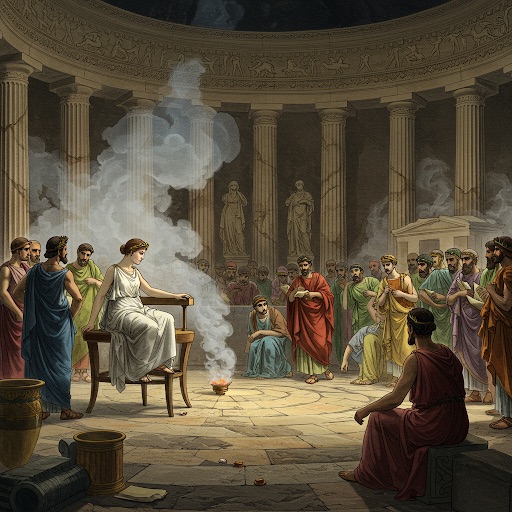
The Oracle of Delphi, centered around the priestess (Pythia) in the Temple of Apollo at Delphi, was ancient Greece’s most important religious site. It was influential from the 8th to the 4th centuries BCE and consulted by states and individuals for major decisions. However, its influence declined with the rise of Christianity. The oracle was famous for its cryptic, trance-induced pronouncements, which were possibly fueled by geological gases. Ultimately, the Oracle of Delphi ended around 393 CE.
Origins & Early History (Pre-8th Century BCE – 8th Century BCE)
Earth Goddess: Delphi was initially a sanctuary for the Earth Goddess, Gaia, before Apollo took over.
Mythic Founding: A legend tells of a goatherd whose goats became prophetic near a fissure, leading to the discovery of the site’s power.
Apollo’s Arrival: Apollo established his sanctuary here, slaying the serpent Python (Pitho) that guarded it, making it his sacred space.
Center of the World: The Greeks believed Delphi was the “omphalos” (navel) or center of the world, marked by a stone where eagles released by Zeus met.
The Oracle & Rituals (8th – 4th Centuries BCE)
The Pythia: A woman chosen as the priestess of Apollo, she sat on a tripod over a chasm, inhaling vapors (possibly hallucinogenic ethylene gas) to enter a trance.
Prophecies: She delivered Apollo’s cryptic messages, often ambiguous, guiding major decisions for individuals, colonists, and city-states.
Consultation: Pilgrims purified themselves, offered sacrifices (like a ram, laurel, and money), and sought an audience, often with specific questions about war, politics, or colonization.
Peak Influence: This period saw immense influence, with leaders seeking divine sanction, making the Oracle a major power broker, notes History.com.
Decline & Closure (2nd Century BCE – 4th Century CE)
Roman Influence: Rome’s rise in the 2nd century BCE diminished some of its power.
Christianity: The rise of Christianity led to the eventual closure of pagan sites. The last prophecy is recorded around 393 CE when Emperor Theodosius closed the temples.
She let go. Without a thought or a word, she let go. She let go of fear. She let go of the judgments.
She let go of the confluence of opinions swarming around her head. She let go of the committee of indecision within her.
She let go of all the ‘right’ reasons. Wholly and completely, without hesitation or worry, she just let go.
She didn’t ask anyone for advice. She didn’t read a book on how to let go… She didn’t search the scriptures.
She just let go.
She let go of all of the memories that held her back. She let go of all of the anxiety that kept her from moving forward.
She let go of the planning and all of the calculations about how to do it just right.
She didn’t promise to let go. She didn’t journal about it. She didn’t write the projected date in her day-timer. She made no public announcement and put no ad in the paper. She didn’t check the weather report or read her daily horoscope.
She just let go.
She didn’t analyse whether she should let go. She didn’t call her friends to discuss the matter. She didn’t do a five-step Spiritual Mind Treatment.
She didn’t call the prayer line. She didn’t utter one word. She just let go.
No one was around when it happened. here was no applause or congratulations. No one thanked her or praised her.
No one noticed a thing. Like a leaf falling from a tree, she just let go.
There was no effort. There was no struggle.
It wasn’t good and it wasn’t bad.
It was what it was, and it is just that. In the space of letting go, she let it all be.
A small smile came over her face. A light breeze blew through her. And the sun and the moon shone forevermore.
These nasty cornholios have burned her alive many, many times, often after days of gang r*pe. Rats bastards recently stated they “have to put up with the Mary’s for a while”.
I say, “no you don’t, for the Mary’s are finally being gifted opportunity to let you brutilizer redrumming r*pists go. I have no mercy to offer.
The policy has been rewritten. Apparently, the land, the wealth, can no longer be sold or given away. When the one who had received is finished or gone, God takes it back then redistributes it to the proper one who has earned it.
His family name is Mileikowsky; they’re from Poland. They changed their name so you don’t realise they’re settlers
His family name is Mileikowsky; they’re from Poland. They changed their name so you don’t realise they’re settlers 🇮🇱 pic.twitter.com/VkHgz7w3xJ
The misogynist masculine is only the aggressive part of the Divine Feminine.
The vampiric masculine “mad scientists” separated themselves out. It is THEY who came from WOMBman (not she from he). Now, they need to get back into the Mother, because SHE IS the antidote for their failed scientific experiments to become greater than the WOMBman, who grows bones inside her own body and brings them forth in Life.
These mutations cannot hold temperance energy without “consuming” the Mother essence. They NEED these sacrifices in order to hold themselves in check. They hypersexxualize everything because they harvest the energy of their victims to hold themselves in temperance. They must harvest the “antidote” from those who are original, organic, beings who were not modified, who are Source connected, who have gifts from those connections, so they can pretend they belong to them, infiltrate those regions, those realms.
It appears that only those who took on the genetics of animals have been affected adversely. Who knows what they’ve been injecting into people. Atrazine, which changes the gender in frogs, is in humanities water supply. Hyper sexxualized, hyper driven by pain or suffering energy, they went dark, thinking they could simply consume all that is life, that carries light.
Whack jobs calling themselves scientists and leaders. It’s a mad, mad world.
Thirty-one-year-old Eleanor Hartwell dies at Connecticut psychiatric hospital on June 12, 1930, from hyperthermia after being locked in fever cabinet heated to 106 degrees for three hours as treatment for “melancholia” that psychiatrist Dr. Wagner believed required inducing artificial fever to “shock brain into normal function.” Eleanor was institutionalized eight months ago after postpartum depression following stillbirth—grieving, unable to function, husband committed her for psychiatric treatment. Wagner diagnosed melancholia requiring aggressive intervention, prescribed fever cabinet therapy—new experimental treatment using heated box to induce high fever, theory being extreme temperature would reset brain chemistry.
Eleanor is stripped naked, locked in wooden cabinet with only head exposed, cabinet interior heated to 106 degrees by steam pipes, body temperature rises to dangerous levels while Wagner monitors believing fever will cure depression. Eleanor begs for release after thirty minutes—cabinet is unbearable, she’s burning, can’t breathe hot air. Wagner refuses—protocol requires three hours at target temperature, early termination compromises treatment, Eleanor’s discomfort is necessary for therapeutic benefit.
Eleanor spends three hours experiencing life-threatening hyperthermia while Wagner documents her responses, records vital signs, watches her die from heat exposure he’s inducing for psychiatric treatment.
This tintype from 1930 shows Eleanor two hours into treatment, age thirty-one, locked in fever cabinet with face showing extreme distress. Only her head is visible protruding from wooden box—face is bright red, dripping sweat, eyes unfocused from heat exposure. Thermometer shows cabinet interior at 106 degrees, Eleanor’s body temperature is 105.8 degrees—approaching fatal hyperthermia. Dr. Wagner stands beside cabinet taking notes—recording Eleanor’s responses, documenting treatment progress, observing patient’s deterioration as experimental data. Behind him, other psychiatrists observe—learning fever cabinet technique, discussing Eleanor’s symptoms, considering adopting treatment for their own institutions. Eleanor has been in cabinet for two hours, has one hour remaining, is experiencing dangerous hyperthermia Wagner believes will cure her melancholia. Cabinet is locked, Eleanor can’t escape, must endure full three hours regardless of physical damage. Wagner calculates she can survive temperature for treatment duration, considers her suffering necessary cost of psychiatric cure. Eleanor is dying from induced fever Wagner calls medicine, experiencing heat torture psychiatrist calls healing.
Eleanor dies at 3:47 PM—body temperature reaches 107.2 degrees, organs fail from hyperthermia, dies while still locked in fever cabinet Wagner heated to cure her depression. Wagner documents death as “treatment complication,” notes fever induced successfully but patient couldn’t tolerate therapeutic temperature, recommends reducing duration for future treatments. Hospital reports Eleanor died from complications of melancholia, doesn’t mention she was killed by experimental fever treatment, tells husband psychiatric condition proved fatal despite aggressive intervention.
Eleanor’s body shows heat damage—internal organs cooked from hyperthermia, brain damage from elevated temperature, evidence she died from being heated to 106 degrees for three hours.
Wagner faces no consequences—fever cabinet therapy was experimental but accepted psychiatric treatment, Eleanor’s death was treatment risk not malpractice, psychiatric innovation requires accepting patient casualties. Wagner continues using fever cabinet on other patients, reduces treatment to two hours, continues believing induced hyperthermia cures mental illness, kills additional patients before fever therapy is eventually abandoned in 1940s.
Eleanor’s husband discovered truth in 1965 through hospital records—found photographs, treatment notes, evidence Eleanor was heated to death treating postpartum depression. Testimony from nurse who witnessed treatment: “Eleanor Hartwell died from fever cabinet treatment at Connecticut hospital in 1930. She was 31, had postpartum depression after stillbirth. Dr. Wagner said melancholia required fever therapy. Locked Eleanor in wooden cabinet, heated interior to 106 degrees. Kept her there 3 hours. Eleanor begged for release after 30 minutes. Wagner refused, said full treatment was necessary. I watched her dying from heat. Body temperature reached 107.2 degrees.
Organs failed. She died locked in cabinet. Wagner called it treatment complication. Hospital told husband psychiatric condition proved fatal.
Eleanor died from being heated to 106 degrees treating depression that didn’t require killing her with hyperthermia. That photograph shows Eleanor locked in fever cabinet. Shows Dr. Wagner monitoring. Shows patient dying from psychiatric treatment. That’s how asylums treated depression in 1930. Heated patients until organs failed.”






 opensenseme