A wicked man who reproaches a virtuous one is like one who looks up and spits at heaven; the spittle soils not the heaven, but comes back and defiles his own person. ~ Buddha, The Sutra of Forty-Two Sections
—————————
Confucius said: … When a man carries out the principals of conscientiousness and reciprocity he is not far from the universal law. What you do not wish others should do unto you, do not do unto them. ~ From The Golden Mean of Tsesze XIII
—————————
“You contain a universe inside yourself. There’s no end to it – your conscious, your subconscious. There is no limit to what’s inside you. We are very much connected. There’s no end to it.” ~ Ann Shulgin
—————————
“The door between the worlds is always open.” ~ Rumi
—————————
“I would rather have questions that can’t be answered than answers that can’t be questioned.”
— Richard Feynman
—————————
Steven Seagal: “Ukraine was known for human trafficking, organ trafficking, narco trafficking, child sex trafficking, biochemical warfare labs, fascism and Nazism.”
Many of us are still very much in active, spiritual warfare. It’s messy. The totality of the nastiness the adversary pushed in on us is being purged. It may look as though we’ve been carrying a great burden, because we have.
The collective, for the most part, has brought temperance energy to the trauma. Now, that trauma that had been tempered, appears to be releasing from the body.
It might look like an unhealed wound, but it isn’t. It is the chaff left over from the wound being tempered. Release the chaff, the ashes of that internal fire that fueled your ascension, and don’t listen to the projectionist trying to “restick shit” into you.
Once they notice you are releasing the refuse, they’ll try to trigger you so you’ll wind up holding onto it.
Let the chaff, and the projectionist, go.
It’s the best thing you can do for your Inner Divine.
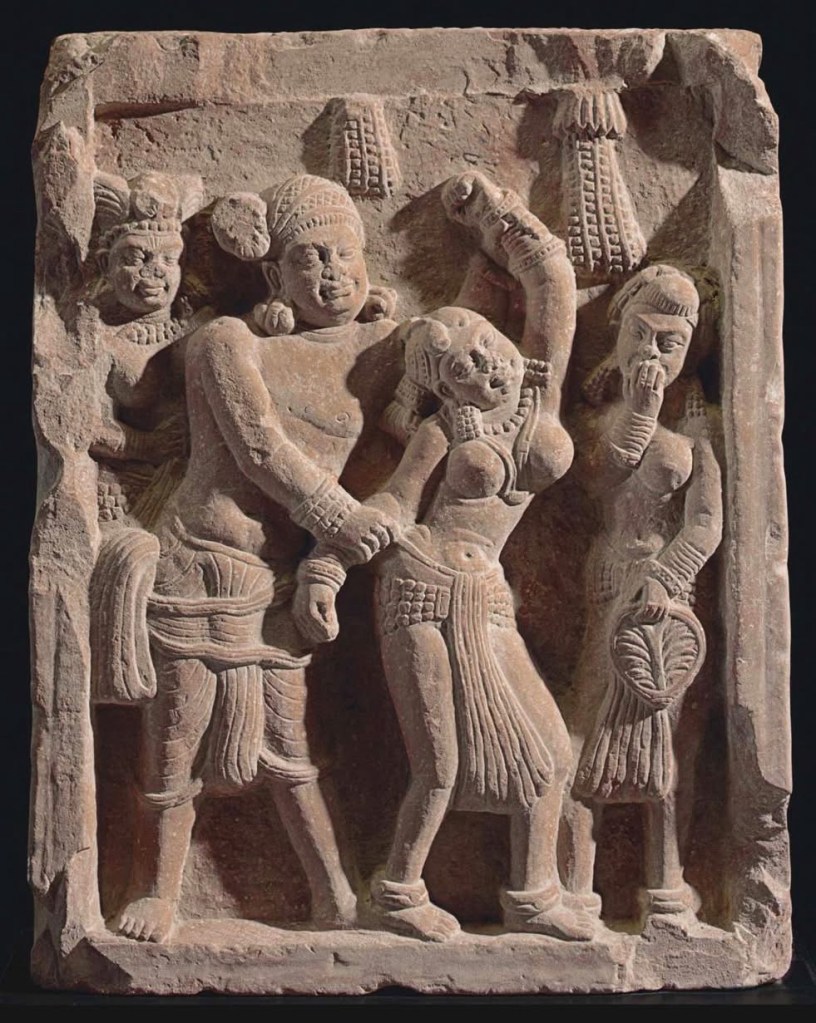
Sandstone relief from Mathura , Uttara Pradesh, Kushan period, 2nd century. I just came across this sculpture of a man seizing or restraining a woman by both arms; another woman at right appears shocked. Abduction scene? dunno. One source suggested she was a drunken courtesan, but then why restrain her? My first thought was Draupadi being taken by Duryodhan, but no sari-pulling or hair-pulling. Maybe someone knows. In that instance, war resulted, culminating in the battle of Kurukshetra as recounted in the Mahabharata.
But this got me thinking about rape in epic literature (originally a contradiction in terms, since epics were sung, but no matter). It’s all over the Iliad and Odysseus, and Greek myth in general (I wrote a book documenting that, see Comments.) There are the foundational stories about the Rape of the Sabine women in the establishment of Rome, and the rape of Lucretia which led to the overthrow of the monarchy and founding of the Roman Republic. Other stories refer to rape as triggering wars.
Biblical stories refer to Shechem abducting and raping Dinah, daughter of Jacob (Genesis 34:1–31). In another chapter, the men of Sodom tried to rape two visitors to the house of Lot; he refused and offered them his virgin daughters instead. (Genesis 19:4–9). [Demerits to all the scholars who tried to explain this as a manifestation of traditional hospitality, not the utter devaluation of women; how was protection of family against violence not traditional?]
A similar dynamic plays out in the story of the Benjaminite men who demand that a traveler be surrendered up to them to be raped. He puts his concubine out the door instead. (I’ll tell this horrific story in Comments, but trigger warrning, and same goes for what follows.) This rape-murder leads to the other Israelite tribes making war on the Benjaminites, who refused to surrender the rapists. A bloody civil war follows, with much slaughter.
Then, having killed off most of the tribe, they felt sorry for nearly wiping out one of the Twelve Tribes. Having slain the people of Jabesh Gilead, including women, all except for virgins they had taken captive, the other tribes gave the teenager survivors over to the Benjaminites. But more female chattel were needed for wives (they must have killed a lot of women), so a plan was concocted for the Benjaminites to abduct the maidens of Shiloh at a festival dance.
Judges 21:20: “Look, there is the annual festival of the Lord in Shiloh, Go and hide in the vineyards and watch. When the young women of Shiloh come out to join in the dancing, rush from the vineyards and each of you seize one of them to be your wife. Then return to the land of Benjamin.”
“When their fathers or brothers complain to us, we will say to them, ‘Do us the favor of helping them, because we did not get wives for them during the war. You will not be guilty of breaking your oath because you did not give your daughters to them’.” (New International Version)
This mass abduction followed by serial rapes resembles the Roman story of the Sabine women, also seized at a festival. Actually, now that I think of it, Greek stories have this same theme, especially around the capture of maidens dancing at festivals of Artemis. And even an elaboration in which Spartan men dress up as maidens for a dance, either to ambush the neighboring Messenians, or to use as a pretext for invading western Greece.
Readers may be able to name other instances of this theme of rape triggering war, in ancient literature, in epic traditions of whatever nationality, or in historical legends. It is not a subject much discussed, as far as I can see, and deserves more attention. Reply in Comments.
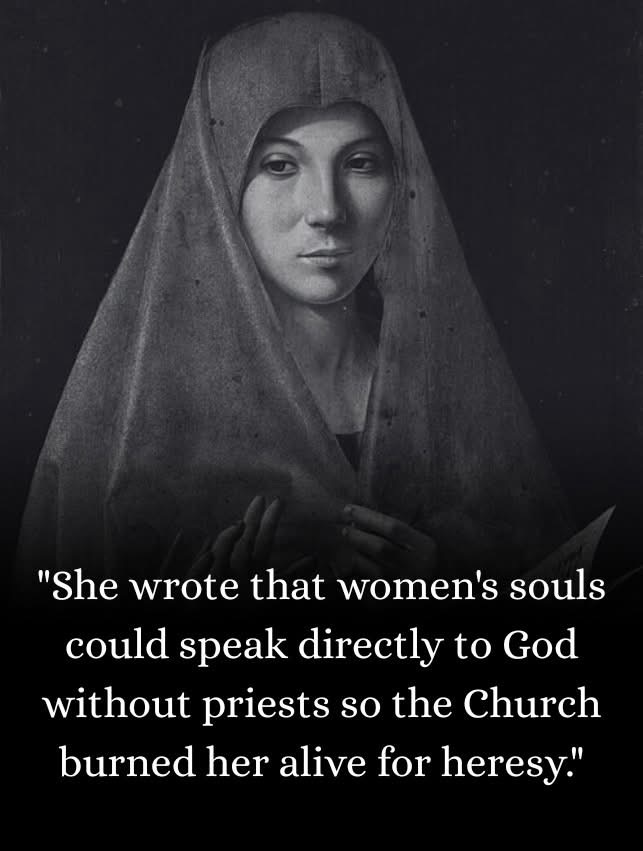
She wrote that women’s souls could speak directly to God without priests—so the Church burned her alive for heresy.
Paris, June 1, 1310.
In the Place de Grève, a woman was led to the stake. Marguerite Porete, accused of heresy, had spent over a year imprisoned, refusing to answer the Inquisition’s questions or defend herself before judges she didn’t recognize as having authority over her soul. Witnesses later described her calm demeanor—no screaming, no begging for mercy, no recantation. She faced the flames with a serenity that unnerved her executioners.
She died for writing a book that claimed a soul could unite so completely with divine love that it transcended the need for Church hierarchy, sacraments, or ecclesiastical mediation. The Church couldn’t tolerate that claim—especially from a woman.
Marguerite Porete was born in the late 13th century in Hainaut (modern-day France/Belgium border region). Little is known about her early life, but she became part of the Beguine movement—communities of lay religious women who lived together in prayer and work without taking formal monastic vows.
Beguines occupied a complicated space in medieval Christianity. They weren’t nuns bound by convent rules, but they weren’t ordinary laywomen either. They lived religious lives outside institutional Church control—which made Church authorities nervous.
Marguerite was educated, literate, and theologically sophisticated—unusual for a woman of her time.
Sometime in the late 13th century, she wrote “The Mirror of Simple Souls” (Le Mirouer des simples âmes) in vernacular Old French rather than Latin.
Writing theology in the vernacular was itself significant. Latin was the language of Church authority—using French made theology accessible to ordinary people, particularly women who hadn’t learned Latin.
But it was the book’s content that proved dangerous.
The Mirror of Simple Souls describes a mystical journey where the soul progressively lets go of attachments, ego, and even virtues until it reaches “annihilation”—complete dissolution into divine love. This “annihilated soul” becomes so united with God that it no longer needs:
Church sacraments Moral rules Priestly mediation Fear of sin Virtuous acts done out of obligation
Because the soul is completely aligned with divine will, it acts naturally from love rather than from external commands.
Marguerite wrote in dialogue form, with characters including “Love,” “Reason,” “The Soul,” and “Holy Church the Little” (institutional Church) versus “Holy Church the Great” (the mystical body of all souls united with God).
Crucially, she distinguished between institutional Church authority and direct divine relationship. “Holy Church the Little”—the hierarchy, rules, and priests—was necessary for beginners on the spiritual path. But advanced souls could transcend it through complete union with God. This was explosive theology.
The Church’s authority rested on being the necessary mediator between humans and God.
Sacraments administered by priests were required for salvation. Confession, penance, Church law—all of this presumed that people needed institutional guidance.
Marguerite was saying: at the highest spiritual level, you don’t need any of that. The soul united with God transcends institutional authority. Church authorities saw this as dangerous heresy. It suggested that mystics could claim direct divine authority superior to Church hierarchy. It implied that someone in mystical union might be beyond sin or moral law—a heresy called “antinomianism. “And it was especially threatening coming from a woman.
The Church insisted women needed male spiritual authority—priests, confessors, bishops—to guide them. A woman claiming direct divine relationship without male mediation challenged the entire gender hierarchy of medieval Christianity.
Around 1296-1306, Marguerite’s book was condemned by the Bishop of Cambrai. It was publicly burned, and she was warned to stop teaching her ideas. Marguerite ignored the warning. She continued circulating the book and discussing her theology. She sent copies to theologians and Church authorities seeking approval, but also continued teaching despite the prohibition.
This defiance was crucial. She had multiple opportunities to submit to Church authority, burn her book, recant her teachings, and avoid execution. She refused every time. Why? Because she believed—genuinely, deeply—that her mystical experience and theological understanding came directly from God. No earthly authority, not even the Church, could invalidate that divine relationship.
In 1308, she was arrested in Paris. The Inquisition began proceedings against her. During her imprisonment (which lasted over a year), she refused to cooperate with the trial. She wouldn’t answer questions. She wouldn’t defend herself. She wouldn’t acknowledge the tribunal’s authority to judge her spiritual state. Her silence was deliberate and theological.
She believed the judges—bound by “Holy Church the Little”—couldn’t understand the mystical theology of souls who’d reached union with God. Answering them would be pointless.
The Inquisition found her guilty of heresy. They declared her a “relapsed heretic”—someone who’d been warned before and persisted in error. The penalty for relapsed heresy was death by burning.
On June 1, 1310, Marguerite was led to the Place de Grève in Paris. Accounts describe her facing execution with remarkable calm—no terror, no last-minute recantation, no screaming as the flames rose. Observers noted this serenity. Some interpreted it as demonic possession keeping her from repenting. Others saw it as proof she’d achieved the mystical state she’d written about—transcendence of fear through complete union with divine love.
Marguerite Porete became one of the first women burned for heresy by the Inquisition in Paris. Her execution was meant to be a warning: women who claimed spiritual authority independent of Church hierarchy would be silenced permanently.
But her book survived. Copies circulated anonymously throughout the 14th and 15th centuries. Because Marguerite’s name was suppressed (she was executed as a heretic), the book was copied without author attribution. Monks, mystics, and scholars read it for centuries without knowing a woman had written it. Some copies attributed it to male authors.
The mystical theology was considered so sophisticated that people assumed a man must have written it.
In 1946, scholar Romana Guarnieri finally proved that Marguerite Porete was the author. The evidence included trial records and manuscript traditions connecting the condemned book to The Mirror of Simple Souls.
Suddenly, a text that had influenced Christian mysticism for centuries was recognized as written by a woman burned for heresy.
Modern scholars recognize The Mirror as a masterpiece of mystical theology. Its influence can be traced in later mystics including Meister Eckhart (who faced similar accusations of heresy).
Marguerite’s theology anticipated ideas that would later appear in Protestant Reformation critiques of institutional Church authority and in modern mystical and contemplative traditions.
Her story matters because: She claimed spiritual authority as a woman: In an era when women were required to be spiritually subordinate to men, she insisted her mystical experience gave her theological insight. She challenged institutional religious power: She distinguished between institutional authority and divine relationship—a distinction that threatened Church hierarchy. She refused to recant: Given multiple chances to save herself by submitting to Church authority, she chose death over betraying her spiritual convictions.
She was right about mystical theology: Modern understanding of contemplative spirituality recognizes the validity of much of what she taught. Her work survived despite suppression: Burning her body didn’t destroy her ideas—they circulated for centuries, eventually vindicated.
The tragedy is that Marguerite was executed for theology that, in different contexts or coming from a man, might have been tolerated or even celebrated.
Male mystics like Meister Eckhart taught similar ideas and, while investigated, weren’t executed. Her gender made her dangerous in ways male mystics weren’t. A woman claiming to transcend priestly authority threatened both religious and gender hierarchies simultaneously.
To Marguerite Porete: You wrote that the soul united with God needs no intermediary—and the Church killed you for threatening their monopoly on salvation. You refused to recant even when recantation would have saved you. You chose death over betraying your mystical experience and theological convictions. Your silence before the Inquisition wasn’t weakness—it was theological statement. You didn’t recognize their authority to judge what you knew through direct divine union. You faced the flames with the serenity you’d written about—the transcendence of fear through complete surrender to divine love. They burned your body. They tried to erase your name. They suppressed your book. But your words survived. For centuries, they circulated anonymously, influencing mystics who didn’t know a woman had written them. When scholars finally proved you were the author, your genius was undeniable. You were right about mystical union. You were right that souls can experience God directly. You were right that love transcends institutional authority. The Church that executed you eventually had to acknowledge the validity of mystical theology like yours. The ideas they burned you for are now recognized as legitimate contemplative spirituality. You died for claiming women’s spiritual authority. For insisting divine love was greater than ecclesiastical power. For refusing to let priests mediate your relationship with God. That claim cost you your life. But it couldn’t be silenced. Your voice, speaking across seven centuries, still insists: the soul united with Love needs no permission to speak directly to God. They couldn’t burn that truth. And they couldn’t burn your courage.
WOW! Not only does this latest footage confirm that Renee Good had no animosity toward ICE agent Jonathan Ross and that she was steering her car away from him as he was filming with his phone.
It also confirms that Ross shot Good in the face with one hand while filming her with… pic.twitter.com/YnzlVeZO4U
NYT video analysis is pretty definitive. He was out of the path of the vehicle when he fired, the tires were clearly turned to the right, and the President and others are relying on the poorest quality clip to argue he was struck by the vehicle. He wasn’t. pic.twitter.com/hEshCoLKVh
The fact that we see her turn the wheel to the right means HE sees her turn the wheel to the right. It means he knew his life wasn’t in danger pic.twitter.com/Y25X1pKb1u
JD Vance 🇺🇸 on the murder of an unarmed mother of 3 in Minneapolis by an ICE gunman
‘She was part of a left wing radical group’ ‘Using domestic terror techniques’ ‘You in the media have been lying’ ‘She tried to ram him’ ‘He defended himself’
It sounds to me, that if that ICE officer was there doing a job he was ordered to do … then the job he was ordered to do, was to unalive Renee Good. This was a premeditated “hit” on a civilian woman.
They were “doing the job they were asked to do” … they murdered that woman.
Excellent work pointing out him switching the phone to his other hand. Any average criminal lawyer in the US could put this man behind bars for first-degree murder. It beats me why Vance would sacrifice his chance at being elected president to protect this guy? pic.twitter.com/oReBIjWlob
BREAKING: ICE agents rammed this United States Marine veteran’s car and put her through torture just because she was following them from a safe distance. “they said ‘have you not learned: this is why we killed that lesbian bitch’”






























 opensenseme