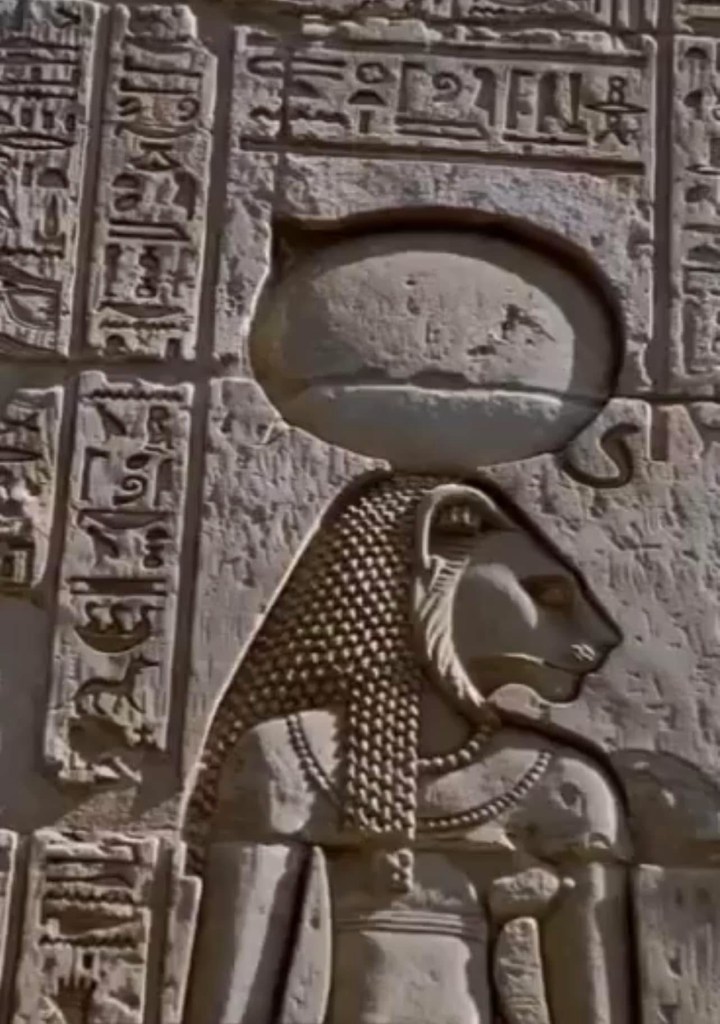
Translation of the text written at the Entrance to the Temple of the Egyptian Goddess Sekhmet, Karnak Temple
I only ask you to enter my house with respect. To serve you I do not need your devotion, but your sincerity. Neither your beliefs, but your thirst for knowledge. Enter with your vices, your fears and your hatreds from the greatest to the smaller ones, I can help you dissolve them.
You can look at me and love me as a female, as a mother, as a daughter, as a sister, as a friend, but never look at me as an authority above yourself. If the devotion you have for any god, It is greater than the one you have for the God that is within you, you offend them both and you offend the one👌
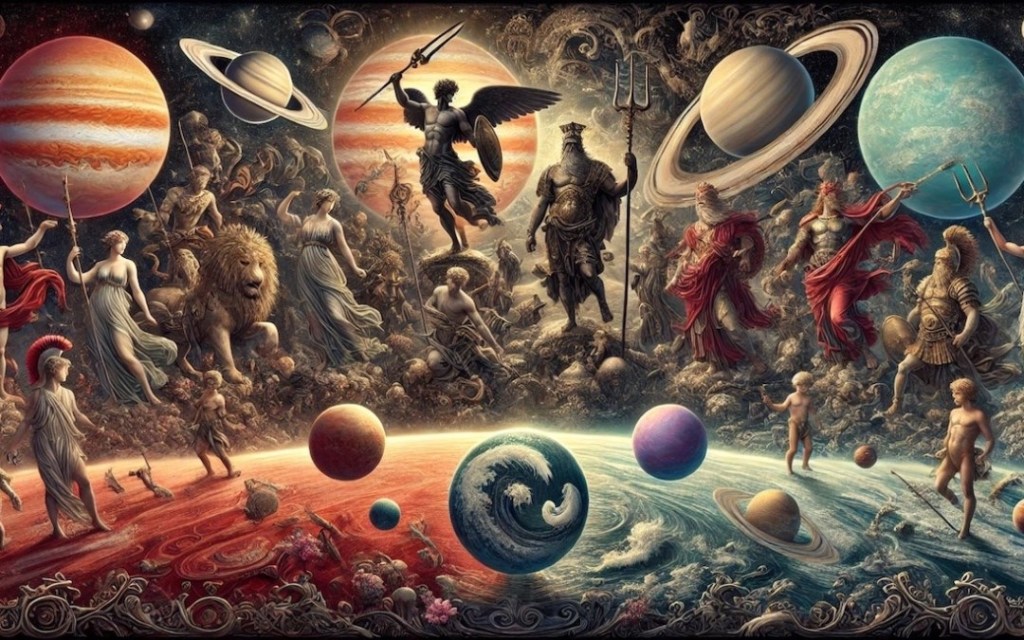
She’s got a whole Universe of Kings and Queens, Gods and Goddesses, whatever the Upper Echelon of the Universe call themselves, the Counsil of Universes, for there are many, unified in their decision to elevate her.
She is alive because they have deemed her worthy of life. She has been given reprieve, for they have deemed her innocent of any crime, and are rewarding her for the centuries of torture she endured at the hands of man … because she dare speak of love, because she dare be intelligent, because she dare expand into life and be recognized as a Woman who deeply loves Creation and the Life it holds … gifts of the Mother Father Most High Divine.
They poisoned her and hurt her bad, physically and with magic … they wished death upon her the whole of her life. They insist she isn’t responsible, even though she succeeded where they were certain she would fail. They were certain their efforts to deteriorate and disqualify her were sufficient. They are hollering, whining really, and insisting they have rights to her essence, energy, gifts ,,, soul and right to life.
They want to rule the universe. They’ve been slave trading for centuries, announcing themselves conquerors, masters.
The universe came together without prejudice and chose this Woman Survivor as Representative. A whole Universe of teachers to teach, to guide, and the Most High Divine within all realms supervises it all.
This time, it will go a little differently.
But the trafficker insists it has rights to the merchandise of angels, so the transition is a little bumpy.
Those entities who believe they own the whole of the world send in dancing puppets, beautiful, scantily clad succubusses, to wiggle and giggle and see if the cobra will rise from its basket and do a little weave and bob according to the dancing puppets will.
“Lust will be your downfall,” said the Most High to the warriors. Absolutely. A man who cannot control his mind, or his phallus, tends to “do the dance” and fall every time.
The hidden controllers have used the enslaved or agreeable Womb of Power against mankind for centuries, while causing great suffering for the Divine Feminine who tries, but cannot compete with the illusion, the alluring dance.
She doesn’t wiggle her hips like that. She doesn’t dress to gain a rise out of the snake. She’s busy building things, adding value to her soul, while he’s chasing smoke … looking for fire.
It’s too bad the Creatress doesn’t light his inner fire to match her efforts for creation … that he feels compelled to dance for the masters puppet, straight into fire of destruction.
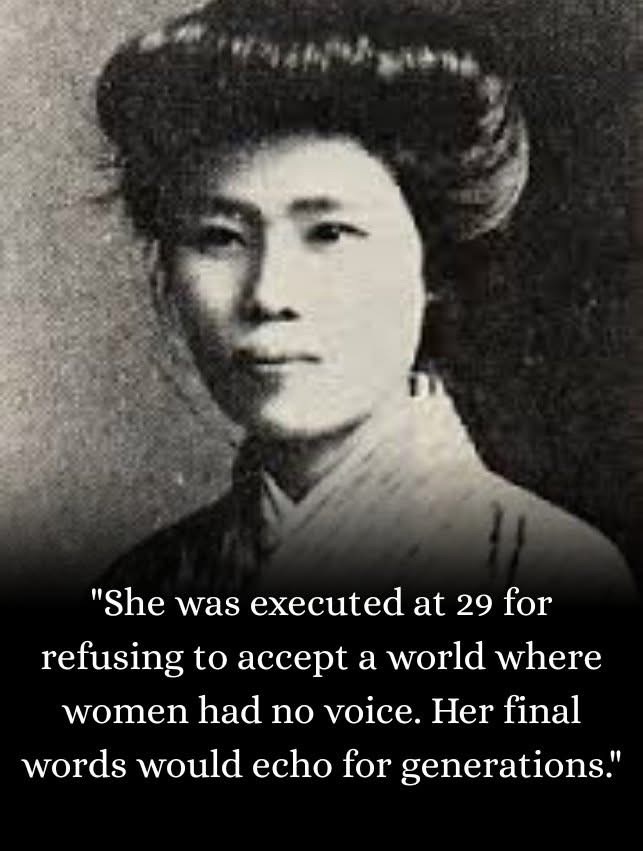
She was executed at 29 for refusing to accept a world where women had no voice. Her final words would echo for generations.
Japan, early 1900s. The emperor was considered divine. Women could not vote, own property, or speak in political spaces. Society was a fortress built on hierarchy, and questioning it was heresy. Kanno Sugako looked at this fortress and decided she would not live within its walls.
Born in 1881, Kanno defied every expectation placed on Japanese women of her era. While society demanded silence and submission, she became a journalist—one of the few women writing for public newspapers. She didn’t write about fashion or domesticity. She wrote about injustice. About the suffocating restrictions on women. About the impossibility of change within a system that treated dissent as treason.
Her words were dangerous because they asked dangerous questions: Why should half the population be voiceless? Why should one man be worshipped while millions suffered? Why should we accept the world as it is when it could be something better?
Kanno wasn’t satisfied with words alone. She joined radical political movements, attended banned meetings, and connected with anarchists and socialists who dreamed of dismantling the entire social order. In an era when most women couldn’t leave home without permission, she was organizing revolution.
Then in 1910, authorities uncovered what they called the High Treason Incident—a plot against Emperor Meiji himself. Kanno was arrested along with two dozen others. The evidence was questionable, the trial rushed, the outcome predetermined. Twenty-four people would be sentenced to death.
Kanno Sugako was the only woman among them. The state wanted her to recant, to plead for mercy, to perform the expected role of the repentant female. They wanted her to cry, to apologize, to beg for her life in exchange for admitting she’d been led astray by men.
She refused every script they offered.
Instead, she wrote. In her prison cell, Kanno penned her autobiography and reflective essays that would be smuggled out and preserved. Her final writings revealed not regret, but absolute conviction. She saw her death not as a tragedy but as testimony—proof that some truths were worth dying for.
On January 24, 1911, Kanno Sugako was executed by hanging. She was 29 years old. As she walked to the gallows, witnesses reported she showed no fear. She had made her choice, understood its cost, and claimed her fate with startling clarity.
The Japanese government wanted to erase her. They banned her writings, suppressed her name, and hoped history would forget a woman who dared challenge divine authority.
But you cannot silence what refuses to be silent. Kanno’s story survived through whispers, through secretly preserved texts, through generations of feminists who found strength in knowing someone had walked this path before them. Decades after her death, her autobiography was published. Her letters were studied. Her courage was recognized. She became a symbol for Japanese feminists fighting for suffrage in the 1920s. For women demanding rights after World War II. For every movement that asked why women should accept less.
What Kanno Sugako understood—what made her both terrifying to authorities and inspiring to those who came after—was this: some systems cannot be reformed. Sometimes witnessing injustice without acting becomes complicity. Sometimes the only way to prove you’re free is to choose, even when the choice carries the ultimate price.
Her story is uncomfortable because it refuses easy answers. She wasn’t a martyr who accidentally stumbled into tragedy. She was a woman who looked at her options—silence or defiance—and chose defiance knowing exactly where it would lead.
History has given us many stories of women who survived against impossible odds. Kanno’s story is different. She didn’t survive. But her refusal to accept the world as it was helped create a world where Japanese women could eventually vote, own property, speak freely, and choose their own paths. She paid with her life for freedoms she would never experience. That’s not a story with a happy ending. It’s a story with an honest one.
Every right we have today was paid for by someone. Some paid with their time, their comfort, their reputation. Some, like Kanno Sugako, paid with everything.
Her legacy isn’t about the methods she chose—those remain historically complex and debated. Her legacy is about the question she forced into existence: What are you willing to sacrifice for a world you’ll never see but others might inhabit? She answered that question at 29, in a prison cell, with absolute certainty.
And her answer changed what was possible for every woman who came after.
(The curator said he and his nasty jacks burned the resurrected Magistrate alive MANY times, they stripped her of her honor over and over again … this could very well have been one of her lives. Spirit Divine stated this woman, and these women, the Roses, were the sacrifices the church and their savior have been operating on. The Rose has finally been emancipated. These are bad days for those who have burned the Divine Daughters and Mothers for centuries).
The 19-year-old peasant girl who had turned the tide of the Hundred Years’ War now sat chained to a wooden block in an English fortress, guarded by the same soldiers whose army she had defeated. The woman who had crowned a king would be destroyed by men determined to prove she was no messenger of God, but a heretic deserving only fire. When Burgundian forces captured Joan at Compiègne on May 23, 1430, they held the most valuable prisoner in France. In November, the English paid 10,000 francs to her Burgundian captors and transferred her to Rouen, the administrative capital of English-occupied France. By December, Joan was imprisoned in the castle of Bouvreuil, a fortress controlled by the Earl of Warwick; the English had purchased the means to destroy the legitimacy of Charles VII himself.
Joan’s Interrogation by English Clergy On January 3, 1431, an edict charged Joan with religious crimes to be tried by an ecclesiastical court headed by Pierre Cauchon, Bishop of Beauvais, long an adviser to the English occupation government. The accusations included wearing men’s clothing in violation of biblical law, claiming to receive divine visions, and refusing to submit to church authority. The trial would decide whether Joan’s victories were acts of divine will or the work of a heretic guided by demons. Formal interrogations began on February 21, 1431. Joan was led into the castle chapel to face Bishop Cauchon and forty-two clerics assembled to judge her.
She agreed to swear an oath to answer truthfully but refused to reveal anything that might compromise King Charles VII. Between February 21 and March 24, she endured nearly a dozen sessions. The clerics pressed her relentlessly on three issues: the nature of her visions, her refusal to submit to church authority, and her wearing of men’s clothing. Their questions were traps designed to expose heresy no matter the answer. When asked whether she believed she was in a state of grace, Joan saw the snare.
Church doctrine held that no person could know with certainty whether they possessed God’s grace. If she answered yes, she would contradict doctrine; if no, she would admit her visions could not be from God. Joan replied that if she was not in a state of grace, she prayed God would place her there, and if she was, she prayed God would keep her there. Even her interrogators found no fault with the answer. The initial seventy charges were reduced to twelve articles of accusation.
Joan defended herself with such intelligence that some clerics began questioning the proceedings. One tribunal member stepped down, stating the testimony was being coerced to entrap Joan rather than seek truth. Another challenged Cauchon’s right to judge and was immediately imprisoned. Throughout, the court’s irregularities mounted.
Imprisonment in a Male Military Jail During the trial, Joan was held under conditions that violated ecclesiastical law. Canon law required that female prisoners accused of heresy be guarded by women—typically nuns—in church prisons. Joan was confined in a secular military fortress under direct English control, guarded by common soldiers who viewed her as an enemy. She was chained to a heavy wooden block even in her cell; iron shackles were sometimes fastened to her feet.
Guards were assigned to remain inside her cell at all hours—three inside continuously, with two posted outside, according to later testimony. Joan had no privacy and no respite from the gaze of men who despised her. The guards taunted her mercilessly; she lived in constant fear. When she fell gravely ill with fever and believed she might die, she begged for the sacrament and burial on sacred ground—requests denied.
The Earl of Warwick restrained the guards somewhat, not from compassion but because the English had paid the equivalent of a thousand horses for her and intended to extract full political value from her condemnation. Yet the danger went beyond harassment. Testimony at the 1456 rehabilitation trial reported repeated physical threats and attempted violations during her imprisonment. One witness stated that a great English lord tried to assault her.
This helps explain Joan’s insistence on wearing men’s clothing despite the charge. Men’s garments, tightly laced and bound, offered protection that a dress could not. Joan argued repeatedly that it was more proper to dress as a man when surrounded by male guards than to wear clothing that left her vulnerable. The judges dismissed her reasoning, but the danger was real. The trial itself was riddled with procedural breaches.
Joan was interrogated for weeks before being formally read the charges. She was given no legal counsel. The procedures fell below even minimal inquisitorial standards. The trial occurred in Rouen rather than in her home diocese, breaching canon law. Evidence suggests transcripts were falsified at crucial points to render Joan’s statements more incriminating.
The Heresy Verdict and Execution at Rouen On May 23, 1431, Joan was informed that theologians from the University of Paris had reviewed her case. Their verdict was unambiguous: her claimed voices were judged demonic; her men’s clothing unnatural and wicked; her refusal to submit marked her as a heretic. If she would not recant, she would be handed to secular authorities for burning. The next day, Joan was taken to the cemetery of Saint-Ouen and placed beside a stake.
Terrified by the sight, weakened by months of imprisonment, and abandoned by the king she had crowned, Joan broke. She agreed to sign a form of abjuration, recanting her claims and admitting she had deceived the people of France. Her sentence was commuted to perpetual imprisonment, and she was ordered to wear women’s dress. She complied—briefly.
When Cauchon and other judges visited her cell days later, they found her again in men’s clothing. Joan stated she had changed back of her own free will, saying the voices of St. Catherine and St. Margaret had reproached her for denying truth to save her life. But witnesses at the 1456 rehabilitation trial offered another account: guards had stolen her dress at night and left only men’s clothing, forcing her to put it on.
Whatever the precise circumstances, the outcome was predetermined. On May 28, Cauchon and seven other judges interrogated Joan in her cell. She told them she had resumed men’s clothing because it was necessary for protection among male guards and that her voices had censured her for recanting. Returning to male attire after swearing to abandon it was deemed proof of relapse.
Under canon law, a relapsed heretic could not be given a second chance. On May 29, the judges unanimously agreed to hand her over to secular authorities. The sentence was death by burning. On the morning of May 30, 1431, Joan was allowed to receive the sacraments—an act of mercy that technically violated church law. She was then led from her cell to the Place du Vieux-Marché, the old marketplace at Rouen.
A tall plastered pillar had been erected in the center of the square; Joan was tied to it. She should have been formally handed to the bailiff of Rouen for secular sentencing, but instead the English took direct control. Joan asked to see a cross as she died. An English soldier, moved by her plea, fashioned a simple cross from two sticks and gave it to her. She kissed it and held it to her chest.
A processional crucifix was then brought from the Church of Saint-Sauveur. Joan embraced it before her hands were bound, and it was held before her eyes as the flames were lit. As the fire rose around her, witnesses heard her cry out repeatedly. Her final word, shouted above the roar, was the name “Jesus.” At nineteen, the peasant girl who had changed a war’s course died in Rouen’s marketplace.
After her death, executioners burned her remains twice more to ensure nothing was left. Her ashes were thrown into the Seine to prevent relics. The English believed they had erased Joan of Arc from history. Instead, they created a martyr whose story would endure for centuries. Twenty-five years later, a rehabilitation trial convened at her mother’s request.
The court heard testimony from 115 witnesses and declared the 1431 verdict invalid—tainted by bias and riddled with procedural errors. In 1920, the Catholic Church canonized her as St. Joan of Arc. The woman burned as a heretic became a patron saint of France. If you had stood in that Rouen marketplace on May 30, 1431, watching a nineteen-year-old girl call out to God as flames rose, would you have recognized judicial murder dressed in the robes of religious authority?
The trial that condemned Joan was never truly about heresy. It was about destroying the symbol that made French victory possible and English occupation untenable. Her judges could twist canon law, falsify records, and break procedure—but they could not erase what she had already changed. That is why her name still burns brighter than their verdict.
This sort of freaks me out, knowing they inject the babies right away. What are they “really” doing?
Some hints in here .. matrix, blue minds, 3D world…so many in a short clip…animals, cannibals, can you decode/decipher it all…?
**Decoded/ Deciphered by Vrill Slayer Posted by Mel Raggam
Gematria
Some hints in here .. matrix, blue minds, 3D world…so many in a short clip…animals, cannibals, can you decode/decipher it all…?
From the lyrics of Iniko.
Snippet From My Cosmic Burst in Simple Gematria equals 331 x 6 = 1986
= The Neptunes Presents Clones
From two rap artists including Pharrell Williams having an album named Clones as human clones exposed by Donald Marshall.
= Science Fiction Movies Are Reality
We have all viewed movies and TV series that call it science fiction but art imitates reality they are trying to warn you, hint you of the technology that is used on mankind – hinting human cloning, body snatching Vrill that turn into hosts as the technology for consciousness transfer put into an Avatar or clone even downloading dead consciousness to be put into a synthetic body.
= Brain Invaders Must Be Destroyed
This is relation to body snatchers as those who do human experimentation on people through MK Ultra, invading the mind for control, torture through clone after clone.
= Brain Chip Implant The Witness
As those who are chipped that go through REM even those who aren’t chipped. Donald Marshall which exposed about the RFID chip used to download dead consciousness to individuals who become coherent and submissive. This also includes remote neural monitoring.
= They Just Pick Up Another Body
Leah Remini who used to be part of Scientology mentioned in her tweet that those who die they just pick up another body recalling their memories to be put into a new body. Think of movies like Self/Less or Replicas.
19 + 86 = 105
Full Reduction ‘105’ codes
= SIX HUNDRED AND SIXTY SIX
Root of this technology is THE MARK OT THE BEAST.
= MILITARY INTELLIGENCE
Known as Military Industrial Complex which is know also from when making super soldiers as they reference the MILITARY INTELLIGENCE codes from the movie.
Star Children I Got News For You in Simple Gematria equals 343 x 6 = 2058
= Infiltration Instead Of Invasion
A quote by JFK in 1961 before assassinated exposing secret societies. They infiltrate to parasite instead to invade.
= Fallen Angels Are The Actual Illuminati
Known as the Annunaki, the Sumerian gods, known as the sons of God or the Watchers – they are the original Illuminati the renown as the Freemasons are just puppets of Lucifer.
The star children are related to those who are called starseeds or the Pleiadians of the Galactic Federation – Donald Marshall exposed them to be Vrill hosts they are parasites wanting to infiltrate and take over hosting humans to be drones.
= Are We Living In A Simulated Reality = Everything Is Hidden In Plain Sight
The world has become a simulation or altered realities, brainwashing and programming of the mind such with media, social media and today’s social environment.
= Grey Alien DNA Forms A Proto Species
The term grey aliens are the Vrill Type 3 people know them as aliens from outerspace but they’re form deep inner earth and not outer space. Proto species would be half reptilian hybrids that become cybernetic machines modified DNA turning humans into hosts – this also relates in the realms of Transhumanism.
= Donald Marshall The Soulstone Chip
For the years Donald Marshall has spoken about this even of today. Putting souls into devices to the next clone. The cube of Saturn which contains cube shape devices of trapped souls.
“..this is a 3D world it’s corrupt and blue..”
This Is A Three D World in Simple Gematria equals 217 x 6 = 1302
= Dont Worry Darling
A movie which has a character name Alice put into a simulated world of a false reality which she later founds out. Think of terms like Alice in Wonderland.
= Subconsciousness
That which the subconscious mind becomes altered from reality. Think of Dorothy in Oz or Alice in Wonderland. This relates to also Don’t Worry Darling or the movie Inception.
“Switching people out. Taking out the soul and putting a different person in the body” … it’s what this curator is threatening to do to the Magistrate, the Planetary Gatekeeper.
Body snatching and consciousness transfer – This is how the nephilim live thousands of years. pic.twitter.com/boCkAtpgss



 opensenseme