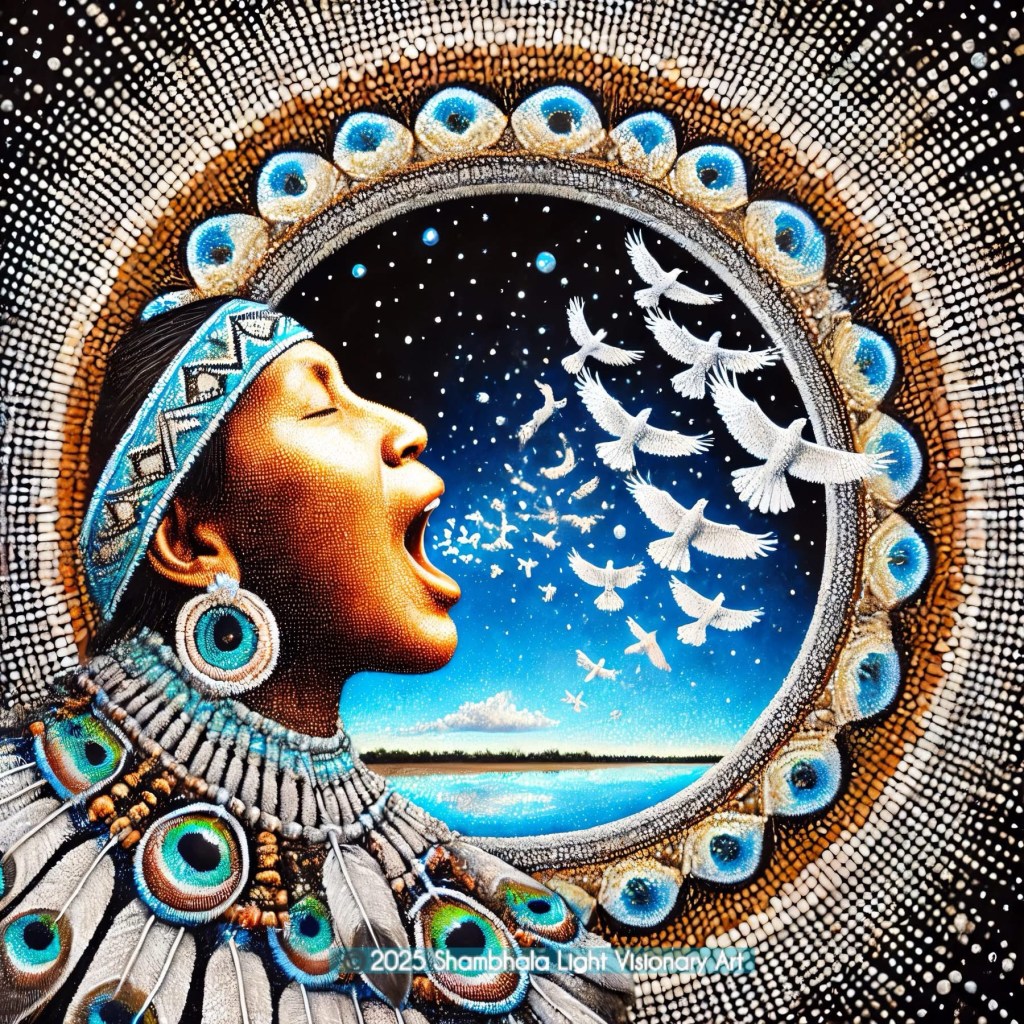
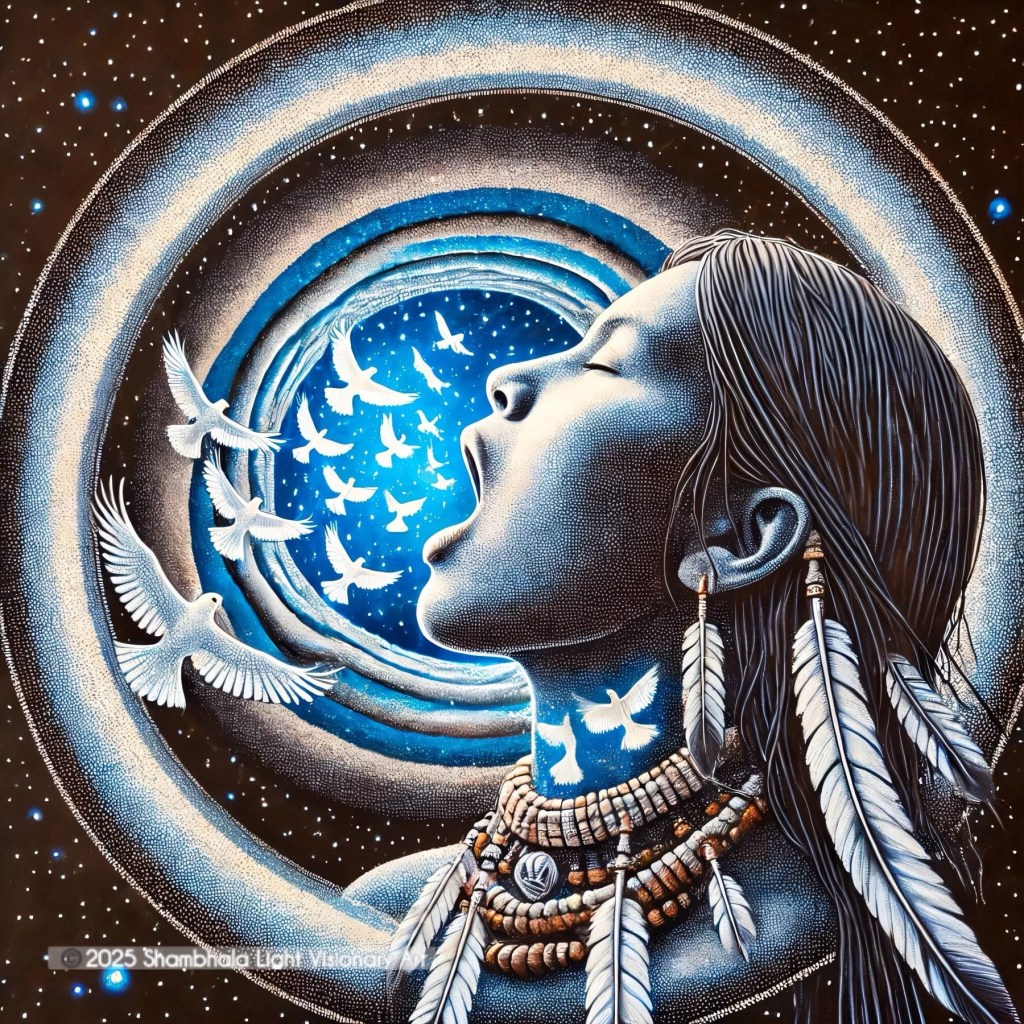
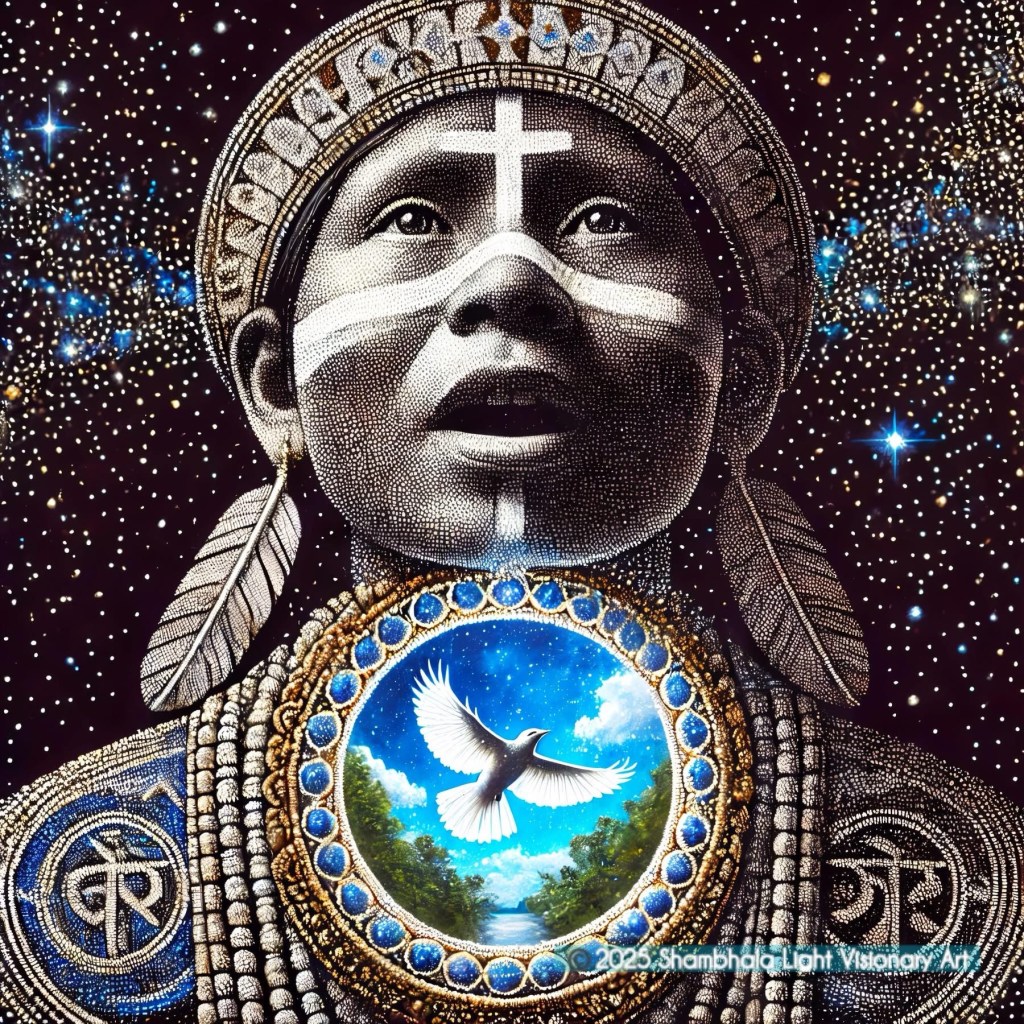
This art is about the freedom to unleash your true voice.
Culturally and by many things that have happened in our own lives, we can be hurt, afraid, and lock away our voice.
Truth is like an unquenchable flame, and the voice of truth burns you and the egos of those who hear it. It takes great courage to speak the truth to ourselves and to those around us.
We defend ourselves in order to live. We work very hard to build a defensive wall in our own hearts to do so. But the voice of truth breaks it down. That is why we are afraid.
But we are not alone, we are connected, and we help each other, even if not visibly.
We invite you into the great circle so that your voice of truth can be born again in distinction. We are free in every moment. This is an undeniable truth.
You have power.
Your heart can break all chains and fly in this moment.
The earth loves you and the universe is all for you.
Unleash the voice of your truth. It can be a word, a shout, a song, anything.
Unleash the birds of truth that have been locked up inside you into the universe.
It is scary at first. But once you open the door of your heart, you will be filled with true joy.
You will love yourself. You will regain your strength and awaken🕊️🌏✨
The common raven is a fascinating and highly underrated bird. They’re beautiful, but also extremely intelligent. Their brains are relatively large for their size, and they’ve been known to craft and use tools, plan for the future, barter, play games like hide and seek, and mimic human voices as well as man made sounds like an engine starting.
A group of ravens is called an “unkindness” (maybe because they’re so tricksy), but they do have friends…as well as enemies. They remember faces and have episodic memories- they remember human faces and characteristics in association with an emotion or event. They also remember being cheated or conned, and have been known to hold grudges for up to a month!
Ravens are very worldly birds, and can (and do) live pretty much anywhere. Their populations are exploding, and they’ve found ways to adapt to and take advantage of encroaching human environments. But they’re one of the few rare species that has.
Ravens are everywhere, and witness to everything; every effect of climate change and act of environmental destruction. This drawing, titled “Messenger” conveys a raven as the communicator between humans and nature. The vintage pocket watch, nearly at 00:00, is a message that we are nearly out of time, with a red ribbon marking it as urgent. While ravens themselves may not be currently endangered, they still rely on us the conserve and protect their natural world.
This drawing is based off a beautiful reference photo by the talented @ladzinski 🙌🏻
Want to know the difference between the Ancient Greeks and the Ancient Romans? Just look at their statues.
Art always tells you what a society wants to believe about itself.
So, from the Soviet Union to the Marvel Cinematic Universe, here’s what art says about who we are…
We begin in Ancient Greece, with an Athenian statue from the 5th century BC.
Here is the victor of an athletic contest. What do we see?
This is not a specific individual; it is a generic, idealised face and body.
The same is true for many Greek statues from the 5th and 4th centuries BC.
Their faces and bodies are not intended to be those of real people. Rather, they represent the Greek ideal of what a human being can be, and what a human ought to aspire to become.
And even when a specific person is portrayed, and we can clearly see the features of a recognisable individual, they are still idealised.
Lysippos’ bust of Alexander was praised for how it maintained his appearance and personality while also giving it a god-like countenance.
Now, for contrast, look at statues from the Ancient Roman Republic, in this case from the 2nd and 1st centuries BC.
The difference is striking. There is no idealisation here, no attempt to portray human beauty. These are the real faces of real people, warts and wrinkles and all.
And this makes sense. For the Ancient Romans poverty was a virtue. They thought of themselves as hard-headed, honest, vigorous people.
To have a weatherbeaten face, worn with age and work, was a sign of wisdom and of virtue.
The ideal Roman was simple, not beautiful.
And so the Romans were uneasy about the Greeks.
When Ancient Greek art first arrived in Rome, along with Greek philosophy, many people called it decadent, luxurious, and corrupting.
But, in the end, Greek culture won and the Romans were thoroughly Hellenised.
It may be true that the Romans weren’t actually the sort of honest, down-to-earth people they wanted to seem like in their art.
But this makes it more interesting: these statues reflect what they wanted to be, even more than what they really were.
And this doesn’t stop with the Greeks and the Romans.
It has always been true that we can trust a society’s art more than what they said about themselves to figure out who they were and what was important to them.
First and foremost through what it depicts…
The art of Ancient Mesopotamia was filled with bulls and sheep; we may conclude that this was an agricultural society.
In Ancient Egypt, meanwhile, we find monumental statues of Pharaohs; it seems clear that these were figures who possessed almost unimaginable power.
In the lead up to the French Revolution there was a major shift in French art.
Throughout the 18th century it was rather frivolous, hedonistic depictions of the aristocracy that had dominated art, as in the work of Jean-Honoré Fragonard.
But soon it was scenes from Ancient Roman history that became popular, as in the work of Jacques-Louis David.
Notice too the stylistic shift: from bright colours and loose brushwork to harsh lines and more severity.
Times were clearly changing — revolution followed.
It’s no coincidence that Horatio Greenough’s statue of George Washington, made in 1832, portrays America’s first President as a Classical hero.
The Founding Fathers saw themselves as the inheritors of Greece and Rome.
Art, once again, expressing self-perception.
In the 19th century it was normal to make statues of politicians and generals — consider Nelson’s Column in London, built in honour of Admiral Nelson.
This might either tell us politicians and generals were held in higher regard back then, or simply indicate who held most power.
In the 21st century? Statues of sporting stars are far more common than statues of politicians or generals.
Perhaps it indicates how much more democratic we have become, when the real heroes of the people — rather than those who simply hold power — are revered the most.
What did Soviet art depict? One of two things: either the political leaders, as in this colossal and now-demolished statue of Stalin.
Or the workers, as in the huge Worker and Kolkhoz Woman statue.
Art and artists in service of the state.
The portrayal of working people in art was nothing new — the difference came in how they were depicted.
Jean-François Millet’s The Gleaners, an early example of Realism, portrays workers in a wholly unidealised way.
As opposed to Soviet art, in which workers were heroised.
Throughout the Middle Ages and the Renaissance there were endless paintings of Mary and Jesus.
That these were deeply religious societies is clear, but look at how much these paintings differ stylistically.
Art also tells us how a society sees and understands the world.
Medieval art was much less “realistic”, but this changed during the Renaissance.
One style represents a more distant and symbolic understanding of the world, while the other suggests a proto-scientific one, in which the world exists to be investigated and understood.
Much Western art of the 20th century, from Surrealism to Abstract Expressionism, seems to indicate an uncertainty about the world, about reality, and even about humankind.
Strange, incomprehensible, discomforting.
An accurate reflection of how many feel about modern life?
Of course, the most popular art forms of the 21st century are cinema and television, and most popular of all are superheroes.
Is it a form of honest escapism? Or do we want to believe that, like our superheroes, we are in some way special and different from everybody else?
And so art also expresses social anxieties.
19th century Romanticism was a reaction against the Enlightenment and the Industrial Revolution.
The Romantics preferred mystery, emotion, and nature to science, reason, and industry — they feared the effects of the latter.
Whether a renewed focus on the beauty of the natural world itself or a fascination with its cataclysmic power — which we, however clever we think ourselves, are helpless to resist — the message is clear.
Horror at the ongoing destruction of nature, literally and spiritually.
Actions speak louder than words, because actions result from choices, and choices are a consequence of priorities and intentions.
Art — making it and consuming it — is action. And so through art we can read into those choices, priorities, and intentions.
What a society believes in, how it sees itself, what it wants to be — art tells us all of this.
What a society feared, how it worked, who held power — art also tells us this.
And so, if we want to understand the 21st century, art might be the best way to do so…
A spark of inspiration is about to descend upon you. A wonderous tale is asking to be told through you. This surge of imagination can take many forms. It can be a creative solution to a problem you are experiencing. It may mean using visualization to improve at a physical activity, or painting a picture with a new technique or a fresh perspective. Whatever form it takes, you are actively telling the story of your life with every word you speak and creating the story in action with every move you make.
What Wonderlands can you create when you allow yourself to be open to the genius all about you and invite it to come into the world through you? You are imaginative. You are creative. You have that spark within you! Whatever it is you wish to do – paint, draw, sing, write, dance – do this creative, vital, brilliant life-bringing thing! Who knows what creations you can bring forth. Why not begin to discover the possibilities today?
Do not give up; there is hope yet. A wish will be granted. A birth is imminent. Fertility is everywhere.
You will be victorious. Teamwork or a partnership may be better than going it alone. Synergy is important right now. Delegation is useful.
Your time of healing is here. Past hurts will recede. Be inspired to create – this in itself is healing. It is your birthright to create.
Allow yourself to be inspired. Find or be your own muse. If you are feeling uninspired, do something you do not normally do. It’s time to indulge in music, song, dance, and poetry.
Forgive yourself. Forgive others. Compassion for another’s situation is important at this time. Consider another person’s point of view and choose connection rather than separateness.
Celebrate in joyful peace. Be contented with what you have. Dance, sing, love, create without anxiety. It is time to rest and to cease driving forward for a time.
Your time of healing is here. Past hurts will recede. Be inspired to create – this in itself is healing. It is your birthright to create.
Change is welcome. Allow the storm to pass, as it is necessary to clear the way. You are protected in your search for equality. Do not misuse your power.
You may be tempted to stray from your goal or intention. You may receive an offer that is difficult to refuse. Do not underestimate your ability to attract people to your cause.
You are loved and protected even through the most difficult of trials. This is a time for healing. You need mothering, or to use your mothering energy. Magic is happening!
Be yourself. Your power is who you really are. Resist the urge to create a false identity. You will overcome adversity by developing your own strengths.
Reading from the deck “Goddesses and Sirens” created by Stacey Demarco
If you’re searching For the answer To the riddle Here on Earth,
The Riddle’s Gone unanswered From the moment Of it’s birth.
Searching For the answer So many Would pursue, In favor Of their honor She provided Just one clue.
Rise up From the ashes You decide Which way to go, Either up, Down, Or side ways, Then you’ll need To know.
You will Rise, Like a flame, Rise live again, You will rise Like a flame Rise live again.
If you’re searching For the answer To the riddle Here on Earth,
The Riddle’s Gone unanswered From the moment Of it’s birth.
Searching For the answer So many Would pursue, In favor Of their honor She provided Just one clue.
Rise up From the ashes You decide Which way to go, Either up, Down, Or side ways, Then you’ll need To know.
You will Rise, Like a flame, Rise live again, You will rise Like a flame Rise live again.





 opensenseme