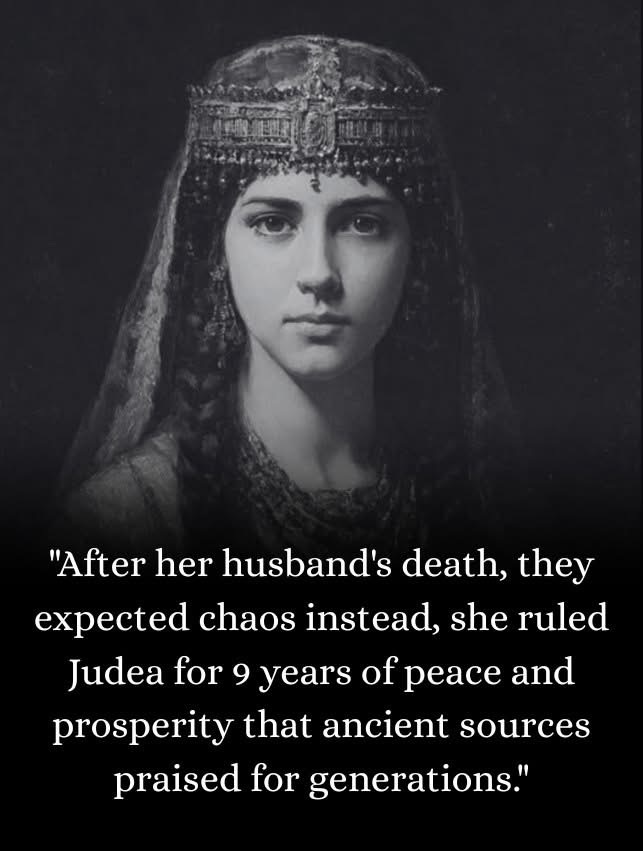
After her husband’s death, they expected chaos—instead, she ruled Judea for 9 years of peace and prosperity that ancient sources praised for generations.
Jerusalem, 76 BCE. King Alexander Jannaeus lay dying. His reign had been brutal—marked by civil war, mass executions, and conflict between religious factions. Judea was exhausted, divided, bleeding.
On his deathbed, Alexander did something unusual: he designated his wife, Salome Alexandra, as his successor. Not one of their sons. Not a military commander. His wife.
She was around 64 years old. She would rule for nine years—and those years would be remembered as among the most peaceful and prosperous in Judean history.
This is her actual story, remarkable enough without embellishment.
Salome Alexandra (known in Hebrew as Shlomtzion, meaning “peace of Zion”) was born around 141 BCE. Little is known about her early life, but she came from a priestly family and was well-connected to Jerusalem’s religious and political elite.
She married Alexander Jannaeus around 103 BCE. He was a Hasmonean king—descended from the Maccabees who’d won Jewish independence from Greek rule. But the Hasmonean dynasty had become corrupt, brutal, and increasingly unpopular.
Alexander’s reign was particularly violent. He fought constantly—external wars against neighbors, internal war against the Pharisees (a Jewish religious faction that opposed him). At one point, he crucified 800 Pharisees while feasting and watching them die.
Judea under Alexander was traumatized.
When he died in 76 BCE, Salome assumed the throne. She became “Queen” (basilissa in Greek, malka in Aramaic)—the only woman to rule Judea independently in the Hasmonean period.
Ancient sources—particularly the Jewish historian Josephus and the Talmud—describe her reign positively, which is notable given how critical they are of other Hasmonean rulers.
What made her reign successful?
Political balance: Salome reversed her husband’s policies toward the Pharisees. She allied with them, giving them influence in the Sanhedrin (Jewish council) while keeping the Sadducees (another faction) from becoming too powerful. This balance ended the civil conflict that had plagued her husband’s reign.
Domestic stability: Unlike Alexander, who was constantly at war, Salome focused on internal governance. The Talmud associates her reign with prosperity—harvests were good, peace prevailed.
Diplomatic skill: She maintained Judea’s position without major military campaigns. She recognized that Judea, surrounded by larger powers (Egypt, Syria, Rome), needed diplomacy more than conquest.
Respect for religious authority: By working with the Pharisees and supporting Torah scholarship (generally—not specifically for women), she gained popular support. The Pharisees emphasized law and learning over the priestly aristocracy favored by the Sadducees.
The Talmud (Tractate Taanit 23a) says of her reign: “In the days of Shimon ben Shetach and Queen Shlomtzion, rain fell on Wednesday nights, so that the wheat grains grew as large as kidneys, barley grains as large as olive pits, and lentils as large as gold dinars.”
This is obviously legendary exaggeration, but it indicates how her reign was remembered—as a golden age of peace and plenty.
Was she opposed because she was a woman? The historical sources don’t emphasize this. She seems to have assumed power relatively smoothly as her husband’s chosen successor.
While some Sadducees opposed her alliance with Pharisees, ancient sources frame this as political-religious conflict, not gender-based.
Did she champion women’s education specifically? There’s no historical evidence for this claim. While she supported the Pharisees who valued Torah study, nothing in Josephus, the Talmud, or other sources attributes specific policies about women’s education to her.
Women’s formal Jewish education remained extremely limited in this period and for centuries after. If Salome had implemented revolutionary policies expanding women’s education, it would likely have been noted in sources—either as praise or criticism.
This doesn’t diminish her accomplishment. Ruling successfully for nine years in the ancient world as a woman was extraordinary. She didn’t need to also be a feminist education reformer to be impressive.
What happened after her death reveals the fragility of her achievements—but not for the reasons sometimes claimed.
Salome died around 67 BCE at approximately age 73. She’d designated her older son, Hyrcanus II, as her successor. But her younger son, Aristobulus II, challenged him.
Civil war erupted immediately—not because people opposed female rule, but because of normal succession disputes between ambitious brothers.
The war weakened Judea at exactly the wrong moment. Rome was expanding eastward. In 63 BCE, Roman general Pompey intervened in the civil war, besieged Jerusalem, and essentially ended Judean independence.
Judea would remain under Roman control (directly or through client kings like Herod) for the next century, until the destruction of the Second Temple in 70 CE.
So yes, everything Salome built collapsed after her death. But not because of gender-based opposition or rollback of women’s rights. It collapsed because her sons’ ambitions destroyed what she’d carefully maintained.
Salome Alexandra’s actual legacy:
She proved women could rule effectively: In a world where female political power was rare, she governed successfully for nine years.
She ended civil conflict: Through political skill rather than military force, she brought peace after years of violence.
She balanced competing factions: Her diplomatic management of Pharisees and Sadducees maintained stability.
She prioritized domestic prosperity: Unlike her husband’s military adventurism, she focused on governance and peace.
She’s remembered positively: Ancient sources—which were often critical of rulers and rarely praised women leaders—speak well of her reign.
These accomplishments are remarkable and historically documented. We don’t need to invent claims about women’s education advocacy to make her impressive.
Why does this matter? Why not just accept the embellished version that makes her sound more feminist?
Because historical accuracy matters. When we project modern values onto historical figures without evidence, we:
Diminish their actual achievements by replacing them with what we wish they’d done
Distort history in ways that ultimately undermine our understanding of how change actually happens
Lose credibility when people discover the claims aren’t supported by sources
Miss opportunities to understand the real constraints and possibilities of women’s power in different historical contexts.
Salome Alexandra’s actual story—ruling successfully for nine years, maintaining peace, balancing factions, being remembered positively by sources that usually dismissed female rulers—is impressive precisely because it happened in a world that offered women almost no political power.
We honor her better by acknowledging what she actually accomplished within the constraints she faced, rather than inventing accomplishments that fit modern priorities.
To Salome Alexandra: You ruled Judea during a period of peace and prosperity after years of violence and chaos. You balanced competing religious factions without resorting to your husband’s brutality. You maintained Judea’s independence through diplomacy rather than constant warfare. You proved that a woman could govern as effectively as any king.
Ancient sources that were often critical of rulers praised your reign. The Talmud associated your years with abundance. Josephus acknowledged your political skill.
You didn’t need to revolutionize women’s education to be remarkable—though later generations sometimes claim you did because they want ancient validation for modern values.
Your actual accomplishment—ruling successfully for nine years in the ancient world—is impressive enough. The fact that civil war erupted immediately after your death shows how much your skill maintained stability.
You proved women could govern. That was radical in itself.
We don’t need to make you into something you weren’t. What you actually were—a capable ruler who brought peace and prosperity—deserves recognition without embellishment.





























 opensenseme