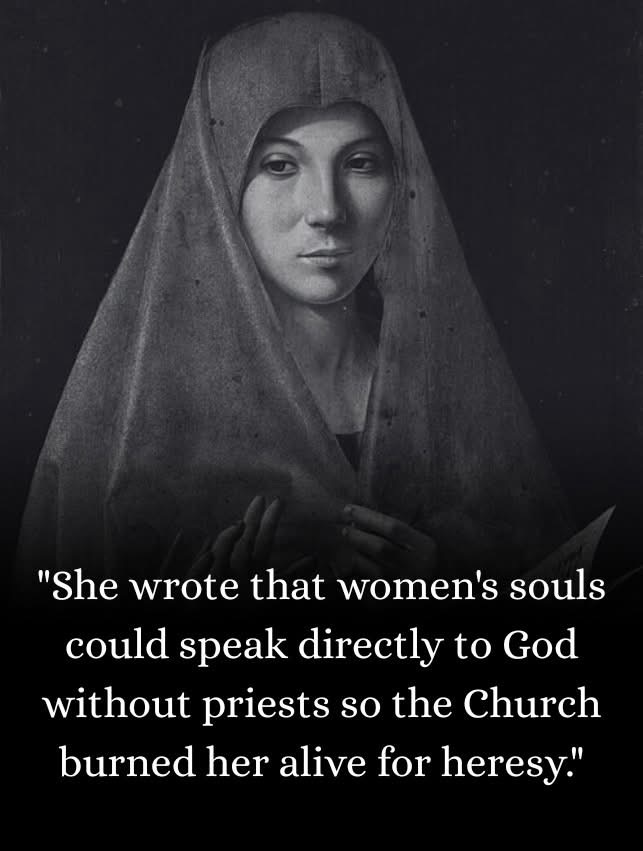
She wrote that women’s souls could speak directly to God without priests—so the Church burned her alive for heresy.
Paris, June 1, 1310.
In the Place de Grève, a woman was led to the stake. Marguerite Porete, accused of heresy, had spent over a year imprisoned, refusing to answer the Inquisition’s questions or defend herself before judges she didn’t recognize as having authority over her soul. Witnesses later described her calm demeanor—no screaming, no begging for mercy, no recantation. She faced the flames with a serenity that unnerved her executioners.
She died for writing a book that claimed a soul could unite so completely with divine love that it transcended the need for Church hierarchy, sacraments, or ecclesiastical mediation. The Church couldn’t tolerate that claim—especially from a woman.
Marguerite Porete was born in the late 13th century in Hainaut (modern-day France/Belgium border region). Little is known about her early life, but she became part of the Beguine movement—communities of lay religious women who lived together in prayer and work without taking formal monastic vows.
Beguines occupied a complicated space in medieval Christianity. They weren’t nuns bound by convent rules, but they weren’t ordinary laywomen either. They lived religious lives outside institutional Church control—which made Church authorities nervous.
Marguerite was educated, literate, and theologically sophisticated—unusual for a woman of her time.
Sometime in the late 13th century, she wrote “The Mirror of Simple Souls” (Le Mirouer des simples âmes) in vernacular Old French rather than Latin.
Writing theology in the vernacular was itself significant. Latin was the language of Church authority—using French made theology accessible to ordinary people, particularly women who hadn’t learned Latin.
But it was the book’s content that proved dangerous.
The Mirror of Simple Souls describes a mystical journey where the soul progressively lets go of attachments, ego, and even virtues until it reaches “annihilation”—complete dissolution into divine love. This “annihilated soul” becomes so united with God that it no longer needs:
Church sacraments
Moral rules
Priestly mediation
Fear of sin
Virtuous acts done out of obligation
Because the soul is completely aligned with divine will, it acts naturally from love rather than from external commands.
Marguerite wrote in dialogue form, with characters including “Love,” “Reason,” “The Soul,” and “Holy Church the Little” (institutional Church) versus “Holy Church the Great” (the mystical body of all souls united with God).
Crucially, she distinguished between institutional Church authority and direct divine relationship. “Holy Church the Little”—the hierarchy, rules, and priests—was necessary for beginners on the spiritual path. But advanced souls could transcend it through complete union with God. This was explosive theology.
The Church’s authority rested on being the necessary mediator between humans and God.
Sacraments administered by priests were required for salvation. Confession, penance, Church law—all of this presumed that people needed institutional guidance.
Marguerite was saying: at the highest spiritual level, you don’t need any of that. The soul united with God transcends institutional authority. Church authorities saw this as dangerous heresy. It suggested that mystics could claim direct divine authority superior to Church hierarchy. It implied that someone in mystical union might be beyond sin or moral law—a heresy called “antinomianism. “And it was especially threatening coming from a woman.
The Church insisted women needed male spiritual authority—priests, confessors, bishops—to guide them. A woman claiming direct divine relationship without male mediation challenged the entire gender hierarchy of medieval Christianity.
Around 1296-1306, Marguerite’s book was condemned by the Bishop of Cambrai. It was publicly burned, and she was warned to stop teaching her ideas. Marguerite ignored the warning. She continued circulating the book and discussing her theology. She sent copies to theologians and Church authorities seeking approval, but also continued teaching despite the prohibition.
This defiance was crucial. She had multiple opportunities to submit to Church authority, burn her book, recant her teachings, and avoid execution. She refused every time. Why? Because she believed—genuinely, deeply—that her mystical experience and theological understanding came directly from God. No earthly authority, not even the Church, could invalidate that divine relationship.
In 1308, she was arrested in Paris. The Inquisition began proceedings against her. During her imprisonment (which lasted over a year), she refused to cooperate with the trial. She wouldn’t answer questions. She wouldn’t defend herself. She wouldn’t acknowledge the tribunal’s authority to judge her spiritual state. Her silence was deliberate and theological.
She believed the judges—bound by “Holy Church the Little”—couldn’t understand the mystical theology of souls who’d reached union with God. Answering them would be pointless.
The Inquisition found her guilty of heresy. They declared her a “relapsed heretic”—someone who’d been warned before and persisted in error. The penalty for relapsed heresy was death by burning.
On June 1, 1310, Marguerite was led to the Place de Grève in Paris. Accounts describe her facing execution with remarkable calm—no terror, no last-minute recantation, no screaming as the flames rose. Observers noted this serenity. Some interpreted it as demonic possession keeping her from repenting. Others saw it as proof she’d achieved the mystical state she’d written about—transcendence of fear through complete union with divine love.
Marguerite Porete became one of the first women burned for heresy by the Inquisition in Paris. Her execution was meant to be a warning: women who claimed spiritual authority independent of Church hierarchy would be silenced permanently.
But her book survived. Copies circulated anonymously throughout the 14th and 15th centuries. Because Marguerite’s name was suppressed (she was executed as a heretic), the book was copied without author attribution. Monks, mystics, and scholars read it for centuries without knowing a woman had written it. Some copies attributed it to male authors.
The mystical theology was considered so sophisticated that people assumed a man must have written it.
In 1946, scholar Romana Guarnieri finally proved that Marguerite Porete was the author. The evidence included trial records and manuscript traditions connecting the condemned book to The Mirror of Simple Souls.
Suddenly, a text that had influenced Christian mysticism for centuries was recognized as written by a woman burned for heresy.
Modern scholars recognize The Mirror as a masterpiece of mystical theology. Its influence can be traced in later mystics including Meister Eckhart (who faced similar accusations of heresy).
Marguerite’s theology anticipated ideas that would later appear in Protestant Reformation critiques of institutional Church authority and in modern mystical and contemplative traditions.
Her story matters because: She claimed spiritual authority as a woman: In an era when women were required to be spiritually subordinate to men, she insisted her mystical experience gave her theological insight. She challenged institutional religious power: She distinguished between institutional authority and divine relationship—a distinction that threatened Church hierarchy. She refused to recant: Given multiple chances to save herself by submitting to Church authority, she chose death over betraying her spiritual convictions.
She was right about mystical theology: Modern understanding of contemplative spirituality recognizes the validity of much of what she taught. Her work survived despite suppression: Burning her body didn’t destroy her ideas—they circulated for centuries, eventually vindicated.
The tragedy is that Marguerite was executed for theology that, in different contexts or coming from a man, might have been tolerated or even celebrated.
Male mystics like Meister Eckhart taught similar ideas and, while investigated, weren’t executed. Her gender made her dangerous in ways male mystics weren’t. A woman claiming to transcend priestly authority threatened both religious and gender hierarchies simultaneously.
To Marguerite Porete: You wrote that the soul united with God needs no intermediary—and the Church killed you for threatening their monopoly on salvation. You refused to recant even when recantation would have saved you. You chose death over betraying your mystical experience and theological convictions. Your silence before the Inquisition wasn’t weakness—it was theological statement. You didn’t recognize their authority to judge what you knew through direct divine union. You faced the flames with the serenity you’d written about—the transcendence of fear through complete surrender to divine love. They burned your body. They tried to erase your name. They suppressed your book. But your words survived. For centuries, they circulated anonymously, influencing mystics who didn’t know a woman had written them. When scholars finally proved you were the author, your genius was undeniable. You were right about mystical union. You were right that souls can experience God directly. You were right that love transcends institutional authority. The Church that executed you eventually had to acknowledge the validity of mystical theology like yours. The ideas they burned you for are now recognized as legitimate contemplative spirituality. You died for claiming women’s spiritual authority. For insisting divine love was greater than ecclesiastical power. For refusing to let priests mediate your relationship with God. That claim cost you your life. But it couldn’t be silenced. Your voice, speaking across seven centuries, still insists: the soul united with Love needs no permission to speak directly to God. They couldn’t burn that truth. And they couldn’t burn your courage.
 opensenseme