Source :: https://www.facebook.com/share/p/1KPb7ZHGoU/?mibextid=wwXIfr
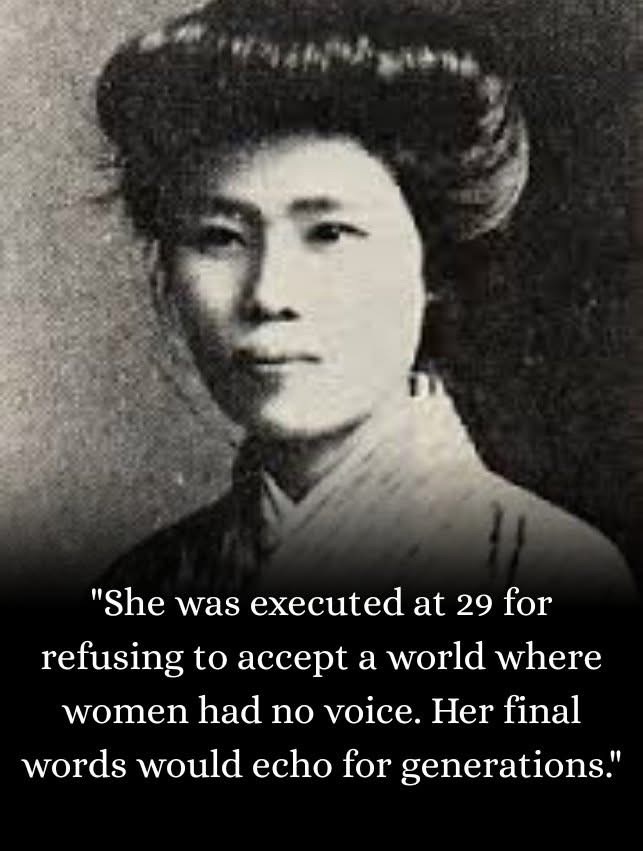
She was executed at 29 for refusing to accept a world where women had no voice. Her final words would echo for generations.
Japan, early 1900s. The emperor was considered divine. Women could not vote, own property, or speak in political spaces. Society was a fortress built on hierarchy, and questioning it was heresy. Kanno Sugako looked at this fortress and decided she would not live within its walls.
Born in 1881, Kanno defied every expectation placed on Japanese women of her era. While society demanded silence and submission, she became a journalist—one of the few women writing for public newspapers. She didn’t write about fashion or domesticity. She wrote about injustice. About the suffocating restrictions on women. About the impossibility of change within a system that treated dissent as treason.
Her words were dangerous because they asked dangerous questions: Why should half the population be voiceless? Why should one man be worshipped while millions suffered? Why should we accept the world as it is when it could be something better?
Kanno wasn’t satisfied with words alone. She joined radical political movements, attended banned meetings, and connected with anarchists and socialists who dreamed of dismantling the entire social order. In an era when most women couldn’t leave home without permission, she was organizing revolution.
Then in 1910, authorities uncovered what they called the High Treason Incident—a plot against Emperor Meiji himself. Kanno was arrested along with two dozen others. The evidence was questionable, the trial rushed, the outcome predetermined. Twenty-four people would be sentenced to death.
Kanno Sugako was the only woman among them.
The state wanted her to recant, to plead for mercy, to perform the expected role of the repentant female. They wanted her to cry, to apologize, to beg for her life in exchange for admitting she’d been led astray by men.
She refused every script they offered.
Instead, she wrote. In her prison cell, Kanno penned her autobiography and reflective essays that would be smuggled out and preserved. Her final writings revealed not regret, but absolute conviction. She saw her death not as a tragedy but as testimony—proof that some truths were worth dying for.
On January 24, 1911, Kanno Sugako was executed by hanging. She was 29 years old. As she walked to the gallows, witnesses reported she showed no fear. She had made her choice, understood its cost, and claimed her fate with startling clarity.
The Japanese government wanted to erase her. They banned her writings, suppressed her name, and hoped history would forget a woman who dared challenge divine authority.
But you cannot silence what refuses to be silent.
Kanno’s story survived through whispers, through secretly preserved texts, through generations of feminists who found strength in knowing someone had walked this path before them. Decades after her death, her autobiography was published. Her letters were studied. Her courage was recognized.
She became a symbol for Japanese feminists fighting for suffrage in the 1920s. For women demanding rights after World War II. For every movement that asked why women should accept less.
What Kanno Sugako understood—what made her both terrifying to authorities and inspiring to those who came after—was this: some systems cannot be reformed. Sometimes witnessing injustice without acting becomes complicity. Sometimes the only way to prove you’re free is to choose, even when the choice carries the ultimate price.
Her story is uncomfortable because it refuses easy answers. She wasn’t a martyr who accidentally stumbled into tragedy. She was a woman who looked at her options—silence or defiance—and chose defiance knowing exactly where it would lead.
History has given us many stories of women who survived against impossible odds. Kanno’s story is different. She didn’t survive. But her refusal to accept the world as it was helped create a world where Japanese women could eventually vote, own property, speak freely, and choose their own paths.
She paid with her life for freedoms she would never experience. That’s not a story with a happy ending. It’s a story with an honest one.
Every right we have today was paid for by someone. Some paid with their time, their comfort, their reputation. Some, like Kanno Sugako, paid with everything.
Her legacy isn’t about the methods she chose—those remain historically complex and debated. Her legacy is about the question she forced into existence: What are you willing to sacrifice for a world you’ll never see but others might inhabit?
She answered that question at 29, in a prison cell, with absolute certainty.
And her answer changed what was possible for every woman who came after.
 opensenseme