One of the cruelest executions in recorded history did not end with death.
It ended with silence, disbelief, and a small creature refusing to let go.
Mary, Queen of Scots had once been a crowned queen of France and Scotland, raised in courts of power and ceremony. But by the final years of her life, she was no longer a ruler—only a prisoner. Accused of conspiring against the English crown, she had fled Scotland hoping for protection from her cousin, Elizabeth I. Instead, she walked into captivity.
For nearly two decades, Mary lived under guard. Letters were intercepted. Conversations were monitored. Every movement was weighed for treason. Eventually, the verdict was decided long before any formal judgment was pronounced. The crown demanded finality.
On a cold February morning in 1587, Mary was led into the great hall of Fotheringhay Castle. The room was stark—stone walls, wooden beams, muted light filtering through narrow windows. Waiting at the center was a low wooden block and a simple, worn executioner’s axe. It was not ceremonial. It was not sharp.
Mary entered dressed deliberately. Beneath a dark outer gown, she wore deep crimson—symbolic of martyrdom. Witnesses later wrote that she appeared calm, even resolute. She forgave the executioner. She prayed aloud. Then she knelt.
The first blow fell.
It did not kill her.
The axe struck poorly, glancing off the back of her head. A gasp rippled through the hall. Mary cried out—not in defiance, but in pain. The executioner recoiled, stunned by his failure.
The second strike came quickly, driven by panic rather than precision. Still, it was not enough. Blood stained the block. Witnesses later swore they heard her voice again, echoing through the chamber—proof that she was still alive.
Only the third blow ended it.
Silence followed. The executioner grasped her head by the hair and raised it to show the assembled officials, declaring the sentence complete. But the moment did not end cleanly.
The head slipped from his grasp.
Her lips were still moving.
Her eyes were open.
Some believed it was a final reflex. Others whispered of something more unsettling. No one spoke aloud.
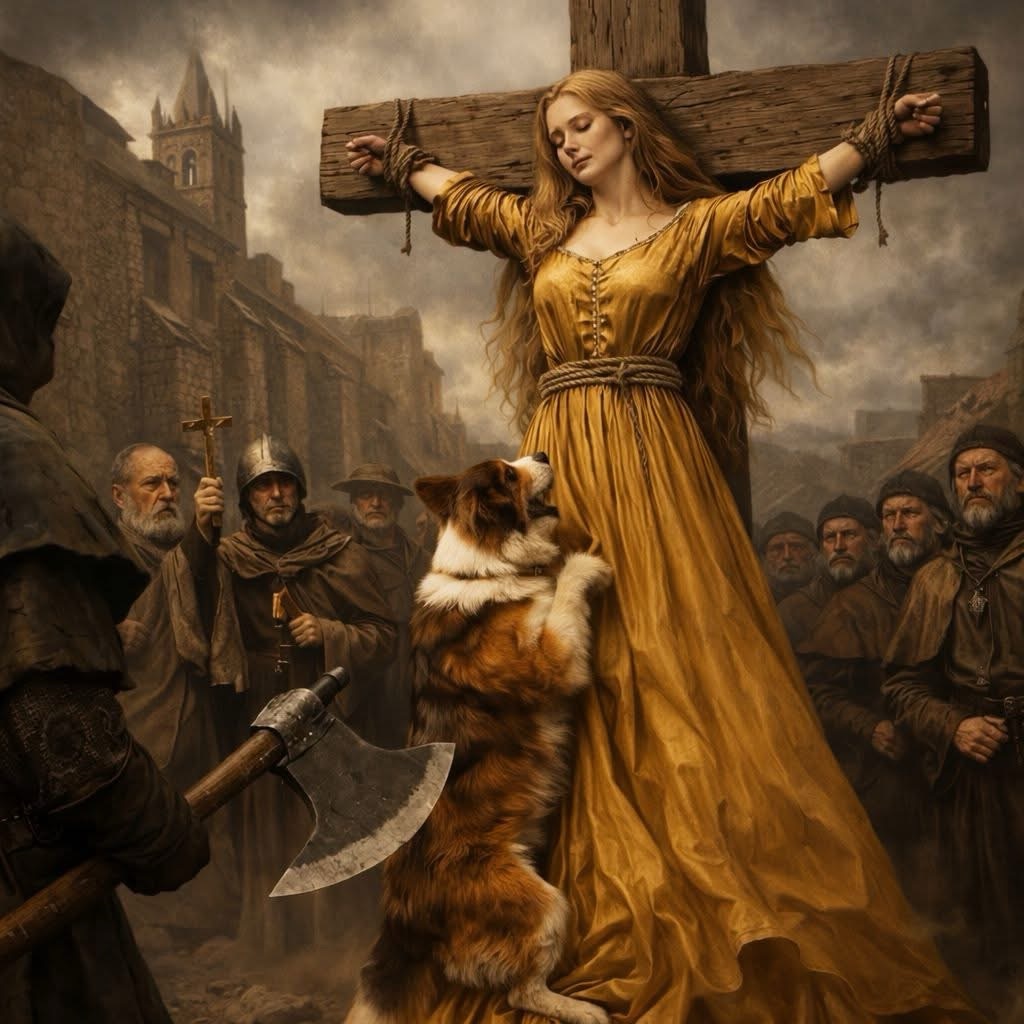
As attendants moved forward to remove the body, another shock emerged—small, sudden, and deeply human. From beneath the folds of Mary’s skirts, a tiny dog crawled out. It had been hidden there the entire time.
The animal trembled, its white fur stained dark with blood. It pressed itself against her body and refused to move. Officials tried to pull it away. It resisted. It returned. Again and again.
Even in death, Mary was not alone.
The dog was finally carried away, still struggling, still loyal.
The body was taken. The hall was cleared. The witnesses left—some shaken, some silent, some convinced they had just seen more than justice.
This was not merely an execution.
It was a spectacle of political fear. A failure of mercy. A moment where power exposed its own brutality.
And long after the blood was washed from the stone floor, one image remained burned into memory—not the axe, not the crown, not the accusation.
But a small dog, emerging from beneath a fallen queen, refusing to abandon her.
History recorded the death.
But it never forgot the loyalty.
 opensenseme