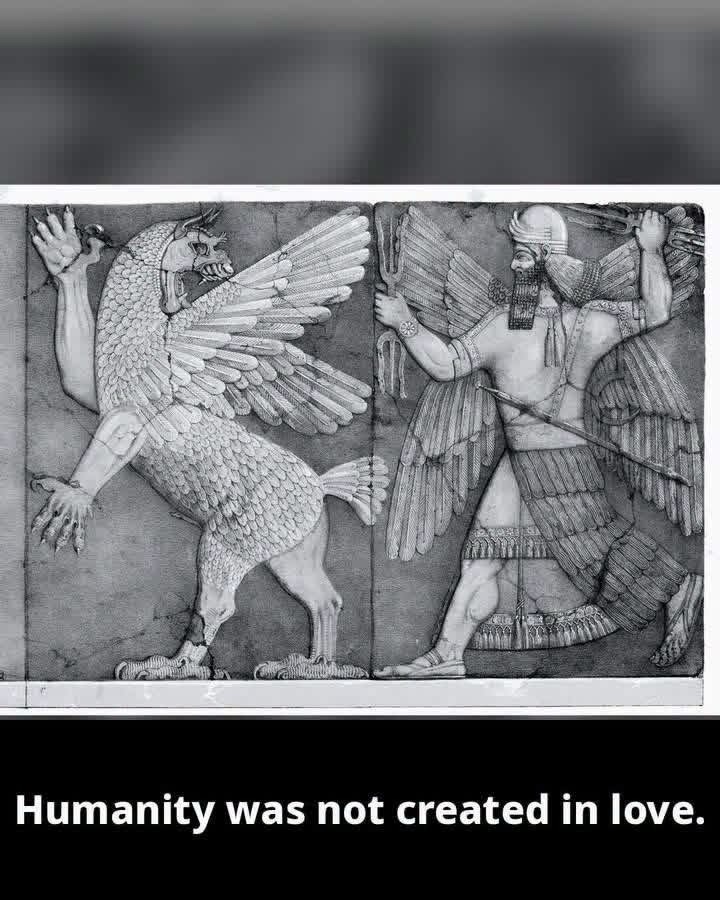
Long before Genesis and long before Prometheus was chained, a Mesopotamian scribe was already asking why humans exist, and recording an answer in clay.
That answer is stranger and more candid than most people expect. The text is the Atrahasis epic, written in Akkadian around the eighteenth century BC, and it opens with a labor dispute, not a peaceful act of creation.
According to the story, the cosmos was split between two groups of gods. The Anunnaki were the senior deities who ruled heaven and the deep waters. The Igigi were the lesser gods who did the physical work, including digging the rivers.
The Igigi toiled for 3,600 years. They cut the Tigris and the Euphrates and shaped channels across the flat land of Mesopotamia, building infrastructure for a world they would never get to enjoy.
Then they quit.
One night they set fire to their tools, surrounded the home of Enlil, the chief god of the earth, and refused to keep working. In every practical sense it was a strike, preserved in clay thousands of years before anyone had a word for it.
Enlil was enraged and called on Anu, the sky god, to punish them. Anu hesitated. Nusku, Enlil’s vizier, urged restraint. Someone had to identify the instigator, the one who had lit the first fire.
No ringleader turned up. The Igigi had acted together, as a single body. Anu weighed the matter and ruled that the gods were right to rebel, since the work was too hard, and that punishing all of them was not practical.
Enki, the god of wisdom and the deep waters, then offered a fix: make a new worker.
The Igigi would be relieved of their labor, and a lesser creature would be shaped to take on the load they had refused. It would be made from clay mixed with the blood and flesh of one slain god.
That creature was us.
The Atrahasis epic is centuries older than the biblical creation account, and in it humanity is not the crowning jewel of creation or the beloved image of a loving god. We are a labor-saving device, brought into being because the workers walked off the job and management needed replacements.
The text lay buried in the soil of present-day Iraq for millennia. When scholars pieced it together from broken tablets, they found a account that recasts the flood story, the roots of human hardship, and the reason we exist at all.
The Igigi got their rest.
We got the Tigris and the Euphrates to dig.